Friday, March 8, 2019

Seriously Fluffy Birds of Sax-Zim Bog

The thermometer on my car read -18 degrees Fahrenheit as I turned off the highway onto a snow covered road northwest of Duluth. A leaden sky didn’t offer any additional warmth. My parents and I were warm, though, wrapped up like onions in our many winter layers with the car heater blasting. We were looking forward to a full day of birding in Sax-Zim Bog. This 300-square mile mix of aspen uplands, rivers, lakes, meadows, dead-ending back roads and farms has become famous for its ability to attract and support many species of birds who usually remain farther north.

Our first destination was a windswept field with a gravel road bisecting it and string of utility poles lining the road. Anemic gray light made the scene look barren from afar, but soon a white shape materialized on the top of a particular pole. I pulled up beside it, rolled my window partway down, and turned on my camera. The shape shifted, rotated, and two dark eyes came into view.

Even though snowy owls sport thick feathers all the way down their legs, this one still chose to hunker down against the cold. Photo by Emily Stone.

Snowy owls can be territorial even in their winter feeding areas, and while there aren’t many other owls around to challenge him, this guy (male, as indicated by his very white feathers) seems to have staked out his claim. That’s a boon for birders who, like my parents from Iowa, drive great distances to see his species in the bog.

The frigid morning, complete with a stiff breeze left over from recent severe weather, didn’t seem to faze the owl. Why should it? Most of his relatives are surviving just fine up above the Arctic Circle. Food and space are more limiting than cold when you have thick feathers all the way to your toes. That substantial winter coat contributes to the snowy owl’s status as the heaviest owl in North America, weighing four pounds.

The open car window soon let in enough cold air to get uncomfortable, so we blasted the heater and drove up toward the Welcome Center run by the Friends of Sax-Zim Bog. Bright sunshine greeted us, as well as a cluster of bird feeders that were just wild with activity.

The stripy little birds with red smudges on their foreheads looked nothing like the snowy owl, but these common redpolls are no less birds of the north than he is. They breed all around the top of the globe, in a circle that borders the Arctic Ocean, and their global population numbers in the tens of millions. They must be doing something right.

Common redpolls add 31 percent more feathers for the winter, and then they also fluff out their feathers and tuck up their toes to stay warm on frigid days. Photo by Emily Stone.

Just like the snowy owl, these little birds have a thick coat of feathers. Redpolls add 31 percent more feathers for the winter. That’s a big increase for a bird that only weighs half an ounce to begin with. Back in January, when Prof. Sheldon Cooper from UW Oshkosh lectured our Winter Ecology participants about the Winter Ecology of Birds, he compared small birds adding feathers to putting a toddler in a snowsuit. A big critter, like a snowy owl or an adult human, can still move pretty well, even if you add some puffy layers. The smaller the critter, though, the more those layers can impede movement.

Redpolls do have one advantage over owls, though, because they can fit into sheltered spaces—snow tunnels for redpolls and tree cavities for most other small birds—that protect them from wind chill even better than feathers could.

Pine siskins put on more fat than many other little birds. They also fluff out their feathers and tuck up their toes to stay warm on frigid days. Photo by Emily Stone.


Just like adding feathers, adding fat has its pros and cons for small birds. Getting too fat can make it harder and more energetically costly to fly, and reduce their ability to escape predators. Chickadees may only achieve 10% body fat, and 12% better feather insulation even in the winter. Pine siskins, though, put on 50% more fat than redpolls do. Little birds don’t store fat in an insulating layer of blubber like penguins and whales; they accumulate stores of brown fat around their wishbone and abdomen as a ready source of fuel for their metabolisms. Birds can also store fuel outside of their bodies. One reason those chickadees don’t need to store fat is that they store food—in up to 2,000 little caches.

Black-capped chickadees don’t put on much extra winter fat; instead they store fuel outside their bodies in the form of food caches. Photo by Emily Stone.


What they do with that fuel is also important. Many birds shiver to stay warm. It’s effective, as long as they have plenty of fat to burn. They can also go about their business as usual. One study found that chickadees’ feathers can capture the heat generated by hopping around to eat. Forage more, shiver less, and you end up warm, with the additional benefit of a belly full of food.

Prof. Cooper’s lecture came back to me as we watched redpolls, siskins, and chickadees hop around the Welcome Center’s feeders. As I photographed a fluffed up siskin perched above the feeder with just its toes exposed, I thought back to a slide Cooper presented to us about “heat conserving postures." The diagram showed a little bird in warm weather standing normally with its legs and feet exposed. With each successive decrease in temperature, the bird squatted lower and surrounded more of its legs and feet with fluffy feathers. Despite his feathered legs, the snowy owl displayed a similar toe-hiding posture.

From inside my warm car, the sight of all these little puffballs made me chuckle. Once the frigid air hit my face, though, I was reminded that fluff is rather serious stuff to a bird in winter.

Emily’s second book, Natural Connections: Dreaming of an Elfin Skimmer, will be available on March 14! Preorder yours at http://www.cablemuseum.org/books/.


For 50 years, the Cable Natural History Museum has served to connect you to the Northwoods. Come visit us in Cable, WI! Our exhibit: "Bee Amazed" is open through March!

Friday, March 1, 2019

Fur Bearing Insects of Denali

The only things fluttering around the Museum’s pollinator garden recently are snowflakes. Dried stalks of beebalm remind me of how vibrant that corner of our yard becomes by midsummer. Currently, the flowers are topped by little puffs of snow instead of fragrant purple petals and buzzing bees. Inside the Museum, though, we’re planning an exhibit all about pollinators. Even while traipsing all over Alaska last summer, I was thinking about pollinators.

Beebalm in the pollinator garden. Photo by Emily Stone.

And that’s how I ended up in a yurt, in Denali National Park’s Teklanika River Campground, at Mile 29.1 on the park road, listening to a presentation about “Fur Bearing Insects of Denali.” The instructor, Jessica Rykken, is Denali National Park’s official entomologist—charged with surveying, collecting, and archiving insects in the park. Denali’s 17 species of bumble bees represent one-third of all the bumble bee diversity in North America, and they are charmingly furry.

The dense hairs covering a bumble bee’s body help it to retain heat and stay active at cooler temperatures. Photo by Emily Stone.

The fur is for more than just looking cute, though, as Jessica explained. Just like my favorite wool sweater, the thick coat of hairs on a bumble bee provides insulation and allows them to be active at colder temperatures. Their relatively large body size makes it easier for bumble bees to retain heat as well. Using these adaptations, and by shivering their large flight muscles, bees can raise their body temperatures 60 degrees Fahrenheit above the air temperature! “I dress in a wool hat and full rain suit to go collecting bees!” commented Jessica.

She wasn’t joking. Outside the yurt, the picnic table sported a light glaze of frost, even in late June. The small group of naturalists taking this Alaska Geographic Field Course wore rain jackets, puffy coats, down vests, hats, gloves, and mittens. Hiking uphill to some of Jessica’s study sites helped us warm up briefly, but intermittent sunshine and drizzle had us adjusting layers frequently. We still found insects!

With warm clothes and snow in the background, students in Alaska Geographic’s Insects of Denali Field Course endured the same summer weather that bumbles must brave! Photo by Emily Stone.

Staying warm in the summer is one thing, but bees need to survive harsh winters in Denali, too. New bumble bee queens mature in late summer, mate with a male drone bee, excavate a small hole in the ground to hibernate in, and produce anti-freeze to keep from freezing as winter descends. Queens who survive the winter emerge in early spring and begin the process of starting a new colony.

Bumble bees need both nectar and pollen to fuel themselves and feed their colony. They’re able to forage on a wide variety of flowers, which helps make sure that there’s always a snack blooming nearby. While you might expect that only a few types of flowers can survive in the harsh environment of tundra, these low-growing plants that carpet the mountainsides and arctic slopes are the most diverse habitat in the state. As glaciers came and went across the continent, tundra habitat was always present somewhere in Alaska, and tundra flowers didn’t have to complete a long migration to recolonize places scraped clean by sheets of ice.

In such a cold environment, even flowers need ways to stay warm. The bowl-shaped blossoms of Arctic poppies and many other species are essentially solar collectors, and they can warm up quite nicely on a sunny day. Some flowers even track the path of the sun. A warm blossom can have many benefits. The heat will enhance evaporation of floral scents, which attracts some pollinators. A cold pollinator who drinks warm nectar gets a double energy bonus; similar to how hot chocolate warms us from the inside out.

The tiny flowers of Alp Lily turns to catch some warm sunshine. Flowers who capture added warmth from the sun can speed up the development of their fruits and seeds in the short Arctic summer. Photo by Emily Stone

I like to imagine a cold bee curling up inside a warm blossom for a nap, but one study found that the ground is an even better place for insects to bask. My classmates and I experienced that firsthand. We started by kneeling to look at an insect, and then slowly lowering ourselves down out of the wind onto the cushioned surface of the mountainside into a warmer microhabitat.

In reality, the ability of a flower to warm up may benefit the flower more directly than by attracting pollinators. Although flowers don’t need to warm up flight muscles in order to move, they develop faster at higher temperatures. Added warmth can help the pollen to germinate, help the pollen tube to grow as it searches out the ovule for fertilization, and help that ovule to develop into a fruit and seeds. All of those processes need to happen quickly, before the short Arctic summer descends back in to winter.

It seems like everyone and everything in Alaska shares that same overwhelming desire to pack as much into summer as humanly (or naturally) possible. Our insect class made use of long, midsummer days by collecting bugs until 10:00 p.m. Bumble bees dress in wool to go foraging. Tundra flowers make seeds while the sun shines. And I zoomed around with my camera and notebook, storing up memories to fuel my learning in the long winter ahead.

Emily’s second book, Natural Connections: Dreaming of an Elfin Skimmer, will be available in March! Listen to the podcast at www.cablemusum.org!

For 50 years, the Cable Natural History Museum has served to connect you to the Northwoods. Come visit us in Cable, WI! Our new exhibit: "Bee Amazed" is now open!

Friday, February 22, 2019

Come ski! Have Fun! Be Sustainable!

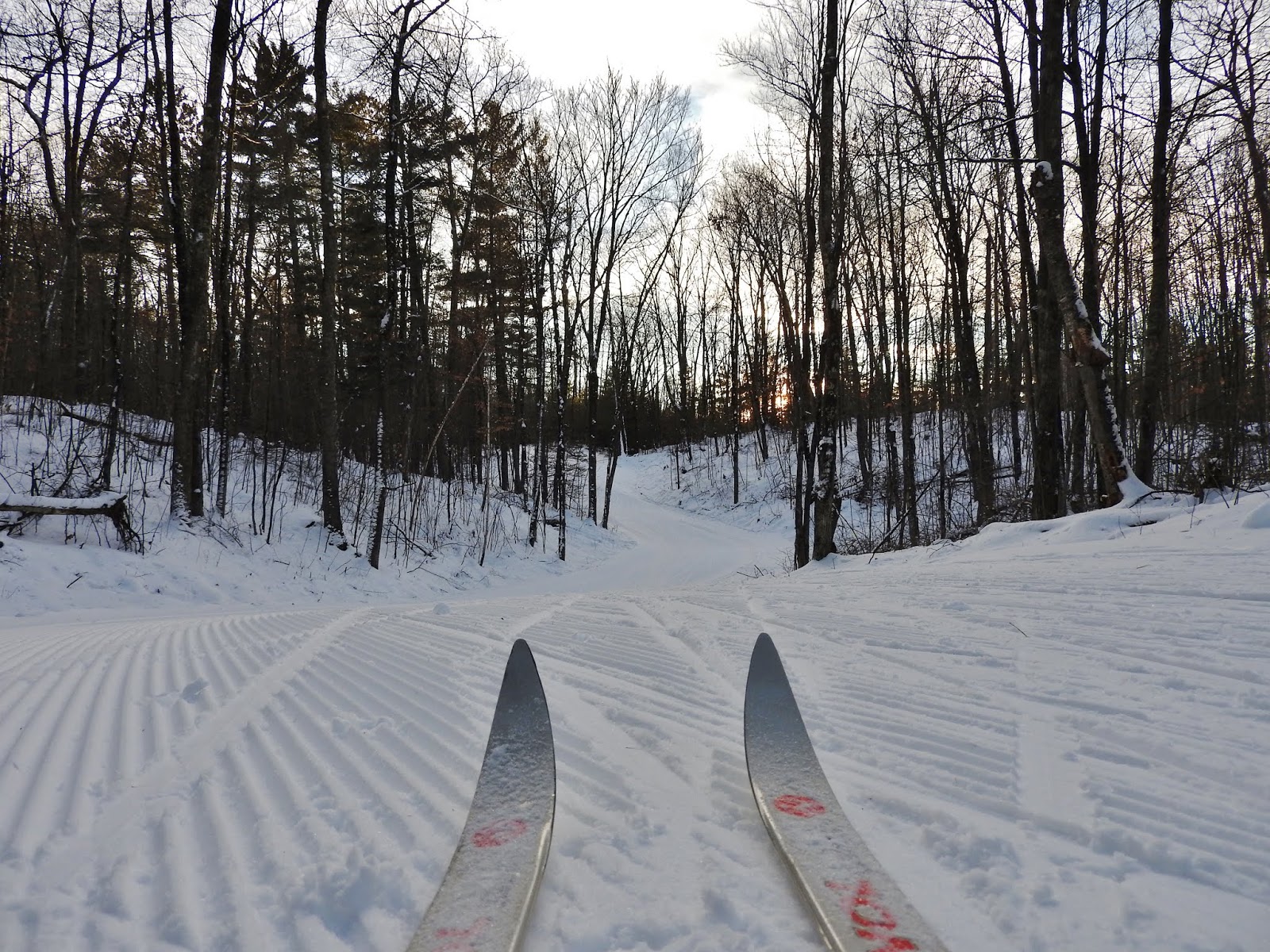
I ventured out cross-country skiing in the middle of that big snowstorm a couple weeks ago, and my ski tips ran incognito under the fluff. Finally, all 100 kilometers of world-class ski trails in the American Birkebeiner trail system were covered in plenty of snow. With a bit of a warm, dry start to the winter, I’m sure some folks had been remembering 2017.

That year, it rained. The snow pack melted, and a hopeful-looking snowstorm tracked just a little too far south. For only the second time in the Birke’s 45-year history, the race was canceled. It was a disappointing, but not entirely surprising occurrence. Skiers all over the country have been contending with warmer winters and a shallower snowpack for years. Hayward’s average winter temperature has risen 4.5 degrees since 1950. The Birkie is featured right alongside maple syruping and ice fishing on the ClimateWisconsin.org website as Northwoods traditions that are threatened by a changing climate.

So how can cross-country skiing adapt to these challenges? Ben Popp has some ideas. Popp became Executive Director of the non-profit American Birkebeiner Ski Foundation in 2013, and his big dreams and big energy have been making things happen.

In 2018, the Birkie purchased their first ever snowmaking equipment using donations from businesses and the ski community. Two big snow guns now rove trails near the Birkie’s start area. The trail crew began making snow on November 7, 2018, and opened a 1 km loop of ski trail on November 17. Someday the man-made snow could be stored over the summer under an insulating layer of sawdust. It would be ready to use in October, even before temperatures become suitable for snowmaking again.

This snow gun helped create 3 kilometers of early season skiing, even while the rest of the Birkie trail took longer than usual to open. Snowmaking is just one piece of the sustainability puzzle, though. Photo by Emily Stone.


Making snow is energy intensive, though, which could increase carbon emissions and exacerbate climate change. Popp wants to make sure that the Birkie isn’t setting themselves up for a short term win and a long term loss, so he’s been meeting with the local electrical companies about installing a solar farm to offset the Birkie’s energy use. Warming huts along the trail already derive their electricity from solar panels.

The Birkie’s most important adaptations to the changing snow conditions are unglamorous improvements to the trail itself. Skiers can make do with just an inch of snow on the velvety turf of a golf course. By smoothing the trail and removing rocks, the Birkie may soon be skiable with just four inches of flakes. It helps that the Birkie’s piston bully trail groomers have rubber tracks instead of metal, so that they float better on shallow snow.

Snow is essential, but liquid water is a threat to the trail. To prevent washouts, crew members harden off the surface by removing soft topsoil. They’ve also installed French drains, reengineered slopes, added ditches, put in erosion bars, and even built the trail higher ahead of a rising water table. In the future, the trail may be rerouted away from southwest-facing hills where snow disappears first.

Man-made snow holds up better than natural snow in warm temperatures, so the early season loop at the Birkie start area is still skiable even after unseasonably warm weather. Photo by Emily Stone.


Popp and the trail crew are even looking at the surrounding forest to eke out more gains in sustainability. Bayfield County, who owns and manages the forests along the Birkie Trail corridor, has respected the scenic quality of the trail by not cutting trees within 100 feet of the trail. As dense groves of evergreens intercept snow, hold in heat, and create thin spots on the trail, though, foresters are being given a green light to manage trees in that buffer zone. “Part of the process is educating skiers that forest management is a good thing, and convincing them that it will actually improve their skiing experience,” says Popp.

Skiing isn’t the only game in town, though. Running, mountain bike, and fat bike races spread both revenue and risk across seasons. Having multiple events to help cover the $380,000/year cost of trail maintenance is part of trail sustainability.  

As the Birkie tries to lead by example in many forms of sustainability, their skiers are stepping up, too. One skier even facilitated the installation of an electric vehicle charging station at the popular OO trailhead. This winter, the organization will launch its Birkie Green initiative, which seeks to reduce waste through reusable backpacks and cups, and to work with partners who are willing to make similar choices toward sustainability.

Why is this all so important to Popp? “The Birkie is a Northwoods icon,” says Popp, “and preserving some version of it is important.” He feels responsible to the local community who depends on the economic boost that the trail provides. More than 90% of the Birkie’s income comes from greater than 50 miles away, and more than 90% of that is spent within a 50 mile radius. The Birkie also provides unique venues for kids’ lessons, high school races, skills clinics, and more. The trail system is a draw for athletes, vacationers, active retirees, and cabin owners.

Popp’s been drawn to this ski community since he was a child, even participating in the kids’ race before it became known as the Barnebirkie. His passion is contagious. His energy is infectious. He’s a “big picture” guy, and under his leadership, the American Birkebeiner will continue to be a big part of the cross-country skiing picture. In his words, “Come ski! Have Fun!”

*A version of this article was published in Northern Wilds Magazine and is reprinted with permission.

Emily’s second book, Natural Connections: Dreaming of an Elfin Skimmer, will be available in March! Pre-order your copy at http://cablemuseum.org/natural-connections-book/.  Listen to the podcast at www.cablemusum.org!

For 50 years, the Cable Natural History Museum has served to connect you to the Northwoods. Come visit us in Cable, WI! Our new exhibit: "Bee Amazed" is now open!


Friday, February 15, 2019

Pretty Warm Small Mammals

Just before the recent heavy snows deepened our drifts, I led a long line of third graders from the Hayward Elementary School into the woods at the North End Trailhead near Cable, WI. A thin layer of fluff covered the hard-packed trail. It recorded the recent passing of a fox, as well as the traffic of squirrels. Off in the woods, I could see little chains of mouse tracks from where they hopped through snow—trail dragging—before disappearing down a hole.

“Subnivean Zone.” I made the students repeat, as I described to them the magical, Narnia-like world beneath the snow where little critters carry out unseen dramas. The Earth gives off warmth. The snow becomes a blanket. Between the two, a realm expands. Mice sniff for food. Weasels hunt for mice. Voles convert vegetables into meat, and owls transform voles into feathers. Shrews hurry scurry in a constant search for snacks. We look out on a featureless façade and assume the winter world is asleep.

With Ally and Sarah—two scientists who have been doing research on small mammals in the nearby national forest—staying at my house, I’m reminded every day that much still moves this time of year. Each evening I burst through the front door asking “What did you catch today?” Their eyes light up and an account of how many mice, voles, shrews, flying squirrels, and red squirrels they caught spills out.

Ally holds a cute deer mouse. Photo by Emily Stone.

Scientists though they are, Ally and Sarah always have at least one story ready to illustrate the cuteness of their catches. There was the mouse that ran up to Sarah’s shoulder before jumping to a tree and posing—Vogue style—on a low branch. Another mouse leapt from Ally’s glove and disappeared instantly into the fluff, leaving only a mouse-shaped hole in the surface of the snow. Chubby voles received cooing and grandma-like comments about their size. Flying squirrels dashed up the nearest tree, then soared gracefully into the woods. And the shrews began foraging for food immediately—by nosing into the top layer of fluff and leaving a wiggly trail behind them.

Many little critters, including mice, prefer to spend winter in the Subnivean Zone where heat from the Earth and a blanket of snow help regular temperatures. This mouse wasted no time in getting back under the snow when it was released from the clutches of science. Photo by Sarah Nagel.


Cute does not even begin to describe these citizens of the subnivean, though. Persistent, tenacious, calculating, skilled, and constantly on the verge of disaster might be more accurate.

A few weeks ago, Dr. Paula Anich came down to the Museum’s annual “Wild about Winter Ecology” weekend workshop to talk about the adaptations of small mammals. She recently became famous when her research group at Northland College in Ashland, WI, discovered that flying squirrels glow hot pink in UV light.

With a few calculations, she illustrated the problem of being small in the winter. First, it’s helpful to realize that there is an 80,000-fold difference in body size between a shrew and an elk. In her estimation, those are the smallest and the biggest mammals in Northern Wisconsin. Size matters, because it impacts the surface area to volume ratio, and we lose heat through our surfaces. As a result, little critters lose more heat, and have to generate more heat in order to maintain a healthy body temperature of about 98 degrees.

Shrews burn twelve times more energy per unit of body mass than an elk. They are constantly racing toward the edge of starvation. With that knowledge, it’s easy to understand why a shrew would start foraging for food immediately when Ally and Sarah release it from a trap. Sadly, not all shrews were able to survive an entire night with only the food inside the trap, and they presented the highest death toll of the research. Death is inevitable for these critters, though, and a high birth rate is part of their survival plan.

Short-tailed shrews were plentiful in Ally and Sarah’s small mammal traps. They are 80,000 fold smaller than elk, and so much burn a lot of calories to stay warm. Photo by Emily Stone.

While chubby-looking voles are slightly bigger than shrews, they also must eat to stay warm. Some of the herbivorous vole’s food gets stored as brown fat—a handy type of tissue that can generate heat without shivering.

Of course, eating isn’t the only thing standing between a mouse and its maker. The advantage of being small is that these creatures can take advantage of microhabitats and microclimates. The Subnivean Zone is replete with cozy, windless, nooks and crannies. The mouse that leapt from Ally’s hands dove straight through the wardrobe into a protected place where no elk could follow. The mouse that scurried up a tree may also have had a microclimate in mind—deer mice are excellent tree climbers and often snuggle up together in an old woodpecker hole. There, the heat one loses soaks right into its neighbor, and windchill becomes a non-issue.

Deer mice are excellent tree climbers and will often use cozy cavities to snuggle in with their friends and stay warm. Photo by Ally Moser Scott.

Flying squirrels use the huddle technique, too, which I have the third graders experiment with on-trail. Small groups smush together with a thermometer in their midst, and I put one minute on the clock to see how warm they can get.

From hearing Professor Anich summarize the body of research in her field, to giggling over field observations with the student scientists, and to sharing just the tip of what is known with the next generation, I’m fully immersed in the Subnivean Zone. Layers of learning pile up just as quickly as the snow.


Emily’s book, Natural Connections: Exploring Northwoods Nature through Science and Your Senses is here! Order your copy at http://cablemuseum.org/natural-connections-book/.  Listen to the podcast at www.cablemusum.org!


For 50 years, the Cable Natural History Museum has served to connect you to the Northwoods. Come visit us in Cable, WI! Our new exhibit: "Bee Amazed" is now open!

Friday, February 8, 2019

Very Cold Small Mammals

My car shuddered and groaned before turning over reluctantly and revving to life. The thermometer had displayed negative 32 degrees as I headed out the door, and my weather app countered with negative 37. Looking back through my kitchen window, I could see Ally Moser Scott filling up thermoses with hot water, and organizing her hand warmers, balaclava, and boots. I was headed to a comfortably heated office. She was preparing to be outside all morning in this potentially dangerous cold.

Ally is a master’s student in Professor Jon Pauli’s lab down at the University of Wisconsin Madison. Her thesis is “assessing the population ecology of small mammals in northern Wisconsin to evaluate prey availability for the American marten.” The field part of her research entailed setting up several 25-trap grids in different forest types, and then checking the live traps for nine days straight in order to estimate the numbers of small mammals in each habitat.

Ally Moser Scott (back) and Sarah Nagel continued to check their small mammal trap line despite the recent bitter cold. Photo by Emily Stone.

With 75 traps to check per day, it’s a good thing that Ally has help. Sarah Nagel, who earned a degree in Ecology and Evolutionary Biology from Minnesota State University Moorhead, is gaining field experience by being Ally’s research technician. Ally and Sarah are staying at the Cable Natural History Museum’s Jackson Burke House, which is convenient to their research sites near Clam Lake and Mellen in the Chequamegon-Nicolet National Forest.

Sarah Nagel takes care of recording data on what the traps hold, the snow depth, and snow density. Photo by Emily Stone.

Although Ally and Sarah are willing to brave our recent polar vortex in the name of science, I looked at the weather forecast closely and picked a slightly warmer day to join them on their trap lines. It was barely below zero with a light drizzle of snowflakes when we loaded up in the work truck at 7:00 a.m.

I wasn’t sure what to expect as we walked single file into the woods at the first study site in a spruce swamp. Because the small mammals that Ally is trying to catch spend most of the winter hiding out and staying warm beneath the snow, it’s important to her research that humans don’t tramp all over the trap grids and mess with mouse habitat. We stepped as exactly as possible into the boot prints that were established the first time someone walked among the traps. 
We all walked in a single file line to minimize compaction of the subnivean zone.

Sprigs of Labrador tea, a common bog plant, poked out of snow, which drifted among the scaly trunks of spruce trees. Also scattered among the trees in a 5 x 5 grid, were 25 wide, black, corrugated tubes, each about two feet in diameter and 30 inches tall. Each tube was covered by a square board and a rounded cap of snow. 

This research takes a village. The Great Lakes Indian Fish & Wildlife Commission (GLIFWC) spearheaded this research in collaboration with UW-Madison. Last fall, a crew of GLIFWC staff helped place these tubes. Then, staff from GLIFWC returned regularly to put bait in the tubes, just to make sure that the small mammals were comfortable using these odd habitats.

Research Tech Sarah Nagel shows off a trap tube (the tube protects an area from snow, and smaller live traps are set inside. The pink bucket holds fresh bait, her clipboard, and tools for weighing and measuring the small mammals they catch. Photo by Emily Stone.

The live trap is set inside the protected space of the tube. Otherwise, deep snow would make it diffulcut to set the traps and have them shut properly. 
Finally, when Ally came up to start her 9-day trapping session here, she and Sarah baited and set a metal live trap inside each tube. The bait packets are an ingenious system of a thin plastic bag filled with a little stuffing and sunflower seeds. The small mammals can easily chew into the bag, eat the seeds, and make a warm nest with the stuffing. Although the plastic may seem dangerous, it can add a layer of warmth, and doesn’t cause suffocation. With the bitter cold, the researchers also strap a big air-activated heat packet to each trap. It must be a fairly comfortable set-up for the critters, because some get “trap happy” and come back day after day for a free lunch.

The live trap gets a little bag of bait in the way back, as well as a giant handwarmer attached to the outside. 

For example, when Ally pulled a little deer mouse out of one trap, it was already sporting tiny metal ear tags. It had already been weighed, its hind foot measured, and its ears pierced, on a previous day. Sarah recorded the ear tag numbers on her data sheet, and the wide-eyed mouse was free to scurry away.

Ally Moser Scott holds up a re-captured deer mouse so that she can read the numbers on its ear tags and then set it free. Photo by Emily Stone.


You may be wondering why scientists would go to so much trouble, and brave the recent bitter cold, just to count the little critters in an area. The answer lies in a slightly bigger critter: American martens. These beautiful animals have been reintroduced to Wisconsin, but aren’t thriving as hoped. Resource managers want to know why. A few years ago, Phil Manlick, now a PhD student in Professor Pauli’s lab, stayed at the Museum’s staff house to study American martens in the area through DNA samples from hair and scat. His results showed that the local martens are eating mostly shrews and road-killed deer instead of their preferred food of red-backed voles.

Phil Manlick set out hair snares for American martens in 2013 and 2014. Photo by Emily Stone.

Ally’s research is following up on those findings. Maybe martens are eating shrews because voles aren’t available? During my single day on the trap line, we certainly caught more shrews than mice, and Ally has only caught a few red-backed voles so far.

Ally holds up a short-tailed shrew that was caught in a trap. As insectivores with super high metabolisms, they are on a constant search for food and don't put on any fat stores. This makes them poor food for martens. Photo by Emily Stone. 

My toes were chilled by the end of that morning afield, but the temperatures I endured were nothing compared to the deep freeze that Ally and Sarah navigated safely three days in a row. Her research will eventually earn her a master’s degree. In the meantime, Ally and Sarah have earned some bragging rights for toughing out the bitter cold.

Emily’s book, Natural Connections: Exploring Northwoods Nature through Science and Your Senses is here! Order your copy at http://cablemuseum.org/natural-connections-book/.  Listen to the podcast at www.cablemusum.org!


For 50 years, the Cable Natural History Museum has served to connect you to the Northwoods. Come visit us in Cable, WI! Our new exhibit: "Bee Amazed" is now open!

Friday, February 1, 2019

A Walk in the Winter Woods

Fifteen pairs of boots crunched down the snow-packed trail at the Forest Lodge Nature Trail. Most of the participants in my Wild about Winter Ecology workshop had hiked this trail in the summer, but with an ultra-fluffy layer of fresh snow draped across the boughs, the forest was transformed.

It was transformed, truly, into a blank canvas that lay ready to record the comings and goings of the local residents. The route of a running meadow vole was embossed into the snow below some pine trees at the edge of the field. It’s warmer for the vole if it can run through the subnivean zone where earth meets snow, but even staying just under the surface fluff keeps them a little more hidden from predators.

Climbing uphill through a thicket of balsam fir, we were startled by the whirr of a flushing ruffed grouse. With the thin layer of crusty snow we’ve been dealing with, that grouse would have been roosting in the dense evergreen branches instead of diving into a fluffy snow cave for nighttime shelter. Just a few steps farther down the trail, we found where the grouse had walked across the trail and into the thicket.

Grouse are exquisitely adapted to winter. They grow their own snowshoes in the form of fingernail-like projections on the sides of their toes. Extra feathers on their beak and legs provide insulation where it’s needed. And when their fluffy body feathers aren’t enough, grouse use the snow like it’s a cozy down comforter.

Left: winter grouse foot with "pectinations."  Right: summer grouse foot without snowshoes. Photo by Emily Stone.


Once there are 10 or more inches of snow on the ground, grouse will dive or burrow into the fluff and spend the night in an air-filled tunnel. Temperatures under the insulating snowpack often reach a pleasant 32 degrees F. No matter how cold it gets, the snow roost rarely drops below 20 degrees F. Research has shown that grouse don’t need to really speed up their metabolism to keep warm until the temps dip below 25, so the snow roost provides them with significant energy savings.

We were not worried about saving energy. In our puffy coats, with handwarmers in our mittens, and lasagna waiting back at the lodge, we were excited to burn a few calories on this hike.

About halfway around the loop trail, we crunched out onto a boardwalk over the frozen bog. Exclamations of surprise and awe rippled through the group as folks recognized the location. Many had visited this bog in June, while learning about ecology during a Wisconsin Master Naturalist Volunteer Training Course. In the hot sun, while swatting mosquitoes, we had examined spongy sphagnum moss, the stained-glass leaves of pitcher plants, the delicate vines of cranberries, and the vibrant pink of bog laurel blossoms. What a change to see the smooth expanse of snow hiding our memories. Just a few old, dried pitcher plant flower heads popped out like little periscopes from the underworld.


The bare, knobby branches of small tamarack trees attracted curious looks, as did some stunted white pines with short, yellowing needles. How did each evolve so differently? Both grow needles, but tamarack’s flimsy needles are deciduous, and are re-grown in a haze of chartreuse each spring. White pine, in contrast, fortifies its needles against frost and desiccation, and holds onto its investment for about three years. Tamarack thrives in the full sun of bogs despite the poor soil fertility, but white pine barely ekes out an existence in this place where it doesn’t seem to belong. The tip of a tiny black spruce tree, just peeking out of the snow, both keeps its needles and thrives in the bog. In the words of Daniel Quinn, from his book Ishmael, “There is no one right way to live.”

Crunching off down the trail, I stopped the group near a pair of old boot tracks that led off across a brushy area. “Just over that rise is the Secret Bog,” I informed them. “We can crash over there to have a look, or we can just head home on the trail.” The cold had not dampened their adventurous spirits, so we plunged into the mess of deep snow and fallen trees. Over the rise, down through a balsam thicket, and then we popped out on the edge of the Secret Bog.

Small hummocks and clumps of trees specked the surface of the windblown expanse. A weak winter sun sinking low on the horizon cast light and shadows over the stark scene. How do we survive the winter? By following our curiosity and finding beauty everywhere. The temperature was plummeting, and the breeze stole warmth from our bodies, but still people turned their faces to the sun.


Emily’s book, Natural Connections: Exploring Northwoods Nature through Science and Your Senses is here! Order your copy at http://cablemuseum.org/natural-connections-book/.  Listen to the podcast at www.cablemusum.org!

For 50 years, the Cable Natural History Museum has served to connect you to the Northwoods. Come visit us in Cable, WI! Our new exhibit: "Bee Amazed" is now open!