Friday, October 5, 2018

Gray Weather and Gray-headed Chickadees

The steady drizzle thickened into real rain as I pulled into the gravel parking lot near the Caribou Creek Trailhead. Damn rain. I was tired of trying to out-guess, out-maneuver, and outrun it. My memory may not be infallible, but it tells me that the average weather during my summer in Alaska was 58 degrees F and misting. Exasperated, I resigned myself to be out in it.


Soggy cottongrass. Also resigned to being out in the rain.

“We just had a cancellation for the public use cabin at Caribou Creek,” said the ranger in the Wrangell-St. Elias Visitor Center when I asked about things to do along the Nabesna Road. The 42-mile-long gravel road is one of only two terrestrial access points into the remote park in eastern Alaska. Within minutes I’d reserved the following night.

Now I was dodging raindrops as I went from door to door on my station wagon gathering the last of my supplies and cramming them into my pack under the cover of my back hatch. Raindrops beaded up like jewels on my brand-new, bright-green rain jacket—purchased in desperation on a rainy day at the end of a rainy week in Anchorage.


Partway up the wide, gravel trail, a bedraggled bumblebee clinging to a hot pink fireweed blossom caught my eye. Then a gray jay whistled from the top of a spruce. My willpower failed and I slid my pack down to dig my camera out from its waterproof layers. It was then I noticed that it had stopped raining.


The rain held off for the rest of my three-mile hike to the rustic log cabin. It waited until I’d had a nice chat with two hikers from France who were exploring the hills above the cabin, and until I’d had a chance to wade through knee-high tundra shrubs up there, too. Then, while I cooked pea soup, sat by a cheerfully crackling fire, painted flowers on postcards, and slept on the wooden bunk, it poured. By morning, rain turned to drizzle, drizzle turned to fog, and then the fog lifted. When I started my hike back down to the road, my camera was slung handily over my shoulder. Sunshine peeked through the clouds with increasing resolve.


Caribou Creek Cabin and Outhouse.

Clouds parted just a bit. There are mountains out there!

Pea soup with cheese, crackers, and hot sauce.

The wood stove!

Postcard watercolor of a dwarf fireweed flower.

Postcard watercolor of a columbine flower.


The stove and bunk.

The "kitchen"

Setting out with clearing skies!

While walking among a grove of spruce near a creek, the striking crimson eyebrow of a male spruce grouse strutting among the roots and rocks caught my eye. With my attention focused through my camera’s viewfinder, my ears picked up on something else.


Spruces and sunshine.


Such a handsome spruce grouse!

Snazzy eyebrow, dude!

Chickadees! Soft “chick-a-dee” and other raspy calls tumbled out of the lichen-crusted spruce bows behind me. These weren’t my friendly Midwestern black-capped chickadees, but every type of chickadee makes me smile. Just like spruce grouse, boreal chickadees reach their southern limit in the lichen-crusted spruces of Northern Wisconsin. Basking in their cheerful banter, I followed their bustling movements with both eyes and lens. When they flitted out of view, I hiked on.


I took advantage of the free Wi-Fi at the Slana Ranger station to post photos to Instagram (follow me @emilysnaturalconnections). Of course, I included a chickadee. At my next encounter with Wi-Fi, a comment popped up on that post “Is that a gray-headed chickadee?” asked @thetundratelegraph. “Boreal chickadee,” I replied. There is no such thing as a gray-headed chickadee, I thought to myself. “He looks so gray to me!” the commenter responded.


I was about to dismiss it again, when I realized that I was communicating with a former college classmate who now lives in Fairbanks. Out of curiosity, I googled “gray-headed chickadee.” This species wasn’t listed on the Cornell Lab of Ornithology’s All About Birds website that I normally frequent, but a news story popped up on the Alaska Department of Fish and Game’s (ADFG) website: “The Quest for Gray-Headed Chickadees.” So they are real! How come I’d never heard of them?

Soon I came across a 2017 article written by Gary Langham, chief scientist at The National Audubon Society. His headline named gray-headed chickadees as “the Most Mysterious Bird in the U.S.” Although gray-headed chickadees are common backyard feeder birds in Russia and Scandinavia (where they are known as Siberian tits), they are the least-known chickadee in North America, and only live in remote areas of northern Alaska and northwestern Canada. Langham billed them as “the Holy Grail of chickadees.”

While confirmed sightings in Alaska are confined to the Arctic National Wildlife Refuge and other far-north locales, the Birds of North America range map indicates that it is theoretically possible to see them in eastern Alaska—in the remote haunts near our largest National Park—Wrangell-St. Elias—the one I’d just visited. Langham wrote about hiring a bush plane, rafting an icy river, camping for days, freezing in a blizzard, and still not seeing a gray-headed chickadee. Could I have sauntered in on a pleasant trail, spent a wood-fired night in a cozy cabin, and then come across these rare birds out of sheer luck?


Logic says no, of course, especially as I glean more tidbits of the sparse information that exists about them. Most recently in Alaska, they’ve been seen in stands of balsam poplar trees in the Brooks Range—not at the northern edge of conifer forests like in their Eurasian range. They are also thought to be solitary birds, rarely seen in groups of more than one or two pairs. I know I saw at least two chickadees, and maybe up to five. My focus was getting a sharp photo, not on counting the chattering sprites who danced in and out of shadows.


And finally, there’s my attempt at identification using field marks from the photos. Boreal chickadees have a brown head, cinnamon-colored flanks, and lots of gray on their cheeks. Gray-headed chickadees have a much fainter blush on their flanks, big white cheeks, and the namesake head. My photos are inconclusive, at least to me. The light is odd, the angles aren’t perfect, and one little stinker was preening with his feathers all askew. So, I sent my photos off to eBird and ADFG, and will wait to hear back.


Even if the birds turn out to be “just” some boreal chickadees, they already brought me smiles and enlightened me about their mysterious cousin. Plus, gray-headed chickadees are one of the most common chickadees on the planet...if you’re prepared to travel to Scandinavia to see them. That’s a hardship I’m willing to endure. Who’s with me?

#  #  #

Postscript: Just as I was about to publish this blog, I received a response to my posting of a gray-headed chickadee sighting on eBird:

Hi Emily, 
Thanks for the good photos of the chickadee and honest assessment.
I believe this is a Boreal Chickadee due to the light facial patch not extending to the nape as extensively as a Gray-headed would. Also, Gray-headed Chickadees typically are more contrasting in their white/brown-gray head tones than Boreal are. 
If you agree and would like to change the species in your report it is easily done otherwise I can simply categorize it as unconfirmed. Thank you for your time taken to report this species. Keep it up! 

Hope all is well,

Aaron Bowman
Cordova

Disappointing, but not surprising. It's nice to have an expert birder weigh in. I changed the species in my report. 

Friday, September 28, 2018

Bunnies #3: How to Process a Snowshoe Hare

 
“Empty,” called Claire Montgomerie over her shoulder with a hint of relief in her voice. Matt Kynoch and I paused in our crashing through the brush, sucked on some tart highbush cranberries, waited for Claire to make sure the live trap was still properly set, and then we all tromped back along the transect together. “Full,” announced Matt as we approached the next trap, a snowshoe hare cowering inside.


Matt and Claire—both graduate students at the University of Alaska Fairbanks—sprang to action with practiced efficiency. Claire fit a long white pillowcase around one end of the trap, grasped the wire door through the fabric, and opened it wide. Matt crouched at the far end and blew little puffs of air on the hare’s rear end to encourage it to run into the bag. Sometimes, cartoon-like, the hare would blast into the bag with such force that you could see the impression of its little face through the fabric.


Then the processing would begin: weight, foot length, sex. The numbers on old ear tags recorded, or new ear tags added. Radio collar fitted. Data collected, Claire gently maneuvered the fabric until the hare’s eyes and ears were exposed. Blink. Nose wiggle. Suddenly, in a flash of fur and huge hind feet, the hare would leap back into the forest. I’d reset the trap with a fresh chunk of carrot and alfalfa cubes, and we’d move on to the next wide-eyed bunny.


For three days we worked on this mark-recapture survey along a pipeline access road in the Brooks Range of northern Alaska. We marked every hare we caught, and recorded how many new hares versus marked hares we caught each day. Using statistics, Donna DiFolco, a scientist at the nearby Gates of the Arctic National Park, will turn that information into an estimate of hare numbers for this year. Our preliminary opinion? The population is high. Almost every trap was full, which meant a delayed lunch and that sense of relief in coming across an empty trap.

Hare numbers can fluctuate wildly during the highs and lows of their roughly 10-year population cycle. Population densities vary from 1 to 10,000 hares per square mile. In Minnesota, the Department of Natural Resources reports that a high year means about 3,400 hares per square mile.

Mortality is high among hares. Up to 85% percent of hares don’t live longer than a single year, and their list of predators is long. Canada lynx are their most iconic predator, but bobcats, fishers, martens, weasels, coyotes, cougars, wolves, owls, hawks, eagles, and various opportunists also eat hares.


As with many important prey species, hares reproduce about as rapidly as they are eaten. Hares reach sexual maturity within a year after their birth. Their breeding season varies by region, but can begin as early as late December and last until August, with females having up to four litters per summer. Female hares have a second uterus, and a second litter can be conceived up to a few days before the first one is born. Each litter contains an average of 3-5 leverets, who are fully furred with their eyes open. Cottontail rabbits are born blind, naked, and helpless, which is a main difference between rabbits and hares.

Hares’ reproductive rate can vary quite a bit throughout their population cycle. As their population rises, hares begin to have fewer litters. Just after their population hits the bottom, they bump up baby production again. Just why this happens, and the role it plays in the cyclic nature of their numbers, is an open question that Claire is currently investigating.

After the mark-recapture survey was complete, we set live traps along a different transect to collect data for Claire’s master’s thesis. When Claire established the transect last spring, she didn’t realize that a hunting guide focused on Dall sheep sets up a camp near there every fall. Jonas the owner, his wife and two young sons, and another hunting guide John, all came over to see what we were doing.


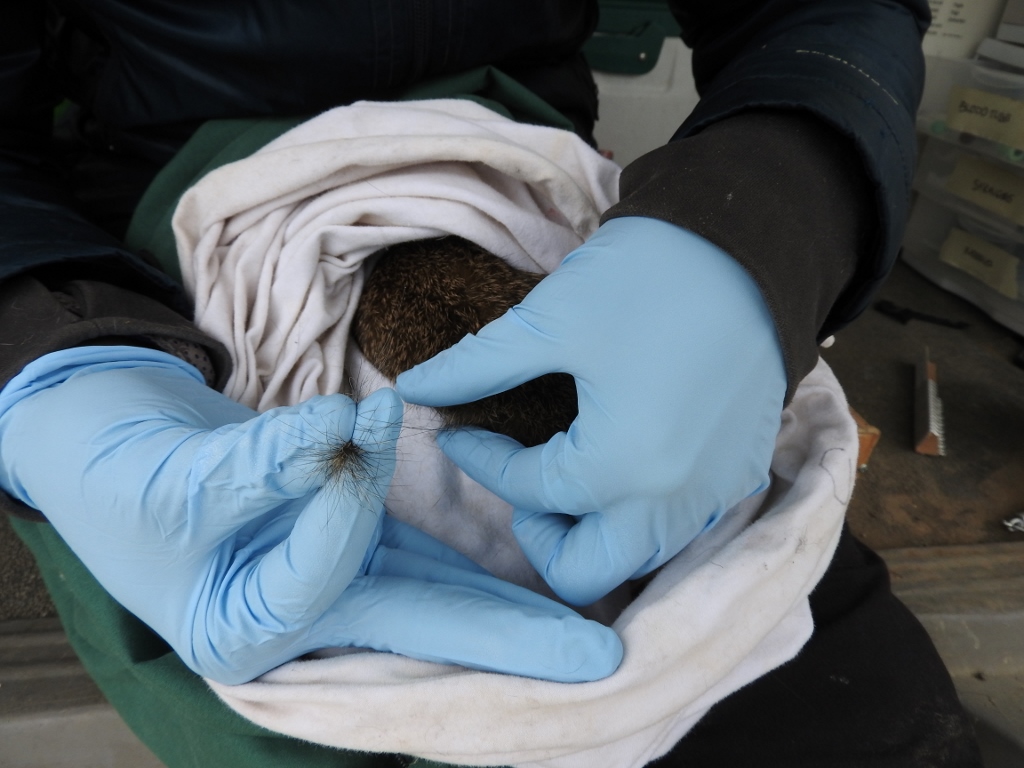
In addition to the basic data, Claire, Matt, and Donna took turns collecting samples that contain information about the hare’s body condition. With each hare they plucked fluffy tufts of hair, clipped a toenail, and drew blood from a vein in the hind leg. Donna and I also helped collect fresh bunny scat into little plastic bags. (See additional photos below.) Before we knew it, John was taking measurements and Miles—age 4 (and incredibly smart and cute)—was handing John baggies and ear tags. My job was to manage the data by filling in a spreadsheet in Claire’s notebook and labeling all the samples with the dates and the hare’s unique ear tag number. We processed those hares in record time, and it was fun!


Back at the bunkhouse, Claire could run some tests on the blood. Later, in the lab, she will run tests on the other materials to find signs of the hare’s stress levels and other measures of health. How does their body condition change throughout the year? That may give some clues to why their reproductive rate changes throughout their cycle, too.


Claire is not the first to try to tease out mechanisms behind a roughly 10-year cycle of snowshoe hare population highs and lows, and she certainly won’t be the last. Miles may be just about ready for graduate school during the population peak after next. Maybe he’ll be the one setting traps and picking away at the problem.


Emily was in Alaska for the summer! Follow the journey in this column, and see additional stories and photos on her blog: http://cablemuseum.org/connect/.


For 50 years, the Cable Natural History Museum has served to connect you to the Northwoods. Come visit us in Cable, WI! Our new exhibit: “Bee Amazed!” is open.

Hare Processing


Donna DiFalco of the NPS helps Claire get a bunny out of the trap and into the pillowcase. Can you see the little bunny nose in the tip of the pillowcase?


Here, Matt helps Claire weigh the hare. The light colored pillowcase is less scary for the hare to run into from the cage, but by putting in the dark pillowcase the researchers can help the scared animal calm down. The green case also has a buttonhole in one corner for attaching to the spring scale. They later subtract the weight of the fabric from the total weight.


The ear tag device looks a lot like a paper hole punch. The hares get one tag in each ear with consecutive numbers. It is no more painful than a human getting their ears pierced. 

So cute!


I was surprised at how much of their research equipment was homemade! This simple device has a section of a plastic ruler in the bottom to measure foot length.


The longer guard hairs of the hares may carry important long-term markers of the animal's health. 


Hare, toenail, and scat samples were packaged in "whirlpacks" with the date and the hare's ear tag number. Everything was recorded in Claire's Rite-in-the-Rain notebook devoted entirely to this project. Scat samples will record a very recent record of the hare's health and stress levels.

The biological samples were placed directly into this contraption, which uses liquid nitrogen in a foam liner to keep things cold. This preserves DNA and other information until it can be extracted.

Claire has trained with veterinarians and is deft and compassionate when handling the hares. Here, she sprays alcohol onto a hare's hind leg to prepare for drawing blood. The liquid not only helps prevent infection, it also helps get the hair out of the way. 

There's the vein!

In goes the needle. The syringe contains a little bit of anti-coagulant to help keep the sample from clotting. That's important for processing.

Donna holds the hare's leg to keep it from kicking, while Claire holds a needle cap at the ready. I helped transfer the blood from the syringe to the vial. It was important to safely discard the needle first--forcing the blood back out through the needle can damage cells and ruin data.

The blood samples were carefully labeled with date and ear tag number (like everything!) and stored in a cooler until Claire could process them at the bunkhouse.

What information will that blood reveal? 
Stay tuned for Claire's master's thesis, due sometime in 2020!


And for fun, gifs of hares being released!


Friday, September 21, 2018

Bunnies #2: Stranger than we can Imagine

Dreaming about snowshoe hares and blueberries up in the Brooks Range near Wiseman, Alaska, soon turned into long days of capturing both the furred and the fruit. Productive days were followed by lively evenings in the bunk house with two graduate students from the University of Alaska Fairbanks; their research advisor, Knut Kielland; and their research partner from the National Park Service, Donna DiFolco.

This group is not the first to try and tease out mechanisms behind a roughly 10-year cycle of snowshoe hare population highs and lows. When hare populations go up, lynx numbers go up, too. When the bunnies crash headlong into a population low, lynx follow. Hungry humans all across the North have been aware of this cycle for hundreds of years, since hares were a staple in their stew pots. I’ve been aware of it since my second semester of college. The lynx-hare cycle has been highlighted in ecology textbooks since 1942, when British ecologists Elton and Nicholson did a thorough quantitative analysis of lynx numbers in the fur trapping records of the Hudson Bay Company.


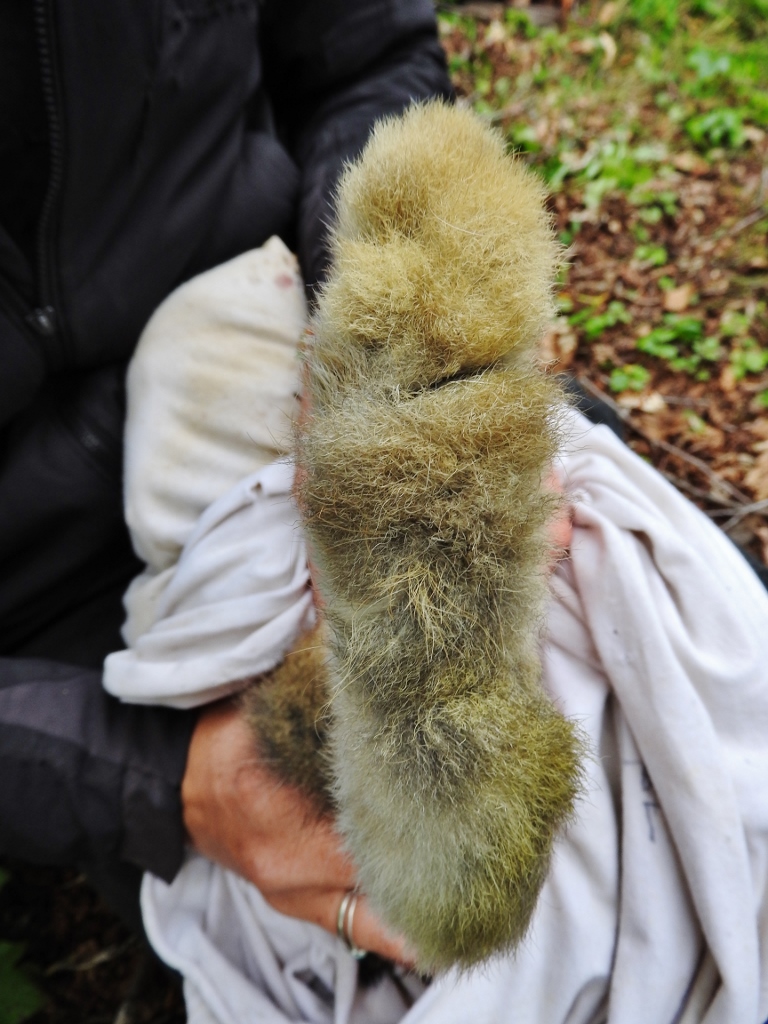
Canada lynx and snowshoe hares and are linked together as predator and prey in a 10-year cycle of population highs and lows. They also share a key adaptation: huge, furry feet that help them float on deep snow. Photo by Emily Stone.
Knut Kielland has been a wildlife biology professor at University of Alaska Fairbanks since 2000, and one evening in the bunk house I peppered him with questions about the state of research on the lynx-hare cycle. He conducted his own survey of published fur harvest records in Alaska. As part of the Bonanza Creek Long-Term Ecological Research Program, he has been monitoring hare numbers since 1999. During both studies, he found that same, roughly decadal, cycle. Like lots of other scientists, Knut and his students are trying to figure out why. When I asked Knut about his favorite theory, he didn’t have just one answer. Instead, after listing off a bunch of recent research, he chuckled and summarized, “As science usually proceeds…people just keep picking away at the problem.”

Near the end of our conversation, Knut also shared a quote from J.B.S. Haldane, who wrote: “Now, my own suspicion is that the universe is not only queerer than we suppose, but queerer than we can suppose.” The accuracy of that quote didn’t sink in until I’d taken the list of scientists and studies Knut had mentioned and used Google Scholar to try and make sense of it all in my own mind.

The classic, top-down, predator-driven theory posits that as hares increase, the number of lynx who feed on them goes up, too. Hares get eaten. Lynx have more babies. Soon there are too many lynx and not enough hares to feed them all. The lynx population goes down, hare numbers recover. The cycle starts over. Most scientists now believe that this is oversimplified.

For example, predators don’t just kill hares by eating them. As Western society has discovered, living a hectic, stressed-out life can have many sub-lethal impacts on your health, and on your ability to have babies. Rudy Boonstra, et al, (1998) hypothesize that when lynx numbers are high, hares experience more failed attacks on themselves, successful attacks on their neighbors, and frequent encounters with predator sign, i.e. lynx scat.  Therefore, hares may spend more time being vigilant and less time seeking out quality twigs to browse on. Put yourself in their (snow)shoes for a second and it’s easy to see why this could lead to a decline in health and reproduction.

What if predators aren’t the hares’ only source of stress? DeAngelis et al, (2015), found that when numerous hares browse heavily on their favorite winter foods, those willow and birch shrubs increase the concentration of anti-herbivory chemicals in their tender new twigs, which makes them less palatable and nutritious to hares.

Do the chemicals that plants produce to protect themselves against hares play a role in the 10-year cycle of snowshoe hare populations? This sharply angled twig is a sign of a hungry hare. Photo by Emily Stone.
Therefore, at the same point in the cycle when hares would be experiencing the most stress from high numbers of predators, they also may be left eating woodier and more toxic twigs than ideal. The resulting food stress could impact current and future reproduction, which could prevent an immediate population rebound, and may be one of the drivers of the 10-year cycle.

So, is the cycle’s driver top-down, fueled in one way or another by lynx? Or is it bottom-up, impacted by the chemical defenses of lowly plants?

In an extreme version of a top-down hypothesis, Selas (2006) suggested that the sun itself might play a role. Our sun goes through an 11-year solar or sunspot cycle where it emits varying levels of radiation. When sunspots are low, the ozone layer is thinner, more UVB radiation (the rays that cause sunburns) gets through, and the plants produce chemicals that defend against sunshine instead of hares. Plants become more nutritious, and hares increase. Except that the sun is on an 11-year cycle, while hares typically fluctuate on a 9-10 year cycle. Close, but no cigar.

Herbert Archibald (2014) also looked to the sky for answers. In addition to the 29.5-day lunar cycle we watch every month, our moon has an 18.6-year cycle of wobbling along its path around the Earth. Every 9.3 years (half the cycle) the orbits of moon and the sun line up and join forces. Tides are more extreme, and the full moon rises as the sun sets, resulting in “nights without darkness.” Archibald hypothesized that the moon’s cycle could drive the hare’s cycle. Hares rely on the cover of darkness to avoid predation, feed themselves, and care for their young. If a bright moon prevents darkness from falling, Archibald suggested, this could reduce hares’ fitness and reproduction. He found that the average hare cycle lasted 9.4 years—which is intriguingly close to the moon’s.

Archibald’s moonlit mechanism seems a little weak to me. Except, what if the moon’s 9.3-year cycle also impacted the amount of UVB radiation that reaches Earth?  Selas (2013) has proposed that at the peak of the moon’s cycle, it interacts strongly with the Earth’s magnetosphere and more cosmic radiation gets through. Plants respond by defending against the UVB radiation instead of hares, and this increases their palatability to hares. Geophysicists don’t think this effect is very strong. Plant physiologists think it just might be strong enough to form an “anchor” in the hare’s cycle, keeping it on schedule, while other factors drive it up and down. Knut is intrigued, because the moon’s 9.3-year cycle is the only one that matches the observed patterns in the lynx-hare cycle.

Hungry lynx, stressed-out bunnies, plant toxins, sun spots, and moon cycles—I never would have guessed that studying snowshoe hares could mean looking beyond our atmosphere, or even beyond the forest canopy. Research continues. People have made tremendous contributions, says Knut, but he is suspicious when they say, “We’ve solved it!” “Being a Norwegian Lutheran,” Knut began, “if someone makes extraordinary claims, I expect extraordinary evidence.” So far, that evidence has been elusive. Maybe information we gathered during this week of field work will add a another piece to the puzzle.

Emily is in Alaska for the summer! Follow the journey in this column, and see additional stories and photos on her blog: http://cablemuseum.org/connect/.

For 50 years, the Cable Natural History Museum has served to connect you to the Northwoods. Come visit us in Cable, WI! Our new exhibit: “Bee Amazed!” is open.

Friday, September 14, 2018

On Top of the World

There was something in the quality of the light that glowed on the green slopes of Mount Fairplay. For one, it was evening light, which is something that’s been rare in the land of the midnight sun. That, plus the clean scent of fresh pine boards in the latrine, and the fact that it wasn’t raining, made me pause and decide to spend the night at this rest area on the Taylor Highway on my first night driving homeward out of Fairbanks.

A few hours later I woke with a full bladder, rolled out of the sleeping platform in my station wagon, and grabbed a headlamp. Relieved, though blinking and squinting as I walked back, something bright caught my eye. A full moon was rising over Mount Fairplay. After turning off my headlamp to see the moon, my eyes adjusted and a sheet of twinkling stars emerged from the dark as well. I’d almost forgotten they existed. For the first time, it really sank in that I was on my way home. A deep breath of gratitude filled my lungs.

As the fog of sleep cleared and more stars appeared, awe began to expand in my heart. Then it exploded. Curtains of vibrant lights were moving just above the horizon. The aurora! My jaw must have dropped as I stumbled backward to lean against the car, and tears welled up as I tilted my head back for a better view. The moon hung full and bright on my east. To my west, spruce trees were silhouetted against the faint, rosy afterglow of the setting sun. And all across my southern sky, northern lights danced in curtains of green and white and pink. The curtains were woven of many wispy streaks, as if I was seeing the individual particles of solar wind blazing through our atmosphere.

Northern lights dance over spruce trees in Alaska. Photo by Emily Stone.
The shimmering sheets swirled and then faded to a gentle fog across the stars, like the smoke that hangs in damp air when the glitter and crackle of Fourth of July fireworks have ended and cars stream away down the dark road. Was that all?

A little spot of light near the top of the sky appeared and intensified. I fixed a gaze of hope on the glow, and it grew before my eyes into a dancing swirl of pink and white and green that showered down all around me. I used to love ducking inside the dangling twigs of my grandpa’s weeping willow tree to find a secret world filled with soft light and magic. That willow went down in a storm years ago, but its glowing ghost now held me inside the same world of light and magic.

Magic indeed. The sky looked as if someone was blasting the Earth with a spray of fairy dust. Which in fact, was nearly true. Our Sun, though, is not some benign sprite. It is like a young wizard who does not yet know how to control his own power. The Sun’s light gives life. The sparkling shower of solar wind and radiation that he shoots at us threatens destruction. Mostly, those charged particles curve harmlessly around the force field of the Earth’s magnetosphere.

Near the poles though, where the magnetic field dips and our defenses are low, some of the solar wind rushes in. Here, the gasses in our atmosphere intercept the marauders, capture their energy, and transform it into colored light. When the solar winds are particularly strong, they can burst through the Earth’s defenses and interrupt radio communication, disrupt power stations, and damage satellites. Northern lights are not just an awesome benefit to living on Earth; they are an absolute necessity to our survival. Our Earth defends us. And the result is unspeakable beauty.

The most magical part to me is that it’s not magic at all. It’s physics, and chemistry, and nature. And we (or at least the scientists) understand what’s happening.

What a miracle that is. What an amazing gift to both have this incredible beauty surrounding us on Earth (on Earth, which we sometimes think of as rock and dirt, and politics and pollution) and to understand it. The Earth receives magic dust from the Sun that makes light dance upon the sky. That’s what we get for living on Earth. That’s what we get.

Emotions I couldn’t name welled up inside and spilled over into hot streaks of tears on my cold cheeks. The lights were dancing and streaking and changing colors like a time-lapse video of clouds streaming off a mountain peak. Moving curtains faded to smoke and came back. They quivered. Ghosts shimmered in front of the stars.

Then I noticed a humming in the air like the buzz of electricity through a wire, like the buzz of a bumblebee on fireweed, like a classroom light that’s trying to turn on. I cocked my head and also heard a chord, like choir holding a note. As the lights faded to smoke the sounds grew louder. It changed. It moved, coming from a different angle. It formed a higher note, and then it stopped. A sleepy bird peeped from the spruces.

I was sleepy, too. My toes were cold, my fingers were numb, and I ached to crawl back into my warm sleeping bag just as badly as I ached to stay out here all night so as not to miss a single instant of beauty. Lights were dancing, falling, streaking, coming together and bursting apart like fireworks. When they faded a bit, sleep won out and I crawled back into my warm cocoon. I knew that more gorgeous vistas awaited me in the morning on my drive over the Top of the World Highway. More beauty awaits me every second of every day.

Anyway, we will never be able to experience all of the splendor that this world has to offer. There is just too much of it. And there will always be more. But I am grateful for this abundance of beauty. And I am also grateful that on clear nights my body has ways of getting me outside to see it.

Emily is in Alaska for the summer! Follow the journey in this column, and see additional stories and photos on her blog: http://cablemuseum.org/connect/.

For 50 years, the Cable Natural History Museum has served to connect you to the Northwoods. Come visit us in Cable, WI! Our new exhibit: “Bee Amazed!” is open.