Thursday, May 16, 2024

The Speed of Spring

Cheerful sunshine illuminated the tiny, just-hatched leaves of maple trees. Their pinks and greens complimented the blue sky perfectly. A few black flies hovered nearby, but none seemed to be biting. No mosquitoes buzzed. Instead, black-throated green warblers trilled from the treetops. The delicate, pink-striped flowers of spring beauty carpeted the hillsides. Spring beauty, indeed!

This was the day I look forward to each spring – the birds were back, the flowers were blooming, and the bugs hadn’t become biting hordes.

My first saunter of the season along the trail to St. Peter’s Dome was a bit of a quiz game, though. While marsh marigolds, spring beauty, and bloodroots were in full bloom, many of the little plants were still tightly furled. I tried to guess their species by the shades of blue or purple in their leaves, or the little dab of red at a leaf node. The leaves of the large-flowered bellwort were big enough to identify, so then the challenge was to see a flower. And after I spotted one bell-shaped bloom of canary yellow petals, I strained to spot three more on the sunny hillside. By the time I’d made the 4-mile trip to the overlook and back, I swear that the tree leaves had gotten bigger.

Quickly growing sugar maple leaves.


Spring moves quickly once she gets going, so when I returned two days later to lead the Professor Hike, I wasn’t surprised to see big changes. Single blooms had turned into petal parties!

Professor Wild Oats was the first station. This pale, delicate cousin to the large-flowered bellwort looked to someone like the drooping, straw-colored seedhead of oats. With his duct-tape-nametag displayed proudly, Kevin taught each of the other participants in turn about this lovely little flower. Later, as we hiked along the trail, he spotted more wild oats than I’ve ever noticed in these woods! That heightened awareness is one benefit of the Professor Hike activity.

Wild Oats

Professor Serviceberry was next. Two days prior, I’d found one serviceberry shrub with their white petals drooping gracefully at the top of the hill. On this day, the forest edges were frosted with their flowers. All the names of this plant refer to their phenology – the timing of their seasonal events. Serviceberry blooms when the ground has thawed enough so funeral services can be held for unfortunate souls who died over the winter when the ground was too hard to dig. A little farther south, their tasty purple fruits ripen in June, hence the name Juneberry. Up here, we should call them July-berry instead.
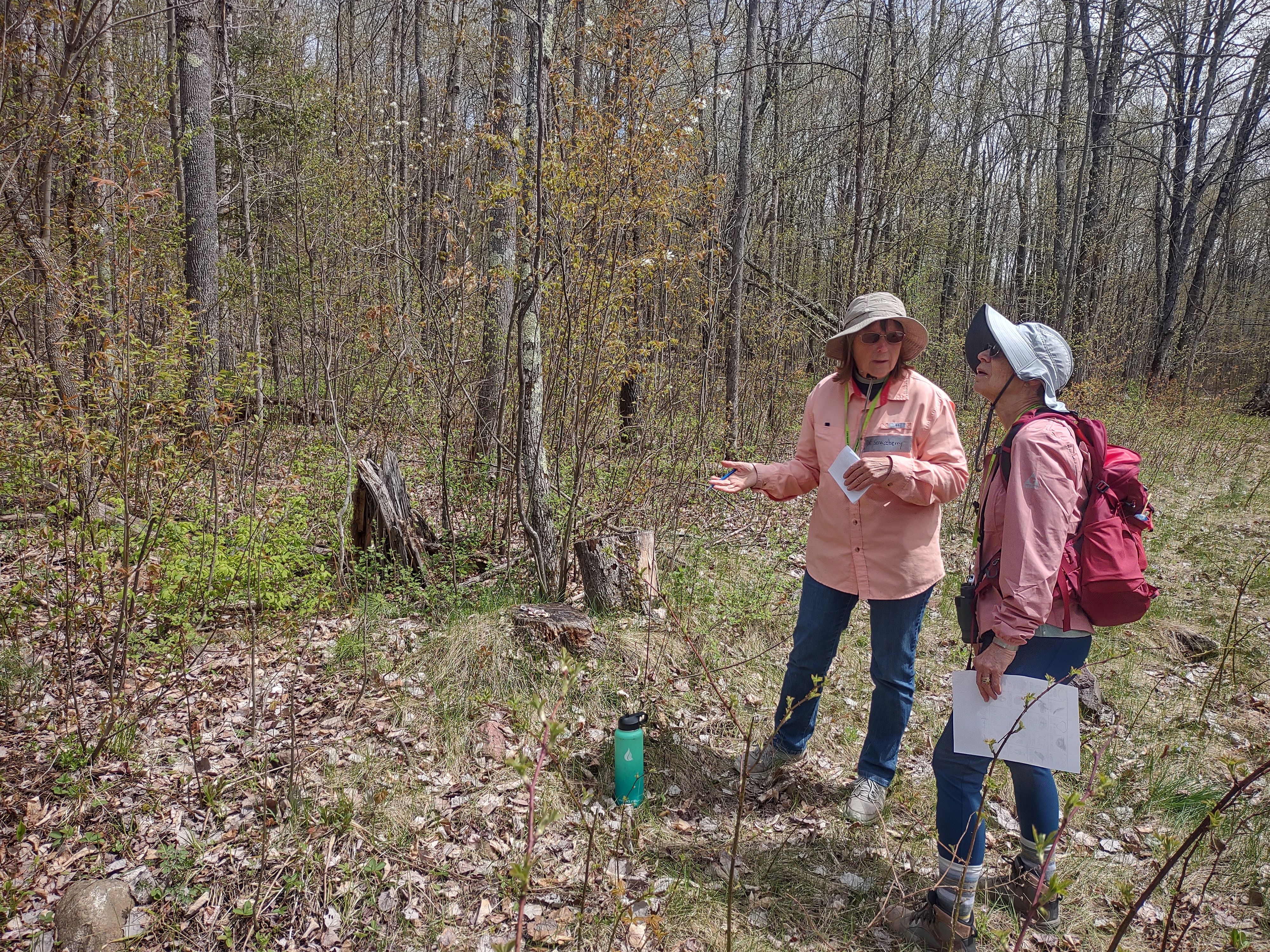
Professor Serviceberry and her first student.


Shadbush is another name for serviceberry on the East Coast, where fish called shad swim from the ocean into the streams to lay their eggs about the time that these pretty white flowers are engaged in their own reproductive rituals.

Serviceberry blossoms.

The early and prolific flowers of serviceberries are an important food source for early-arriving bees, butterflies and hummingbirds. The flowers themselves benefit from this schedule because there is less competition for pollinators, and their blossoms may be easier to find in a leafless forest. This results in better pollination and more viable seeds.

The speed of spring can be dizzying, but it is no accident. Trees are racing to leaf out and take advantage of the intersection of bright sun and plentiful soil moisture. Flowers, like wild oats, are racing against the leaves. Known as spring ephemerals, they can benefit from the rich soil in shady depths of deciduous forests, so long as they get a head start on the trees. Flowers bloom, leaves unfurl, bees hum, ants crawl, seeds are set, photosynthesis produces sugars, and then—just as the tree leaves above are reaching their full potential and shade—the ephemeral leaves melt back into the duff.

All summer, fall, and winter, the sugars that the spring ephemerals raced to produce are stored as carbohydrates (complex sugars) in starchy roots. Burrow your finger into the soft soil near any of these plants, and you will soon pull out a small white tuber or thickened rhizome. This stored energy allows spring ephemerals to get a head start on the tree leaves each spring, and then rush to replenish their pantry for next year.

After Professors Flower Symmetry, Marsh Marigold, Cherry, and Black Ash had taught each of their peers, we continued up the trail to find carpets of spring beauty, bellwort, Dutchman’s breeches, cut-leaved toothwort, trilliums, and wild ginger. At the top, we gazed across the tops of trees, their leaves practically growing as we watched. Even though I wish my beloved spring ephemerals could last longer, each spring I also cheer them on in their race against leaf-out. In many ways, the speed of spring is what makes it such an amazing season!

View from St, Peter's Dome

Marsh Marigold

Spring Beauty

Bloodroot

Dutchman's Breeches

Large-flowered Bellwort

Emily’s award-winning second book, Natural Connections: Dreaming of an Elfin Skimmer, is available to purchase at www.cablemuseum.org/books and at your local independent bookstore, too.

For more than 50 years, the Cable Natural History Museum has served to connect you to the Northwoods. The Museum is open with our brand-new exhibit: “Anaamaagon: Under the Snow.” Our Summer Calendar of Events is open for registration! Follow us on Facebook, Instagram, YouTube, and cablemuseum.org to see what we are up to.

Thursday, May 9, 2024

Honeysuckle from Near and Far

The cool, damp air smelled delicious as I ambled up the gravel road. I’ve been up and down ladders and scaffolding for exhibit construction lately, and so I haven’t had the energy for big bike rides in the afternoon. That’s fine. I will still be able to bike once the mosquitoes hatch, but I won’t be able to walk slowly without a head net.

When the blossoms of a honeysuckle bush caught my eye, I was even happier for my slow pace. I stopped to admire the prismatic raindrops caught under each flower’s chin.

The native, Northern Fly Honeysuckle looks much more delicate, has pendulous flowers, football-shaped berries, and a white center to their stem. Photo by Emily Stone.


Northern Fly Honeysuckle’s pale yellow flowers dangle in delicate pairs. Their fluted shape with a long nectar tube is a clue that hummingbirds love them. The flowers don’t last long, though, and are soon replaced by two green fruits, shaped a little bit like tiny footballs, and joined at their pointy ends. The berries ripen to a vibrant shade of red, which really pops in the cool shade of the forest. Birds, especially robins and cardinals, love them.

The week prior, I’d been in Duluth, getting some fresh air on one of the many creek side trails, before buying some last minute items for exhibit construction. It was a cool day, but sunny, and was starting to look like spring. Dandelions dotted the grassy areas, and in the woods, there were a lot of little green leaves right at eye-level. My friend commented on how nice it was to see the green. I tried to agree, but couldn’t quite muster excitement. These leaves – unfurled a week or two before much else – belong to a non-local honeysuckle who evolved with the spring schedule of an entirely different continent!

I grew up with this variety, Tartarian honeysuckle (Lonicera tatarica), in my backyard, and spent many days gathering the round red and orange berries to use as pretend food in my playhouse. Now I know that this childhood friend can be quite invasive. A native of China, Manchuria, and Korea, they left behind their native predators when arriving here, and tend to run rampant in our vacant lots and deciduous woods, creating impenetrable thickets in the worst cases. They joined several other species of non-local honeysuckles who all share the same invasive tendencies.

While native and non-local honeysuckles share some characteristics, it’s not hard to tell them apart. All have pairs of white, pink or yellow flowers with a nectar tube and fluted petals. All have paired leaves (“opposite arrangement” to botanists,) and all have red or orange berries. The invasive honeysuckles get much bigger and bushier, though, and some species have pointed, serrated, or fuzzy leaves. Their abundant flowers are held upright. Plus, the berries on invasive honeysuckles are round instead of football-shaped.

The non-local species of honeysuckle have pairs of upright flowers which are sometimes pink; round, bright red berries; and a brown or hollow center to their stem. Photo by Emily Stone.


The surest way to distinguish the honeysuckles in any season is to crack open a twig and look at the pith. The pith is the soft, spongy tissue in the center of the stem. In native honeysuckles the pith is white. In non-local species, the pith is either brown or hollow.


Native honeysuckles have a white pith.


Non-native honeysuckles have a hollow or brown pith in the center of their twig.


Like many invasive species, the Eurasian species of honeysuckles tend to crowd out native plants and provide a lower quality food source to animals. As birds and mammals eat the berries and disperse the seeds, non-local honeysuckles quickly invade open woodlands, old fields, and other disturbed sites, and form a dense thicket that prevents other native plants and trees from growing. The northern fly honeysuckle is one that gets pushed out by their cousins.

With lower diversity, the wildlife cover is reduced, and cardinal nests in particular are less successful, despite the thicket. Fewer insects in the non-local honeysuckle reduce food sources for many warblers and flycatchers. Although abundant, the berries contain less fat and energy than their native counterparts. When cedar waxwings eat too many red honeysuckle berries, the pigment tints their normally yellow tail tip and turns it orange. On the flip side, male cardinals who eat non-local honeysuckle berries may be brighter red, even though they are less fit. Females have a harder time determining the healthiest mates.

As you pass yard after yard surrounded by Eurasian honeysuckle hedges in full bloom, it’s easy to imagine how this invader got here. They were first introduced into North America as an ornamental in 1752! Many invasives got their start in the nursery trade, either as the main attraction or a hitchhiker.

As I continued up the gravel road with my eyes tuned for honeysuckle, I began to notice more and more of the delicate native, Lonicera canadensis. They may not be as showy as the other kinds we imported for hedges, but they have a subtle beauty I adore. Even with the exhibit finished, I think I’ll keep walking slowly until the buzzing hordes appear!


Tips to reduce the spread of invasive species:

Prevention is worth an ounce of cure, so they say, and it is definitely easier to keep the weeds out than to get rid of them once they’re here. Do a little research before you buy new plants from a nursery, and try to choose native species. Use those boot brushes at trailheads to make sure that you aren’t carrying seeds from trail to trail. Clean your equipment between locations, especially if you know that you’ve just been working in a place that has non-local species.

If you discover an invasive species on your property or public land, contact the Northwoods Cooperative Weed Management Area (NCWMA) by calling 715-373-6167 or emailing info@northwoodscwma.org. Various local land management agencies can help you set up a plan to control the non-local species and create better habitat on your land.


Note: Portions of this article are reprinted from 2023.


Emily’s award-winning second book, Natural Connections: Dreaming of an Elfin Skimmer, is available to purchase at www.cablemuseum.org/books and at your local independent bookstore, too.

For more than 50 years, the Cable Natural History Museum has served to connect you to the Northwoods. The Museum is open with our brand-new exhibit: “Anaamaagon: Under the Snow.” Our Summer Calendar of Events is open for registration! Follow us on Facebook, Instagram, YouTube, and cablemuseum.org to see what we are up to.

Thursday, May 2, 2024

Plant Professors of Early Spring

Last June, I strode down the trail with a roll of duct tape bouncing along in my backpack, and a permanent marker poking out of my pants pocket. A group of 20 Wisconsin Master Naturalist Volunteers-in-Training ambled behind me. We’d had a challenging morning of botany and geology at Morgan Falls in the Chequamegon-Nicolet National Forest. Lunch had revived us, and now it was time for the afternoon activity. Anticipation bubbled.

“During this activity,” I explained, “you will each become a professor of something in these woods.”

Over the years, I’ve found that this Professor Hike activity is very effective at connecting students to nature. What’s been a surprise, especially as I lead it with adults instead of sixth graders, is how wonderful it is at connecting people to each other as they teach and learn.

While most of the group opened up their new nature journals to pass the time, I led my first “professor” a little ways down the trail. Maggie and I paused by a big log on the ground, and I asked, “How would you feel about being Professor Coarse Woody Debris?” She was game. I dug out the marker and tape as I explained that foresters use this term to describe fallen dead trees.

We looked at some punky places on the log where fungi were clearly doing their decomposition work, admired the moss growing in the spongy, water-holding material, and talked about death’s roll in the ecosystem. “Ecologists often say that a tree is more alive when it’s dead,” I quipped.

Then, as I handed Maggie a strip of duct tape with her professor name written in black marker, she practiced teaching that same information in her own way. Satisfied with her grasp of the material, I waved at the group of remaining students, beckoning one forward.

“Hello, my name is Professor Coarse Woody Debris,” Maggie introduced herself, and proceeded to teach Craig this little chunk of newly acquired knowledge, ending with a deep thought about how death provides the resources for new life. Then Maggie stayed by her log and invited a new student forward, while I walked Craig down the trail to find a new professor topic.

Several of the next stops revolved around Jack-in-the-Pulpit, a neat little flower who blooms toward the end of spring and beginning of summer. But the flowers of early May are quite different than mid-June! Jack-in-the-Pulpit won’t even have poked their little green shoots above the soil yet.

As I prepare to lead another Professor Hike next week – this time as a public program – I’m contemplating who my “professors” will be. On a recent hike in a similar habitat, I found some clues.

At the base of a sugar maple tree, I crouched to look more closely at some blackened rhizomes. These horizontal stems connect the upright plants in a patch. My first thought was “stupid worms.” The reason the rhizomes were exposed is that earthworms had been feasting on the soil’s maple-leaf blanket all winter, and all that remained now were little piles of worm castings. The stacks of tiny round balls reminded me of cannonballs – both in their shape and their destructive power.

While European earthworms (brought here with ship ballast or in root balls) are wonderful at breaking down organic matter and mixing the soil in our gardens, they are just too efficient for the plants in our woods. Our northern forests evolved in the absence of earthworms, after the glaciers froze them out. Many plants here need thick, slowly decomposing leaf litter to grow, and for their seeds to sprout. In this exposed patch, with the continued possibility for nighttime frosts and a lengthening drought, it is easy to see why fallen leaves are important. The tiny fern fiddleheads sprouting from the rhizomes have a back-up plan, though: they are wrapped tightly in a coat of hairs and scales.


Under a different tree, where the worms hadn’t feasted so thoroughly, I spotted a brigade of tiny, spoon-shaped leaves poking up through the duff. As I crouched to photograph them, I found a tiny chandelier of tightly closed buds. Spring beauty is one of the earliest delights to bloom on the forest floor, but I suspected I was just a day or two early. Then, sunlight glowing through pale pink petals caught my eye. I just needed to look more closely to find the beauty of early spring.


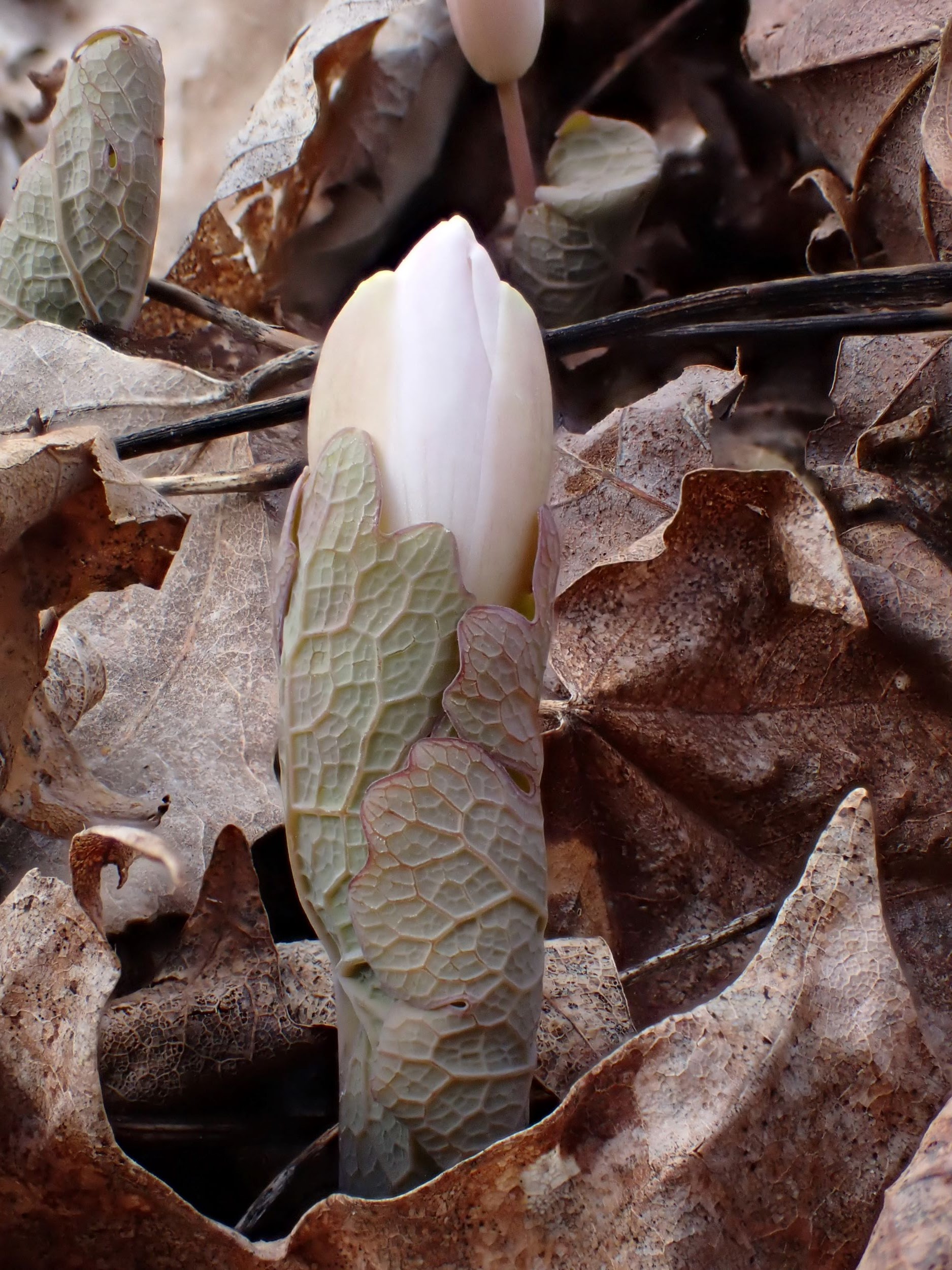
A little farther along, I paused next to some coarse woody debris. Didn’t I see bloodroot blooming here last year? Scanning the area from a standing position, all I saw were dry maple leaves. When I bent low, though, a miniature grove of white bloodroot buds blushed in the protective embrace of their leaves.


Professors indeed, these little plants have reminded me of the value in taking the time to look closely. I can’t wait to share more of their wisdom during the Professor Hike program on May 8! Register by May 6 at cablemuseum.org.

Note: Portions of this article are reprinted from 2023.


Emily’s award-winning second book, Natural Connections: Dreaming of an Elfin Skimmer, is available to purchase at www.cablemuseum.org/books and at your local independent bookstore, too.

For more than 50 years, the Cable Natural History Museum has served to connect you to the Northwoods. The Museum is open with our brand-new exhibit: “Anaamaagon: Under the Snow.” Our Summer Calendar of Events is open for registration! Follow us on Facebook, Instagram, YouTube, and cablemuseum.org to see what we are up to.


Thursday, April 25, 2024

The Woodcock Dating Game

Dusk was deepening in the alder brush of the Bibon Swamp as we tiptoed down the gravel road. Robins yakked from the trees and spring peepers yelled from the water much louder than our feet, but still we kept our breath and movement and thoughts as quiet as possible so as not to miss it.

Peent.

I heard it first, since I knew what to expect. I pointed eagerly toward a featureless place in the bushes. Peent. The brand-new birder with me strained to pick that one sound out of the thicket. Peent. We waited; breaths held. Peent. We wanted more.

At the next grassy opening along the road, we heard another peent. We paused, peering into the place where grasses met alders. Twittering sounds burst from the grass, and a flappy little flier rose in a broad spiral, soon clearing the treetops and circling up toward the crescent moon. Fatter than a robin, smaller than a grouse, the winged shape twittered ever higher into the navy blue. About 200 feet up, the twittering became sweet chirping, and the American woodcock sideslipped down like a falling leaf. Peent. Back on his dancing ground, the male began his courtship display again. Peent. My friend and I turned to each other, grinning.

If you look closely there’s the tiny shape of a woodcock twittering up into the blue near the center of the photo. Bibon Swamp, Grandview, Wisconsin. Photo by Emily Stone.


Nature has invented some pretty interesting courtship behavior over the eons, and American woodcocks are a lovely example. Somewhere in the bushes, a female woodcock pretends not to watch the male’s strenuous antics. If he passes muster, she will let him approach her, bobbing with his wings raised, to seal the deal. That’s it, though. She goes off to build a nest and he keeps displaying.

Over a decade ago, in Maine, I spent another evening surrounded by woodcocks. The blueberry bald reminded me of Friar Tuck’s iconic haircut. Low shrubs and lichen-covered rocks dotted the top of the hill, with a shaggy forest forming a circle around the crown. As dusk fell, woodcocks peented and twittered and chirped in ethereal surround sound, as if in my own private Omnitheater. Private, except for an acquaintance who was not a birder. He stood by – bored – while I slowly spun in circles, high on the wonderment of nature.

Fast forward a couple years to my closest encounter with a woodcock. His peent buzzed right through the thin nylon of my tent wall. When I sat up in my sleeping bag to look out of the mosquito netting, his funny shape was just a few feet away, strutting on the packed dirt of the campground. I could see the silhouette of the woodcock’s three-inch-long bill open with each peent. Absolutely thrilled, I poked my tent mate so that he wouldn’t miss this cool experience. Grumbling about the noise, he pulled his sleeping bag up over his ears.


Woodcocks are funny looking birds with a fascinating spring display.
Photo by Ramos, Keith, USFWS.


Like people, woodcocks’ peculiarities are what make them fun to get to know. For example, they have some great nicknames: timberdoodle, Labrador twister, and bog sucker top the list. And their oddly fantastic attributes don’t stop there. Sure, having big eyes on the top of a pointy head looks like a badly drawn cartoon, but that gives woodcocks the ability to see danger in any direction. Probing the mud for food with a super long bill doesn’t seem like elegant dining, except that using their flexible, sensitive bill tip, woodcocks can both perceive a worm and grab it, all underground.

Woodcocks can even dance! Stepping one foot forward, they’ll bob their body rhythmically while their head stays eerily still, then take a step and bob again. TikTok has discovered all the pop music with just the right beat to match the woodcock’s moves. Scientists aren’t sure why woodcocks do this funny walk, but stirring up earthworms for easier feeding is one hypothesis.

Food wasn’t their priority under the crescent moon last week. The peents came from both sides of the gravel road. The beginner birder and I listened to a particularly loud male call for a few minutes, and when he took to the air, we stumbled forward over grassy hummocks to get closer to where we’d thought he’d been. When his twitters turned to chirps, we crouched low and tried to become invisible. Peent. No luck, he’d landed behind us.

It didn’t matter. Grinning in the darkness, we talked about all the amazing events of the evening on our way back to the car. I’m not sure what traits woodcocks are looking for in a partner, but I want to hang out with someone who goes looking for woodcocks!


Emily’s award-winning second book, Natural Connections: Dreaming of an Elfin Skimmer, is available to purchase at www.cablemuseum.org/books and at your local independent bookstore, too.

For more than 50 years, the Cable Natural History Museum has served to connect you to the Northwoods. The Museum is closed until May 1 to construct our new exhibit: “Anaamaagon: Under the Snow.” Our Summer Calendar of Events is open for registration! Follow us on Facebook, Instagram, YouTube, and cablemuseum.org to see what we are up to.

Thursday, April 18, 2024

Appreciating Earthly Gifts

What if we stopped calling trees, water, minerals, fruits, fish, soil, and everything else Natural Resources and started using the term Earthly Gifts?

This was one of the first questions posed by Dr. Robin Wall Kimmerer at a talk last month in La Crosse, WI. Kimmerer is the author of Braiding Sweetgrass: Indigenous Wisdom, Scientific Knowledge and the Teachings of Plants. Published in 2013 without much fanfare, this amazing book slowly gained momentum by word of mouth, and finally reached the bestseller list in 2020. “I’d like to be named Head of the Department of Earthly Gifts,” she quipped, not truly joking.


As spring turned to winter and back to mud season in the days since that talk, I’ve been thinking about Robin’s words…and finding her ideas echoed elsewhere. Kathleen Dean Moore is another of my favorite authors, who, like Kimmerer, won the Sigurd Olson Nature Writing Award. I’m often delighted by how Moore and Kimmerer arrive at the same conclusions from their different backgrounds—Moore is a Western philosopher, and Kimmerer gains wisdom from her Indigenous heritage.

They both encourage us to appreciate gifts from the Earth.

Moore wrote, “The Earth offers gift after gift—life and the living of it, light and the return of it, the growing things, the roaring things, fire and nightmares, falling water and the wisdom of friends, forgiveness…Failing to notice a gift dishonors it, and deflects the love of the giver…But to turn the gift in your hands, to say, this is wonderful and beautiful, this is a great gift—this honors the gift and the giver of it…”

Here are a few of the Earthly Gifts I’ve received recently. Please admire them with me, and then reflect on a few of your own.

1. Voices and laughter echo throughout the Museum even though we’re closed. Hammers pound, drills squeal, paintbrushes swish. We’ve asked our volunteers to do the oddest things: install a giant slide indoors; adhere a big sticker printed with the face of a marten to our doors; line the entire exhibit hall with fabric printed to look like the inside of a snowbank; enlarge animal tracks to 12x life size and then glue them to strips of chiffon and hang them from the ceiling; write flute arias to represent ten beings who live beneath the snow, and so much more. The list of volunteers grows longer every day, and the table can barely accommodate us all at lunch. As it turns out, it takes a village to turn an exhibit hall into the Subnivean Zone at 12x life size. “Anaamaagon: Under the Snow” opens in May, thanks to the work of many talented volunteers, Museum staff, and professional artists!

Volunteers work in the exhibit hall. 


2. On a rare day away from the commotion, my friend and I hike through birch woods below a craggy, mossy cliff. The sound of a hundred little bells makes us look up from the rocky path, and we discover that the trees are twinkling with the movement of birds. As we walk, a huge flock of redpolls tumbles ahead of us. They hop and poke about the leaf litter looking for seeds as their friends fly just ahead; then when the back of the flock reaches the ground birds, they flutter up. The beings ahead of them flutter up. The beings ahead of those flutter up. The movement is delicate and overwhelming. My heart flutters up, too. We shake our heads in wonder.

Can you spot the redpolls?


3. Most plants—at least the smart ones—are still holding their buds tightly closed against the possibility of frost. But I know to look more closely. Leaning into a certain shrub, I carefully examine the tip of each brown bud. It only takes a few tries before I find what I’m looking for: tiny, translucent, red tentacles squeeze their way out of the bud scales. Shifting around, I position the Sun just so, and the pistils of a beaked hazel flower begin to shine as if from within. As if they are the light inside a film projector, memories begin to play: spring in California and the comfort at finding an old friend in a new place; the pandemic spring when I walked down my road every day for two weeks straight, waiting for them to emerge from their homes, too; and countless other tiny scavenger hunts when I looked for these tiny flowers and found joy.

The translucent red pistils of beaked hazel never fail to bring me joy in the spring.
Photo by Emily Stone.


4. Awake in the darkness, I stress about falling back to sleep. Then the loons begin. Soft wails echo across the lake and seep in through my windows. These are the first I’ve heard this spring. Now I’m grateful I didn’t snore right through them.

Loons from last summer.


5. On a walk, the rattling bugle of a sandhill crane raises the hairs on my neck. I follow the sound across a field, between trees, and onto the edge of a bog. Through a screen of alder twigs I watch a single bird. Neck stretching, wings flapping, they call again and again. Then, with a few running hops they are airborne on wings so large I can feel the breeze they stir in my soul.


The rattling bugle of sandhill cranes always makes me pause and be grateful for the wildness of the world where we live. Photo by Emily Stone (in Nebraska, not Wisconsin).


“We are called to live lives of gratitude, joy, and caring, profoundly moved by the bare fact that we live in the time of the singing of birds.” – Kathleen Dean Moore, Wild Comfort


Emily’s award-winning second book, Natural Connections: Dreaming of an Elfin Skimmer, is available to purchase at www.cablemuseum.org/books and at your local independent bookstore, too.

For more than 50 years, the Cable Natural History Museum has served to connect you to the Northwoods. The Museum is closed until May 1 to construct our new exhibit: “Anaamaagon: Under the Snow.” Our Summer Calendar of Events is open for registration! Follow us on Facebook, Instagram, YouTube, and cablemuseum.org to see what we are up to.

Thursday, April 11, 2024

Finding Snow Fleas

With soggy skies above and soggy snow below, my recent hike on the North Country Trail was not inspiring a love for spring. But with my head bent to watch my footing, I noticed a sprinkling of debris coated the surface of the softening snow. Suddenly one of the little specks vanished. Crouching down for a better look, I discovered that most of the sprinkles were tiny, leaping springtails known as snow fleas. I dug out my macro camera.


While springtails have six legs, they aren’t insects. Instead, they belong to the insects’ sister group with several different characteristics. A lack of wings, simple instead of compound eyes, differences in molting, a special mouthpart for drinking, and a hinged body part that can fling them into the air set springtails apart from true insects.

A springtail’s namesake spring is a forked appendage called a furcula, made from two modified legs on their final body segment. In my research, I found photos of two-pronged furculae, but in the photos and videos I captured of these little beings, the furcula has three prongs (see above photo).

While resting, a springtail locks the prongs of their furcula up against their belly, thereby storing potential kinetic energy in their abdominal muscles. A rubber-like protein called resilin in the springtail’s exoskeleton helps to flex and store energy, too. The whole system is similar to an upside-down mouse trap.

When the springtail is startled by a potential predator, such as a giant human hiker, they release the clasp and the furcula snaps open against the ground. The being launches into the air, as far as 100 times their one-eighth-inch body length! This explanation, summarized from a variety of sources, makes me think that it would be impossible to see the furcula before the springtail goes flying. However, my videos show the furcula expanding from the springtail’s rear end for a second before they disappear. 


After an uncontrolled flight, a springtail might land mere inches from their starting point, which is still far enough to fool many of their predators—like ants, beetles, and salamanders. Post fling, springtails don’t always land on their feet. Luckily, they have a neat trick for righting themselves. Two inflatable grooming tools not only help them to keep clean, the sticky tubes can be adhered to the ground and used to pull the springtail upright.

While springtails are in the running to be the most abundant of all macroscopic animals (you might find 100,000 individuals in a square meter of soil, and there are about 3,600 species total), we typically only notice the one or two species who spend time on the surface of snow. Snow fleas get their name from their jumpy behavior and the substrate that makes them visible.

On balmy winter days, snow fleas scatter like pepper over the surface of the snowpack, or they might congregate in crawling hordes of a million individuals, drawn together by pheromones for a mating party. It’s amazing that such a tiny being can survive at all in the frozen expanse of snow. The magic that makes this possible is a unique protein especially rich in the amino acid glycine. This protein binds to ice crystals as they start to form, preventing them from growing larger, and so it acts as an antifreeze. The protein works down to about 21°F, and at warmer temperatures it disappears! Doctors are studying its potential to help preserve human organs on their way to a transplant surgery.

Snow fleas don’t really spend much of their life on top of the snow. Like other springtails, they inhabit the soil and leaf litter. Other species of springtails (not snow fleas) live in tree canopies and even on top of water. A moist environment is essential to prevent desiccation. Since they breathe directly through their skin (another difference from insects, who use a trachea), springtails must balance hydration with breathing. Complex structures on their skin trap tiny, durable reservoirs of air.

In their damp habitats, springtails are essential members of the community. What they lack in size, they make up for in numbers. They fragment organic material and make it easier for decomposers to break down. Springtails also curate the soil’s microbial inhabitants by eating bacteria and fungi, and by spreading them around. One common fungus—Laccaria bicolor—has turned the tables on springtails. This fungus paralyzes and decomposes the springtails, then sends their nitrogen over to a white pine through their roots.

On your next adventure in the snowy woods, be sure to keep an eye out for tiny, leaping specks on the snow. They just might be more interesting than you’d expect!


Author’s Note: This article has been updated from 2016. I’m busy building an exhibit!

Emily’s award-winning second book, Natural Connections: Dreaming of an Elfin Skimmer, is available to purchase at www.cablemuseum.org/books and at your local independent bookstore, too.

For more than 50 years, the Cable Natural History Museum has served to connect you to the Northwoods. The Museum is closed until May 1 to construct our new exhibit: “Anaamaagon: Under the Snow.” Our Summer Calendar of Events is open for registration! Follow us on Facebook, Instagram, YouTube, and cablemuseum.org to see what we are up to.

Thursday, April 4, 2024

Protecting Birds from Your Windows

The soft but sickening thud sent out a wave of impacts. Conversation, typing, and higher-level thinking stopped. From four corners of the office, heads instinctively turned toward the sound. Bright morning sunshine streaming through the window illuminated nothing unusual, though. With a mix of hope and dread, I opened the back door and scanned up and down the patio. Nothing. I sighed with relief and stepped back inside.

I’d been expecting to find a small bird—lying either lifeless or stunned and glassy-eyed—at the base of the large row of windows that face the Museum’s back yard. Low-angled sunlight in the spring, in the fall, and early in the day, sneaks under awnings and tints the glass of our windows with stunningly accurate reflections of trees and sky. When little birds try to fly into that scene, they get a painful—and often deadly—surprise.

This juvenile cedar waxwing died after flying into a reflective window. Photo by Emily Stone.


Birds can collide with windows in any season, but I’ve always noticed an increasing number of those sickening thuds in spring. As waves of migrating birds head north, we see both a huge increase in the number of individuals, and an increase in birds who are new to the neighborhood and more likely to be hoodwinked by windows.

According to the Humane Society, roughly half of the birds who hit windows succumb to their injuries or are killed by predators while they’re vulnerable. The thud I heard was from one of the lucky ones who flew away. An estimated 1 billion birds die this way each year.

From the number of calls and emails I get on this topic, I know that these bird deaths weigh heavy on the hearts of many. Not only is it distressing to find feathered corpses outside your home, or to watch the life go out of something so innocent and delicate, but headlines tell us that birds are in global decline due to habitat loss, climate change, and more. Each small life counts toward the whole.

Now that warm days are turning even window washing and yardwork into attractive tasks because they give us excuses to get outside, it’s a good time to think about making your windows better for birds.

Window screens that go on the outside of the glass are one of the best tools for preventing collisions. Not only do they break up the reflection, they also act as a safety net. If your windows didn’t come with bug screens, you can use bird netting from a garden store (meant to keep robins out of your strawberries) instead. Just make sure to pull the netting taut like a trampoline, and keep it at least 3 inches off the window so the birds don’t bottom out.

A purely visual grid can also work well. Using tape, soap, tempera paint, or paint pens, you can add designs to your windows that make the glass visible to birds. If you’re feeling artistic, an intricate doodle would do the trick. Otherwise, using a level and a yardstick, you can simply draw lines. The key is to make the spaces between the lines small enough that birds don’t try to squeak through. For best results, vertical lines should be no more than 4 inches apart, and horizontal lines no more than 2 inches apart. If your casualties include hummingbirds, then use the 2-inch measure all around.

While not practical for everyone, you could make the designs permanent by etching or sandblasting them directly onto the glass. If you’d rather use decals, they need to be just as densely spaced as the grid in order to be effective. A company called CollidEscape makes grids of dots and one-way transparent film that can do the job. But those single, elegant hawk silhouettes have been shown not to work. Likewise, past recommendations about how to safely space bird feeders away from windows haven’t stood up to testing.

You can also combine the ideas of a grid and a screen and make “Zen Curtains.” Basically a grid made of cords; they hang down over the glass on the outside of the window. They can be easier to install than paint, longer lasting, and can be aesthetically pleasing. I’ve seen them made from sparkly string with tiny mirrors attached, and the effect was delightful! A simple internet search will turn up both commercial and DIY versions.

Not every window or every homeowner can accommodate these ideal modifications, though. Using a simpler option, or a combination of techniques, is still helpful. At the Museum, we often tape a single length of curling ribbon at the top center of each window. As the ribbon blows and bounces in the breeze, it helps to deter birds. Awnings, external sunshades, and shutters can also minimize reflections. Having flowers and shrubs at the base of windows can encourage birds to dive in for shelter instead of trying to fly through to escape from a predator.

Making changes indoors can have an impact, too. Blinds, shades, or even sheer curtains on large windows change the reflection quite effectively. And my favorite recommendation is one of the easiest: letting your windows stay slightly dirty can cut down on the realism of the reflection.

Recent research found a positive relationship between the diversity of bird species in a neighborhood and the life satisfaction of people who live there. Add that to the reduction in those sickening thuds, and bird-proofing our windows feels like a great way to increase happiness this spring.

Author’s Note: This article is reprinted from 2021. I’m busy building an exhibit!

Emily’s award-winning second book, Natural Connections: Dreaming of an Elfin Skimmer, is available to purchase at www.cablemuseum.org/books and at your local independent bookstore, too.

For more than 50 years, the Cable Natural History Museum has served to connect you to the Northwoods. The Museum is closed until May 1 to construct our new exhibit: “Anaamaagon: Under the Snow.” Our Summer Calendar of Events is open for registration! Follow us on Facebook, Instagram, YouTube, and cablemuseum.org to see what we are up to.