Thursday, August 25, 2022

Bryozoans

“Hey, I’ve got something over here!” called one of the paddlers on our Aquatic Plant Ecology and Identification field trip last week. He was floating in a sparse patch of wild rice near the edge of Chippewa Lake east of Cable. “It’s about the size of a soccer ball,” Pat exclaimed, just in case we assumed he had discovered yet another species of pond weed or something.

“Is it gelatinous?” asked our instructor Paul Skawinski, Citizen Lake Monitoring Network Educator with UWSP / Extension Lakes and author of Aquatic Plants of the Upper Midwest, as he began paddling over. “Looks like it,” responded Pat. Paul already had a good idea of what he would find, and a name popped into my head, too: bryozoan.

Bryozoans are a colony of tiny invertebrates that cling to the stem of an aquatic plant.

The individual invertebrates may be tiny, but this bryozoan was huge! The round, beige mass was at least the size of a soccer ball, and maybe more like a basketball. The surface pattern was a hybrid between those two as well. A quilted-looking pattern of bumps covered the entire surface with vaguely geometric pattern quite a bit bigger than the pebbles on the basketball, and interlocking like the polygons on a soccer ball.

After dunking my waterproof camera in the lake for some photos, my bow paddler and I backed the canoe away so that others could get a good look.

A bryozoan the size of a basketball delighted the aquatic botany students on Chippewa Lake. Photo by Emily Stone.


This specimen was far too impressive to touch and risk damaging it, but several years ago I saw one in the Namekagon River while learning to snorkel. The firm-jello-with-a-textured-surface feel of the bryozoan triggered my “gross” reflex just as much as it sparked my “cool” instinct. I was impressed when the group of teenage girls I was snorkeling with didn’t bat an eye. Showing interest but not disgust, they all had a look before we put the colony back into the river.

While the blob looked more like a patterned glass art piece than a living being, it is actually formed of hundreds of genetically identical, physiologically interconnected animals called zooids. Similar to coral in their colonial lifestyle, each individual zooid is made up of an outer sleeve-like structure that produces a gelatinous exoskeleton; a mass of organs that can move within the sleeve; and the lophophore, which is a ring of tentacles that filters food particles out of the water. Instead of pooping out waste, a zooid just grows a new sack of organs when the old one fills up.

While each zooid is capable of independent feeding, digestion, and reproduction, they share certain fluids and tissues that unify the colony, and it’s impossible to separate them entirely. Some types of bryozoans also have specialist zooids that produce eggs, defend the colony, and attach to the substrate. Altogether, a zooid may be only 0.5 mm long, so little of this is visible to the unaided eye.

Sketch of a bryozoan zooid by Jo Lafrancois.


That fall, after the snorkeling expedition, I examined a bryozoan under the Museum’s digital microscope. The surface texture resolved into a conglomeration of various-colored polka-dots, often with concentric rings. Nothing looked remotely like the feeding tentacles I’d read about. I snapped some photos through the scope and sent them off to aquatic ecologist Dr. Toben Lafrancois for clarification.

“They are statoblasts,” he wrote back, “or dormant buds getting ready for winter.” While bryozoans can reproduce sexually, they also produce these statoblasts, which are sort of like tiny “survival pods” that develop while attached to zooids. Inside each bivalve-like chitin shell hides a proto-zooid with some stored food.
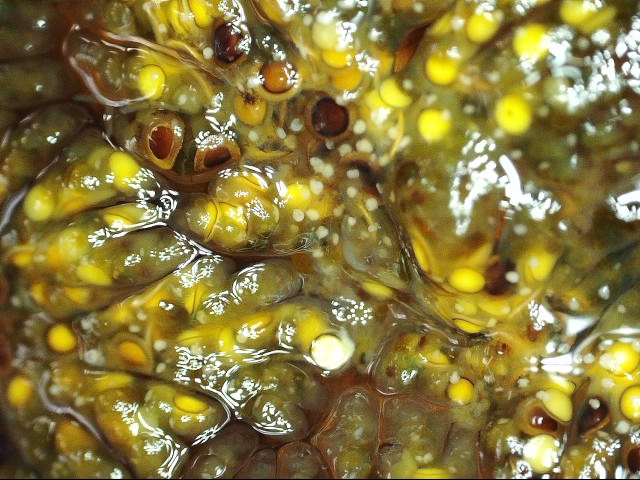

Statoblasts in various stages of development. Photo by Emily Stone.


The statoblasts of some species contain a gas bubble that will float them up to the surface. Others drift on a current or just sink to the bottom. Apparently, the various shades of brown and yellow represent various stages of statoblast development, and their prevalence is a result of the bryozoan’s autumnal push to create clones who can survive the winter.


Statoblasts that have become floatoblasts and are ready to float away! Photo by Emily Stone.


The bryozoan colony will die as temperatures drop, but statoblasts are incredibly durable and can survive long periods of dormancy, freezing, dehydration, and even transport in the gut of a duck or the ballast of a ship. In the spring, the proto-zooid will grow, bud off more zooids like itself, and form a new colony. By fall, colonies have reached their largest size, and people start to notice them in slightly flowing, nutrient-rich water like the wild rice beds of Chippewa Lake.

After viewing the bryozoan, our field trip on Chippewa Lake switched back to looking at bladderwort, water celery, coontail, and slender naiad. As with many botany expeditions, we barely got out of sight of the parking lot while encountering an impressive array of biodiversity. The stories of those new friends will have to wait for another day!


Emily’s award-winning second book, Natural Connections: Dreaming of an Elfin Skimmer, is now available to purchase at www.cablemuseum.org/books and at your local independent bookstore, too.

For more than 50 years, the Cable Natural History Museum has served to connect you to the Northwoods. The Museum is now open with our exciting Growing Up WILD exhibit. Follow us on Facebook, Instagram, YouTube, and cablemuseum.org to see what we are up to.

Thursday, August 18, 2022

Bird Banding

By Olivia Rataezyk

Olivia Rataezyk is from Seattle, Washington and studies biology at Kenyon College in Ohio. On campus, she divides her time between a research lab studying birds (her favorite animal) and her college’s art gallery. Olivia just finished her tenure as a Summer Naturalist Intern at the Cable Natural History Museum.

The sun was hot in the Moquah Barrens as I trekked up a hill to meet Jim Bryce and watch him band birds as part of my Wisconsin Master Naturalist Volunteer Training. I had some experience with this process through my school; I work in a lab that occasionally catches and bands birds in our area.

As we watched Jim carefully arrange small metal bands, a handheld scale, a ruler, and pliers on his table, I thought back to my last experience with bird banding. On a warm morning in May 2021, my lab mates and I loaded into my friend’s minivan with the necessary supplies. At our research site, I helped hoist a mist net between two tall poles. About the size of a volleyball net, mist nets are made of such fine filaments that they disappear into their surroundings.

Within a few minutes, birds started flying into our net, and we began extricating them and putting them into small, cloth bird bags for transportation back to our lab. At a small table, we measured their weight as well as the lengths of their wings, beaks, legs, and tails using tools similar to Jim’s. This data became the foundation of the project’s database. We also slipped simple plastic bands onto the legs of each bird. Each one got a unique combination of up to three colored bands that became the bird’s “name.”

The goal of this study was to figure out if the GPS tags that researchers often attach to birds have any impact on their flight or fitness. Each individual was first filmed without a tag, then fitted with a homemade mock-tag made from aluminum foil and electrical tape and filmed several more times over ten days. We measured how each bird’s flight changed as they adjusted to wearing the extra mass, and also tracked their body condition. The colored bands allowed us to easily identify each bird so that we knew who we were filming and measuring. Using the data we collected, we determined that these tags temporarily decreased flight velocity in our subjects.

In the Barrens, we followed Jim around to his three mist nets to watch him extricate the birds. At his ancient folding table, he talked us through the process as he measured each bird and selected a band sized for their species. Instead of color bands, Jim uses tiny metal bands stamped with unique numbers. The U.S.G.S Bird Banding Laboratory issues these bands to certified bird banders and manages banding data for future reference.

Jim Bryce extricates a towhee from the mist net while the Wisconsin Master Naturalist students observe. Photo by Emily Stone


Metal bands rarely fall off, so unless the numbers get worn to the point of illegibility, the band will be useful indefinitely. As he wrote down band numbers in his worn logbook and used special pliers to close the band around a bird’s leg, Jim talked about how rare it is for him recapture a banded bird. Each one holds a special place in his memory.

Jim Bryce applies a metal band to the leg of a yellow warbler. Photo by Emily Stone.


Recaptures may be rare, but they are a main goal of the U.S.G.S. banding project. When a banded bird is recaptured, their new captors can check the band number to discover past information, like where and when the bird was first banded. Birds are sometimes caught across widely varied locations.

Or, just as tellingly, birds can be recaptured in the same location. That’s happened for Jim twice at this site. Both a male clay-colored sparrow and a male yellow warbler found their way onto his banding table two years in a row. Each of them had migrated thousands of miles over many months and then returned to the same territory for another breeding season.

Jim Bryce holds up a just-banded yellow warbler in 2021—this same bird was recaptured in the same net, on about the same date, in 2022! Recaptures like this one are important for bird research. Photo by Emily Stone.


The location-based information made available by a band teaches us about birds’ migration habits, such as if they tend to summer and winter in the same area year after year and the dates of their migrations. Recaptures can also provide body condition information that creates a partial record of a bird’s health over the course of their life.

The color bands I worked with in the college lab wouldn’t be useful for the broad mark and recapture studies Jim was contributing to, but they are useful for their own reasons. They allow us to work with large groups of temporarily captive birds while making it easy to keep track of the data we collect. That study gave us more information about how GPS tags—yet another way to study birds—impact flight and health. Taken together, all of these different ways to mark and study birds give us valuable tools to answer questions about bird behavior.

I hope you enjoyed learning more about banding as much as I did. I think this is a fascinating practice, which is especially useful since this fall I’m headed back to school where I hope to continue to do bird research this year!


For more than 50 years, the Cable Natural History Museum has served to connect you to the Northwoods. The Museum is now open with our exciting Growing Up WILD exhibit. Follow us on Facebook, Instagram, YouTube, and cablemuseum.org to see what we are up to.

Thursday, August 11, 2022

The Magical Mesic Forest

By Anne Torrey, guest contributor

Anne was a student in both my Natural Connections writing workshop last winter, and my Master Naturalist training this spring. Here she combines both of those experiences to share with you her newfound excitement for the mesic forest! –Emily Stone.

Speechless, my eyes traveled upward from the sparkling pool at the base of Morgan Falls to the lush, green canopy, and back down to the soft, green mosses carpeting patches of the forest floor. A multitude of ferns and plants rustled gently in the breeze as I moved away from the rushing water into the peaceful embrace of the mesic forest. Surrounded by greenery in every direction, sound was muffled, dampened by the thickness and density of foliage. This place felt primeval, evoking visions of an ancient time before humans walked the Earth.

Morgan Falls, Photo by Emily Stone


Around twenty thousand years ago, glaciers covered the region we call home. The Laurentide Ice Sheet advanced and retreated over the course of many years, during a period called the Wisconsin Glaciation. The glacial masses scraped powerfully along the Earth’s bedrock, gathering all sizes of rocks as they traveled.

When the mile-high ice floe melted back about 11,000 years ago, it deposited some of these sediments in glacial till. With a nice mix of clay, silt, and sand, these loamy mesic, or middle moisture, soils are not too dry and not too wet. They form the foundation for the rich variety of plant life in the northern mesic forest, where hardwood trees such as sugar maples, basswoods, and yellow birch mix with eastern hemlock and eastern white pine.

The dense canopy of the northern mesic forest helps to retain valuable moisture, but also creates deep summer shade. Spring flowers like white trillium take advantage of abundant sunlight that shines through before emerging leaves block the sun’s rays. As shade closes in, some ephemerals will go completely dormant. For the rest of the summer, plants in the understory must rely on tiny, filtered specks of sunlight to capture life-giving energy.

The leaf of a Canada mayflower dappled with sunlight and shade in the understory of a Northern Mesic Forest. Photo by Emily Stone.


As I wandered, enshrouded by lush greenery, I noticed a large mound and accompanying trunk lying on the forest floor. This is called a tip-up and is one of my favorite discoveries when I hike, as they may, on occasion, contain wondrous treasures. When a tree goes over, the root ball is exposed, revealing rocks, fossils, arrowheads, or even bones that lie beneath and tangled within the subterranean system of roots.

Tip-up
Photo by Anne Torrey


The conglomeration of the exposed roots and soil provide a nutritious foundation above the leaf litter for seeds to sprout and thrive as sunshine now streams through the newly opened canopy. This type of disturbance—a single tree falling—is the primary way a mesic forest regenerates itself. New trees may sprout on the exposed soil or take advantage of the increased light. Proliferating in this mass of roots were tiny plants with berries, moss, and a couple of beautiful maroon and green striped flowers called Jack-in-the-pulpits.


Fallen trees returning to soil.
Photo by Anne Torrey


The root ball of this tree was not its only interesting element. The trunk had long since begun to decay, becoming a sponge. As it deteriorates back into the forest floor, it provides a nutrient-rich base for more new growth to take hold, such as fungi, mosses, and baby trees. This is important for multiple reasons: mosses help to soak up rainfall, maintaining moisture in the soil and keeping conditions humid. Fungi are essential to our ecosystem as decomposers, breaking down both dead plants and animals, which aids in creating healthy soil. Tree seedlings become the next generation. The mere fact this tree keeled over and exposed its roots enabled an entire miniature ecosystem to take hold.

Making my way back to the trailhead, I thought about all I had seen that day and felt an epiphany of sorts. This beautiful place was the evolving result of a series of occurrences that had taken place over millions of years and continues to evolve even on this very day. Regeneration of the mesic forest is dependent upon the demise of the old, which in turn provides the life sustaining basis for new growth. These are the natural connections that provide the foundation for the circle of life in the magical mesic forest.

Anne Torrey, guest contributor


For more than 50 years, the Cable Natural History Museum has served to connect you to the Northwoods. The Museum is now open with our exciting Growing Up WILD exhibit. Follow us on Facebook, Instagram, YouTube, and cablemuseum.org to see what we are up to.


Thursday, August 4, 2022

#$%& Deer Flies

The smell of sweetfern wafted up from the warm, dry plants all around me in the Moquah Barrens. A cluster of deep blue caught my eye, and that particular handful of blueberries went straight into my mouth. Mmmm…so satisfying.

As I plucked more berries off a neighboring twig, the sharp tip of a blade of grass poked my upper arm. Dropping the berries into my ice cream pail, I brushed away the grass…only to discover I was brushing away a deer fly with striped wings and green eyes. When it returned to the scene of the crime, I squashed it with a satisfying pop—both audible and tactile. Mmmm…so satisfying.


Deer Fly By Bruce Marlin - Own work, Creative Commons


Deer flies are the bane of summer here in the Northwoods—and around the world. Only Iceland, Greenland, and Hawaii are safe. Just as the black flies become a distant memory and the mosquitoes are relegated to “mosquito hour” in the evening, the deer flies start interfering with our beautiful, sunny days above 71.6 degrees Fahrenheit.

The reason we dislike deer flies so much is that the females need a blood meal to fuel egg development. Unlike the precise, syringe-like mouth of a mosquito, deer flies have two scalpel-like mouth parts that they use to make a cross-shaped incision in your skin. Their saliva contains anti-coagulants to make it easier for them to lap up your blood with a sponge-like tongue.

As I discovered the next day, the anticoagulants can cause allergic reactions. The bite on my arm became sore, and even a little hard when I pressed on the area. Although it seems plausible that these flies would transmit diseases to humans, Purdue University Medical Entomology Department reports that extensive studies have only confirmed limited transmission of tularemia or “rabbit fever” in the western United States.

Once the blood meal is complete and the eggs are ready, the female fly deposits batches of 100 to 1,000 of them onto vegetation near water or damp soil. The larvae hatch in just a few days and drop down. Larvae breathe out of their butts and eat tiny animals or rotting organic matter. They take up to three years to develop, pupate, and emerge as an adult. Males emerge before females and feed primarily on pollen. While many websites claim that this makes them important pollinators (many flies are), no site gives any specifics. I have to admit, I’m skeptical.

While it makes them seem more distinguished, the fact that deer flies are “true flies” in the order Dipertera doesn’t make them any more lovable. Unlike their predators such as dragonflies and wasps, Dipterans use just one set of wings to fly (di=two, pteron=wing). Their hindwings have shrunken into halteres, which sense rotational movement and enable acrobatic flight.

Often, that flight is in tight circles. In the Boundary Waters, I’ve spent many a portage with a deer fly buzzing around my hat. In that context, the wilderness rangers I worked with called them head flies and cursed them loudly. With hands full of canoe paddles or clasping the gunnel of the canoe on our shoulders, there wasn’t much we could do to shoo them off. At the far end of the portage there was a mad scramble to load gear back in the boat and paddle furiously away from shore.

Deer flies are territorial, so if you get far enough away from their home, they might leave you behind. If not, paddle strokes were interrupted with wild slaps and frustrated hand waving until their beady green eyes and yellow-striped body popped between our fingers. Sometimes a dragonfly came to our rescue and darted around the canoe—eating the mosquitoes and deer flies drafting in our wake.

Insect repellents don’t work well on deer flies, but because they are so attracted to your head, one of the best ways to protect yourself is to put something sticky on your hat. The deer flies land—hoping to burrow into your hair for a meal out of your scalp—and instead get trapped. Piragis Northwoods Company sells Deerfly Patches 12 for $12 in their Boundary Waters Catalog. Otherwise you could follow the advice from the Bangor Daily News in Maine—make friends with a taller person so the flies circle their head instead!

While humans haven’t found effective control measures for deer flies (we’d have to poison the wetlands where their larvae live), nature has options. Certain parasitoid wasps lay their eggs in the larvae and pupae of deer flies, and then the wasp larvae slowly eat the fly larvae alive. Revenge! Other wasps simply chew up the fly larvae and feed this slurry to their young. Mmmm…so satisfying.

It's natural to curse these blood-drinkers and cheer the wasps who eat them, even while chewing delightedly on blueberries ourselves. Every being needs to eat! Do deer flies have a purpose in nature? Certainly, they are woven into the food web. But ecologists recognize that value is subjective, and the purpose of any living being is simply to ensure the continued existence of their species. Your blood can help! Mmmm…so satisfying. (Just kidding! Even I’m not that magnanimous!)


Emily’s award-winning second book, Natural Connections: Dreaming of an Elfin Skimmer, is now available to purchase at www.cablemuseum.org/books and at your local independent bookstore, too.

For more than 50 years, the Cable Natural History Museum has served to connect you to the Northwoods. The Museum is now open with our exciting Growing Up WILD exhibit. Follow us on Facebook, Instagram, YouTube, and cablemuseum.org to see what we are up to.


Thursday, July 28, 2022

Pretty Pipsissewa

On the first afternoon after the Museum’s summer naturalist interns arrived, we took a walk up the driveway. Despite head nets and long sleeves, we slapped continuously at mosquitoes who found slivers of bare skin.

You’ve read about my driveway before—fluorescent moss, wolves on the trail cam, tracks, scat, fungi, oak apple galls, and contemplative walks provide inspiration not far from my house. I’m lucky to live where mycologists can spend an entire three-hour program just exploring the few tenths of a mile that lead to the Museum’s staff house.

But for all its wonders, there’s one treasure on my driveway that’s been eluding me: pipsissewa.

“There!” we all squinted through bug netting as I pointed out a tiny grove of evergreen plants. While sometimes called Prince’s Pine, the shiny, dark, oblong leaves look nothing like pine needles or like the clubmoss that also bears that whimsical common name.

It’s these evergreen leaves that inspired pipsissewa’s genus name—Chimaphila which means “winter-loving” in Greek. It’s also the leaves that have been used for medicine throughout the millennia. Native Americans, colonists, and pioneers all report using this plant to treat rheumatism and kidney issues, among a long list of other ailments. Modern chemistry has demonstrated the potential of chimaphilin to have antifungal and antioxidant effects.

But it’s the flowers I’ve been longing to see. The memory of hot pink petals with a bright green center is emblazoned onto my memory from a July 4th canoe trip in the Boundary Waters in 2007. I dropped my pack beside the portage trail and crouched down to admire the splash of color. Somehow, that’s the only time I’ve managed to catch this beauty in bloom.

On my driveway, one plant, with four whorls of those elegant leaves climbing up its stem, displayed a dry, brown cluster of last year’s seed capsules on the tip of the stalk. Should that make me feel hope or frustration? I obviously missed the flowers last summer—probably while zooming past on my bike. But those empty seedheads are also confirmation that at least one of these plants is mature and will likely put up a flowering stalk again this year. The question is, will I see it?

“Help me out,” I pleaded with the interns on that walk in early June. “If we all remember to check for flowers once in a while, surely one of us will notice when they bloom!”

Each day as I passed the little grove of pipsissewa in my car or on my bike, I slowed down to look, and the interns did too. “Still not blooming,” we confirmed back at the house. And even when a cluster of pale pink buds appeared at the top of the stalk, they seemed to pause there for ages, sleeping beauties waiting for some cue to open.


For some flowers, the cue seems to be the touch of the sun. But in all the times I paused to check on their status, the plants were never once in direct sunlight. Hemlock boughs formed a lacy ceiling just the same color as pipsissewa’s leaves. How can a plant survive in such darkness? Certainly, the woody stems and leathery leaves that can last four years are part of that. Their durability allows for thriftiness in the face of limited resources. But pipsissewa has another secret.

Down under the ground, attached to pipsissewa’s roots, are the pale, threadlike mycelium of fungi. Those fungi are connected to other roots from other plants within this grove. Like the rest of their cousins in the Health Family—Ericaceae—this diminutive plant is networked into the Wood Wide Web. About 90% of all plant species have a mycorrhizal relationship with fungi on their roots. The intricate net of fungi is highly efficient at gathering water and nutrients. In return, plants manufacture sugar during photosynthesis and share some with the fungi.

Pipsissewa, a diminutive plant of the deep shade, is a bit of a mooch. Known as a partial myco-heterotroph, they produce some sugars on their own, but also steal some of their energy from other plants, siphoning off sugars from the mycorrhizal network in order to supplement their own photosynthesis.


That energy is essential to construct tiny pink buds and then burst them open into vibrant parasols—which they finally did on July 8th. Each nodding flower contained a lime green center pistil shaped like a stocking hat, surrounded by a lovely pink brim, with a fringe of ten pairs of pink anthers, all ringed by five white petals arching gracefully toward the sky. They were just as beautiful as I’d remembered.


It’s hard to begrudge pipsissewa a little bit of stolen sugar, when that energy allows their sweet flowers to brighten up their dark forest home.


Emily’s award-winning second book, Natural Connections: Dreaming of an Elfin Skimmer, is now available to purchase at www.cablemuseum.org/books and at your local independent bookstore, too.

For more than 50 years, the Cable Natural History Museum has served to connect you to the Northwoods. The Museum is now open with our exciting Growing Up WILD exhibit. Follow us on Facebook, Instagram, YouTube, and cablemuseum.org to see what we are up to.


Thursday, July 21, 2022

Adventures with Princess Entelegyne

As the sheer, white curtain material of my mom’s homemade insect nets unfurled, small children seemed to materialize out of nowhere as if called by the Pied Piper. The wooden dowel handles with bent coat hanger frames were longer than any of the kids was tall.


Same net, different adventure (they've been on lots of them!). It's made out of an old curtain, a wire coat hanger, and a wooden dowel. Not too hard to make your own! Photo by Larry Stone.


The nets were light, though, and the long handles allowed us to keep feet and bare legs firmly planted in mowed grass while reaching into the tall field of goldenrod, rattlesnake master, and other flowers of the restored prairies in Honey Creek State Park in southern Iowa.

The adults of the Stone Family Reunion were busy hugging each other hello, setting up camp chairs in the cabin’s yard, and organizing a taco bar for supper. This gave me time to demonstrate proper sweep netting technique to my cousins’ kids: swish the net back and forth across the tall plants, then fold it over to keep the flying insects in while preparing to catalogue our finds.

I think it was Catherine, age 9, or maybe Freyja, age 7, who caught the first spider. We all crouched around the net for a better look, and I let the spider crawl up on my hand. As she climbed, and I twisted my hand to keep her in view, the light caught her tiny abdomen and it shimmered like white satin. We oohed and aahed.

Princess Entelegyne, a juvenile female banded garden spider.


“What kind is it?” asked Catherine, with her eyes transfixed on our new friend. I wracked my brain to match the narrow, slightly teardrop shape of this spider with eight equal-length tan legs to any of the spider groups I knew. Crab spiders are easy to identify with their larger pair of front legs. Wolf spiders’ two body segments are roughly equal in size. Jumping spiders are hairy. Cellar spiders are leggy.

I peered at this little spider’s face, trying to find something I could tell the kids. The two little sensory appendages under her chin (called pedipalps) were uniformly thin and looked simply like shorter legs: a female. In male spiders, the last segment of the pedipalp is swollen and looks like little boxing gloves.

I looked around the cluster of little girls and their brothers, all at prime fairytale age. Then I looked back down at the young, female spider, shimmering in the sun…” She’s a princess spider!” I exclaimed, and suddenly the air crackled with magic. Even Rosemary, age three, with eyes full of awe, held out her hand to let the tiny spider tickle her fingers.

The kids ran off with the nets to catch more critters while I quickly uploaded a photo of the spider to my SEEK app. “We believe this is a member of the order Entelegyne Spiders,” was all it could tell me.

“Princess Entelegyne is her name,” I told the crew when they rushed back with nets full of more strange and colorful creatures. And then we got to work, picking through the nets and corralling the rest of our menagerie into little plastic “see boxes” with magnifiers in the lids.

Not a great photo of the Halloween Pennant dragonfly, but this shows the "see box" we used to hold the bugs long enough to look at them. They've been a hit with my family since my mom was our Girl Scout leader. The Museum uses them, too. Here's one place I found to buy them.


Before I collapsed into my bed that night, I posted a photo of the spider to the ID Request section of BugGuide.net. By 8:30 a.m. the following morning, I had an expert identification: Banded Garden Spider, Argiope trifasciata. Most of the photos were of large, female spiders with fat, black, yellow, and white striped abdomens, and elegant, banded legs. Spider royalty, if you ask me! They build the most beautiful round webs with a shiny lightning bolt down the center, but usually aren’t noticed until late summer. This was early July.

Males are the same shimmering white as the spider we found, but only grow to 5 mm long. Our catch was twice that size already. So, I surmised, Princess Entelegyne was (appropriately!) a juvenile female, and wasn’t building conspicuous webs yet. In a few weeks, after a few molts, she would don the colors and stripes of her kind and finally debut in a form that would make people sit up and take notice.

The prairie was full of life, and our nets caught the magic. There was a tiny male lynx spider with big black pedipalps; a yellow crab spider with round abdomen and large front legs; and a young praying mantis with swivel head and giant forearms. We marveled at the sharp beak of a robber fly and admired the colorful markings on a bush katydid. Tiny grasshoppers elicited laughs of surprise as they vanished ahead of poking fingers.

During the round of goodbye hugs, Catherine gave me a serious look. “Thank you! I learned so much from you.” I grinned. Some of the insects and spiders they’d caught were ones I’d never seen either. “Thanks to your excellent bug catching,” I told her, “I learned lots of new things, too!”

Catherine was a dedicated bug catcher and became fascinated with this Carolina mantis.
Photo by Emily Stone.


Emily’s award-winning second book, Natural Connections: Dreaming of an Elfin Skimmer, is now available to purchase at www.cablemuseum.org/books and at your local independent bookstore, too.

For more than 50 years, the Cable Natural History Museum has served to connect you to the Northwoods. The Museum is now open with our exciting Growing Up WILD exhibit. Follow us on Facebook, Instagram, YouTube, and cablemuseum.org to see what we are up to.

Thursday, July 14, 2022

Carnivorous Caterpillars

“Oh wow! No way!”

Exclamations like this, spoken with absolute, unbridled enthusiasm, have become the soundtrack of my summer.

In this case, Cade Campbell, one of our two Summer Naturalist Interns, was delighting over a small, rusty, spotted butterfly. Perched on the leaf of a chest-high shrub in the dappled sunlight of the deep forest, it looked to me like many of the other small, rusty, spotted butterflies that Cade had been exclaiming about all day as we explored a prairie, a fen, and now this. Of course, I’m not complaining.


My typical, nearsighted M.O. is to see something interesting, try to zoom in with my camera, get it in focus before it flies away, and then identify it later when I can zoom in even farther on the detail. Cade’s younger eyes and knack for taxonomy mean that he’s able to put a name on butterflies, dragonflies, grasshoppers, and more, right there in the field.

Is he right 100% of the time? I’m often not in a position to argue, but almost every time, my squinting, computer-aided IDs have matched with his.

“It’s a Harvester,” replied Cade when I asked him to explain his excitement. “They are carnivorous. Have you heard of them?”

I had heard of a carnivorous butterfly, or rather blood-drinking moths. Vampire moths include several members of the same genus that belong to a larger group of moths who feed on fruit. They use their barbed proboscis to pierce tough skin and lap up sweet juices. Sugar from fruit isn’t a complete diet, and males need to acquire sodium and nitrogen to give to their love interest as a nuptial gift. The females then use the nutrients to lay eggs.

Many butterflies and moths engage in a behavior called “puddling,” which occurs not just on the edges of puddles where salts are concentrated, but also on animal scat, rotting plants, and dead animals. Vampire moths learned that they could use their barbed tongue to puncture the skin of an animal, lap up the blood, and get necessary nutrients that way. Unlike mosquitoes, it’s just the males who drink blood. While they occasionally feed on humans, they don’t seem to be dangerous. Thankfully, vampire moths are not native to North America.

“Their caterpillars eat woolly alder aphids,” explained Cade, as we both crept closer to the Harvester butterfly with our cameras ready. “And the adults sip on the aphids’ honeydew.”

I felt a little twinge of dismay. Woolly alder aphids are one of my favorite creatures! In the fall they float around like little fairies covered in wispy strands of white wax. I’ve written about them before. Just like most aphids, woolly alder aphids suck plant juices from a host. The alder shrub harvests sunlight, water, and air; the aphids harvest the alder’s sap; and then ants (and, I just learned, Harvester butterfly adults) feed on sugary honeydew secreted by the aphids. In return, ants provide the aphids some protection from predators…predators like the Harvester butterfly’s caterpillars.


Woolly Alder Aphid adult


Except that the caterpillars somehow manage to avoid detection by the ants, and thus avoid eviction from the aphid colony. Wax from the aphids clings to the caterpillars’ hairs, providing them with camouflage. The caterpillars may also weave themselves a silk blanket and decorate it with the dead bodies of aphids—more camouflage.

Ants aren’t visual creatures, though. Their communication is chemical. So, the caterpillars endeavor to have a similar chemical composition and therefore smell like aphids. The caterpillars may even scrape against a leaf to mimic the sounds of aphids eating. With all of these tricks, the caterpillars are able to live among (and feed on) the aphids undetected by the ants.

As the Harvester caterpillars munch on a rich diet of tasty aphids, they grow incredibly quickly. Monarch caterpillars, feeding on the tough, toxic leaves of milkweed, take up to 17 days to reach full size. Harvesters make in 8. Then they spend the winter in their chrysalis, never straying too far from an alder swamp that houses their buffet.

Something lured Cade deeper into the forest as I finished snapping photos of this particular rusty-colored butterfly. From somewhere in the sun-dappled forest emerged the familiar cry of “Oh wow! No way!”

Nature, it seems, is just full of surprises and delights—if you know how to see them.

Cade, looking for butterflies!


Emily’s award-winning second book, Natural Connections: Dreaming of an Elfin Skimmer, is now available to purchase at www.cablemuseum.org/books and at your local independent bookstore, too.

For more than 50 years, the Cable Natural History Museum has served to connect you to the Northwoods. The Museum is now open with our exciting Growing Up WILD exhibit. Follow us on Facebook, Instagram, YouTube, and cablemuseum.org to see what we are up to.