Thursday, May 27, 2021

Two Colors of Warblers Mix and Match

Bee-buzzzzzz. From my parents’ deck overlooking their hilltop of restored prairie and ravines of brushy woods in the Driftless Area of northeast Iowa, the buzzy call of a bird cut through the much sweeter cacophony of orioles, grosbeaks, and cardinals.

The quality of the song was strikingly similar to that of the golden-winged warbler I’d heard in Northern Wisconsin just a few days prior, but with only one longer buzzzz at the end instead of a series of buzz-buzz-buzz syllables. I walked closer, and when the bee-buzzzzz came again, I turned toward the sound and caught just a glimpse of a very yellow bird among the emerging leaves. He flew before I could focus my camera, and buzzed cheekily from out of sight.


Blue-winged warblers are moving north, and encroaching on the habitat of golden-winged warblers. Photo by Andy Wilson, used under Creative Commons from iNaturalist.com.


Had I spotted this little guy in the Bibon Swamp, I might have exclaimed in dismay instead of delight. Blue-winged warblers are moving north, and have been for several decades. At the same time, golden-winged warblers have disappeared from many places (declining by 68% since 1966), with the southern limit of their range shifting 340 miles to the north. Their northern limit has also shifted—by 500 miles—into places like Minnesota and Manitoba where they had never been seen before. Where the two birds overlap, they often mate and form hybrids like the Brewster’s warbler I spotted last week in the Bibon Swamp. [Location MAP]

Golden-winged Warbler range contraction. Source


Here's a map of both of the warblers' ranges, with the green showing areas of overlap. Source


This Brewster’s warbler is actually a hybrid between a golden-winged warbler and a blue-winged warbler. The mixing of their gene pool may have an impact on their conservation. Photo by Emily Stone. 


Some scientists worry that this hybridization may ultimately lead to the demise of the golden-winged warbler as a species. That may well be true, although it’s impossible to predict the future. The scientists I talked to all have a pretty philosophical view of the situation.

David Toews, a researcher who compared the genetics of the two species, found that these two members of the Vermivora genus share 99.97% of their genes. Even when scientists find a bird that looks completely like one species or the other, the birds’ DNA reveals evidence of past hybridization. “They could only have gotten this way by hybridizing for a very long time,” he told me. “We like to try and put nature into neat boxes,” he added, “but the distinctions between different species are not always neat and tidy.”

Since both warblers tend to use brushy habitats such as alder swamps and regenerating aspen stands, there doesn’t seem to be a way to prevent the blue-winged warblers from encroaching on their northern cousins if it suits them. “The notion that somehow we’re going to stop them from hybridizing is not within the realm of reality,” Toews added. That might be ok. He thinks we can take a nuanced view and appreciate this “cool evolutionary thing happening in our own back yard.”

Don’t get me wrong, these birds are in dire need of our help, but trying to stop hybridization probably isn’t the answer. What we should do, added Amber Roth, a professor at the University of Maine and co-chair of the Golden-winged Warbler Working Group, is make sure that we manage habitat for the entire Vermivora species complex—which includes golden-winged warblers, blue-winged warblers, and all of their hybrids.


Golden-winged warblers face a myriad of threats as their population both declines and shifts north. Sharing genes with blue-winged warblers may be part of both their demise and their future. Photo by Emily Stone.


As with most species, habitat loss is a critical cause of their decline. Beaver meadows used to provide key habitat, before we trapped them for fur. Wildfires used to create a patchwork of shrubby habitats among larger forests, before we started putting fires out as fast as possible. Even settlers clearing forest openings for farming—and then abandoning them again—in the late 1800s and again in the 1930s was good for the birds, until those openings closed in again. (Those clearings may also have been what brought the two warblers into contact and started this most recent round of increased hybridization.)

Although it often feels unsightly, allowing more aspen clear-cuts within a dynamic, forested landscape could be beneficial for both colors of warblers. Just as essential is making sure that housing developments don’t encroach on important habitat, refraining from draining wetlands, and allowing beavers to do what they do best.

Protecting the warblers’ winter habitat in Central and South America is also critical. While there’s an alliance focused on just that, you can help by choosing bird-friendly coffee, which promotes agricultural practices that really do help birds.

Of course, no amount of habitat conservation will be enough if we don’t get climate change under control. Models predict that with a 2°C increase in temperature, much of the winter habitat in Central America will become unsuitable, and golden-winged warblers will be extirpated from Minnesota, Wisconsin, and much of their current range.

Although hybridization with the blue-winged warbler is often listed as one of the many threats to the long-term survival of golden-winged warblers, it may also provide some hope, at least for the Vermivora genus as a whole. Tom Will, now retired from the U.S. Fish and Wildlife Service, thinks that gene sharing among the two species may allow the best adaptations to surface, and provide a buffer against environmental change. He concluded our interview by advising us all to “Enjoy evolution, admire its processes, and keep birds—all birds—on the landscape!”

Want to find out more? The Working Group is working on their website, but in the meantime The Cornell Lab of Ornithology has put together some really great resources here.

Emily’s award-winning second book, Natural Connections: Dreaming of an Elfin Skimmer, is now available to purchase at www.cablemuseum.org/books. Or order it from our friends at redberybooks.com to receive free shipping!

For more than 50 years, the Cable Natural History Museum has served to connect you to the Northwoods. The Museum is now open with our exciting Mysteries of the Night exhibit. Connect with us on Facebook, Instagram, YouTube, and cablemuseum.org to see what we are up to.

Thursday, May 20, 2021

Golden-Winged Warbler

Bee-buzz-buzz-buzz. A dozen heads turned toward the sound as it filtered through a shrubby mess of willows and alders. Brad Gingras, a former Museum Naturalist and avid birder, pointed toward the sound as his eyes lit up. “That’s it! That’s the golden-winged warbler!”

A dozen pairs of eyes and binoculars soon found the little singer, flitting around the backside of a willow thicket. Those thickets, and this bird, are two of the main reasons that Brad leads a field trip to the Bibon Swamp almost every spring for the Chequamegon Bay Birding & Nature Festival. In this weird year, I invited him to lead that trip for the Museum.

Just a little farther down the dead-end gravel road, we heard another bee-buzz-buzz-buzz. Necks craned up, and we were soon admiring the yellow cap, black-and-white face, black throat, and yellow wingbars of our quarry as he foraged among the tiny flowers in a sugar maple tree—visible at last!


Golden-winged warblers are one of the fastest-declining birds in North America…and we found several in the Bibon Swamp!


The Bibon Swamp is prime habitat for golden-winged warblers as they seek shrubby wetlands for nesting, and then move to mature forests nearby as soon as their chicks fledge. The tangled mess of alder, muck, and tussocks may not look inviting to us, but researcher David Toews told me “they are pretty particular about the crappy habitat that they like.”

Loss of that “crappy” habitat is a big reason why golden-winged warblers are one of the fastest declining songbird species in North America. Their population has dropped by 68% since 1966, and they now have the smallest population of any bird not on the endangered species list. Wisconsin, Minnesota, and Manitoba are their last strongholds. Happily, the Bibon Swamp is protected both as a State Natural Area, and an Important Bird Area.

Even this big block of prime habitat can’t protect the birds from all perils, though, and we found one potential threat singing nearby.

The now-familiar bee-buzz-buzz-buzz song sent us scanning the thickets in the hope of glimpsing yet another individual. We found this one crooning from the dangling twig of an elm tree, while picking insects out of the flowers. Thankful to have a clear shot, I focused my camera just as Brad was getting a good look with his binoculars.

Suddenly, the excitement in his voice went up a notch. “It’s a hybrid! This is the Brewster’s!” Zooming in on the photos I had just snapped, I could see that this little guy (we knew it was a male because of the song) had the same gray body, needle-sharp bill, yellow cap, and yellow wingbar as the other golden-winged warblers we’d spotted, but this individual had only a black eyeline instead of a full mask, and no black throat.

(Here's the location of the Brewster's Warbler on Google Maps if you'd like to go see him!)


This Brewster’s warbler is actually a hybrid between a golden-winged warbler and a blue-winged warbler. The mixing of their gene pool may have an impact on their conservation. Photo by Emily Stone.


This combination of traits is a result of mixed parentage. Brewster’s warblers are the hybrid offspring of a match between a golden-winged warbler and a blue-winged warbler. Blue-winged warblers are painted in all the same colors, but in a different combination. They have a black eyeline, gray wings, and a yellow head, throat, and breast.

In 2016, David Toews (then a post-doc at the Cornell Lab of Ornithology and now a professor at Penn State) and Scott Taylor dove into the genetics of these two visually distinct birds. Toews and Taylor found that the birds are 99.97 percent alike, with only six regions on their genomes that differ significantly. Those regions code for two of the most striking differences in appearance between the two birds: throat color and body color. Just a tiny change produces a very different-looking bird.


Blue-winged Warbler by Tony Castro - Own work, CC BY-SA 4.0,
https://commons.wikimedia.org/w/index.php?curid=60519322


Remember those Mendelian genetics you learned about in high school? Gregor Mendel grew pea plants, and discovered that some traits—like purple flowers—were dominant, and others—like white flowers—were recessive. In order to produce a white flower, the plant must have two copies of the recessive gene. Otherwise the dominant trait will show through.

As it turns out, the white throat and white body of this Brewster’s warbler represent the dominant traits. The black throat of a golden-winged warbler and the yellow body of a blue-winged warbler are both recessive traits. They rarely show up in the same bird, but when they do, we call it a Lawrence’s warbler.


Lawrence's Warbler by Dominic Sherony -
CC BY-SA 2.0, https://commons.wikimedia.org/w/index.php?curid=6856439


Our little group of birders wandered on from there, eventually identifying 40 species of birds by sight and sound. I kept mulling over what I’d read the night before, though. Some scientists worry that the interbreeding of these two warbler species, and the resulting hybrids like the one we just spotted, are a dire threat to the already-declining population of golden-winged warblers. Could there be more to that story? Find out next week! [or the week after]


Emily’s award-winning second book, Natural Connections: Dreaming of an Elfin Skimmer, is now available to purchase at www.cablemuseum.org/books. Or order it from our friends at redberybooks.com to receive free shipping!

For more than 50 years, the Cable Natural History Museum has served to connect you to the Northwoods. The Museum is now open with our exciting Mysteries of the Night exhibit. Connect with us on Facebook, Instagram, YouTube, and cablemuseum.org to see what we are up to.

Thursday, May 13, 2021

Dan’s Dill

By guest writer Kathryn Simpson, Northland College ‘22

Columnist’s Note: Kat is a writing major at Northland College who was recently my student in “WRI 273: Writing the Environmental Essay.” It was a joy to have her in class, and I’d like to share one of her essays with you this week, as we begin to plant our gardens. Enjoy! –Emily Stone

Kathryn Simpson poses with a hazelnut—one of the other crops grown in the Northland College gardens. Photo by Danny Simpson


Dill grows like a weed in the garden hidden on the outskirts of Northland College’s campus. It grows like a weed because I put it there.

As I settled into my first summer working in the campus gardens and living along the south shore of Lake Superior, I was comforted by the discovery of a familiar object in the garden shed: a Smucker’s grape jelly jar with a purple lid, half-full of dill seed. I knew in an instant that this had been my grandfather’s. Every summer morning, he carries one of those jars while he strolls along his fence, dolloping jelly on the posts for the orioles, who hang a few feet back, waiting for their breakfast. The seeds the jar contained could only have come from his garden.

The migration of that jar from Durand, Wisconsin, all the way to the Northwoods of Ashland could be attributed to my brother, a former garden crew employee and my current boss. He approved of my decision to scatter the remaining seed all over the garden, much to the confusion, and even dismay, of my fellow gardeners. I gave orders that the dill was not to be pulled up, hoed, or disturbed, except where it choked out our other produce. The dill had to stay. And stay it did, enough to pop up again the following year, when I collected mature stalks by the bucketful, saving even more seed.

This spring, that same jelly jar sits full of seeds. I take a few out on occasion and rub them between my fingers. They’re thin, with rounded sides, and they come to a point on both ends. These flat, fragile seeds contain all the essentials for a life to begin. Somewhere, buried in their DNA, I know they hold the memory of a garden, tucked behind a house, not far from the Chippewa River.

I haven’t seen my grandfather in over a year. I’m glad he and I have been cautious about COVID, but it’s tough to stay in contact with him. He’s not one to chat on the phone very long. Usually, he calls with a specific question in mind, and when he’s past the formalities of checking how I’m doing, he’ll end the call abruptly with a, “Well, be good.” Click. He’d rather give someone a bucket of raspberries and a pound of ground beef than delve too far into his feelings. I can’t say I’m all that different.

Those dill seeds preserve my connection to him. Even though we’re separated by miles of woods, lakes, and farmland, our dill can remember each other.

I think my hunger for connection was what drove me to scatter those seeds in the first place. How could I work the soil without the company of those familiar, pale-yellow blossoms, branching out like an upside-down umbrella and wafting their scent on the breeze?

On campus, we certainly don’t grow dill because it sells well. Only a few people appreciate its culinary uses. A woman with a southern drawl and a wallet full of two-dollar bills will eagerly seek out our young dill leaves at the farmer’s market, but most days it’ll slowly wilt in the sun, untouched until the end of market, when I try to hand it off for free.

Pickling season is a different story. Certain people come hungry for it then, buying it in bundles of mature stalks. But it only satisfies the few customers who desperately need it and is overlooked by everyone else. We harvest the leaves and stalks all the same, cleaning and recording how much was harvested, along with the other produce. The dill’s specific variety has been forgotten, so on the record sheet it’s listed as Dan’s Dill, after my grandfather.


The golden flowers of Dan’s Dill brought a sense of connection through the pandemic.
Photo by Kathryn Simpson.


My grandparents never used dill for much either, but I think they enjoyed the aroma. I still remember my grandma, sick and couch-ridden from chemotherapy, asking me to get her some dill from the garden. She seemed so happy to smell those small, yellow flowers, rolling the stalk between her fingers. She was too ill to go outside, but the dill could help her imagine the garden—what it would be like to stroll around it again, if only her lungs would cooperate.

After she asked for that first stem, I started bringing bouquets of blossoms to her more often, so she could enjoy the scent. Now that she’s gone, I think a lot about that little bit of dill—that small gift—a simple herb helping her cling to a shred of humanity while her body withered away.

When I finally leave Ashland, I’ll take that jelly jar with me, stuffed to the brim with fragrant seeds to scatter wherever I land next. I’ll keep bringing them with me, to every garden, every farm, every salvageable piece of land. And all along the way, they’ll have trace memories woven into their DNA, remembering a garden, tucked behind a house, not far from the Chippewa River.


For more than 50 years, the Cable Natural History Museum has served to connect you to the Northwoods. The Museum opens on May 15, 2021, with our Mysteries of the Night exhibit and in-person public programs. Connect with us on Facebook, Instagram, YouTube, and cablemuseum.org to keep track of our latest adventures in learning.

Monday, May 10, 2021

Switch your email subscription

Hello Natural Connections Subscribers! The plugin that sends this blog to your email inbox each week is being discontinued. If you'd like to get an email reminder when Natural Connections is published, please sign up for the Cable Natural History Museum e-newsletter. You'll get an email every Friday at 6:00 a.m. with a link to this blog. Thanks!

Thursday, May 6, 2021

The Path My Mother Walks

By guest writer Toni Alioto, Northland College ‘23

Columnist’s Note: Toni is a writing major at Northland College who was recently my student in “WRI 273: Writing the Environmental Essay.” It was a joy to have her in class, and I’d like to share one of her essays with you this week, in honor of Mother’s Day. Enjoy! –Emily Stone

This week’s guest author, Toni Alioto, is a writing major at Northland College. Provided photo.


The trail was full of sharp turns, exposed roots, peek-a-boo rocks, and one spot slanted at such a steep angle that if a camper did not grip onto the trunk of the above tree, they will make a big splash. The Lucas Lake Trail at Camp Silver Brook near West Bend, Wisconsin, is the path on which Girl Scout troop 834 would follow their leader, Mrs. A, to the main camp for morning activities. Mrs. A was often the most talked about troop leader at camp; not only was she fantastically creative and organized, but she was also blind.

There are many versions of blindness, but what Mrs. A had was a form of macular degeneration where she saw nothing but white at all times, as if a round room was painted the color of milk from floor to ceiling. What impressed the other campers most was the fact that she was rarely seen with her red and white cane or hooked onto someone’s arm for guidance. Instead, she led us with trust in her own footing, no matter the obstacles ahead.

Oh, there’s one more cool thing about Mrs. A: she’s my mom.

I often think of those years we spent following her around camp when I struggle on my own path. This is where I find myself now; uncertainty flowing through me like the water from Silver Creek into Lucas Lake back at Camp Silver Brook. A white wall of doubt obscures my path toward graduation, grad school, and teaching in a field I love. My opposing wants litter the ground like obstacles, tripping me up.

Do I continue on this path of academia where jagged twists and turns keep me from picturing a clear future? Or do I take a path I’ve walked before but never completed; the path of an untethered life, living in a canned-ham trailer, moving to a new state every year, and becoming an explorer of humanity, creativity, and change? How do I trust my footing enough to find the path right for me when I cannot discern what lies ahead in either direction? How can I be more like my mom?

Twenty years later and my mom and I still go off into the woods together. She leaves her cane in the car, only takes my arm for guidance when there’s a steep drop-off nearby, and asks that I simply let her know when a large obstacle or rough terrain is coming up. The soles of her feet do most of the work, reading the ground like braille, and each time I am awestruck at her capabilities and her trust.

To learn her ways, I once tried walking along the trails in Grant Park in Milwaukee with my eyes closed. I know the path well, as it’s a favorite of mine. It went fine at first, taking slow and deliberate steps—but ended with my foot in a stream and a soggy-sock car ride home. Putting trust in my other senses, when I so often rely on my eyes to do the work of all five, proved difficult.

As I was writing, I called my mom to make sure I remembered our troop number correctly; I didn’t. She asked what my topic was this week, and I said, “mostly you.” I explained a bit more about the idea for this essay, to which she responded with a laugh, “the other night at bowling my friends were explaining me to a new bowler, and I overheard them say. ‘She can see, but she can’t see.’”

I am glad there are others taking notice of what an unusually gifted person she is. My mom relies on all her senses, often clarifying that she doesn’t have heightened hearing, she simply makes use of its full potential. This holds true with all her senses, which allows her to walk this world as if she were a sighted woman.

While I am not blind, I can’t see what lies past the obstacles on my path. I’ve lost trust in myself because I have not given weight to the senses that might guide me beyond my vision. Could I learn to walk these paths by focusing on where my foot must land next, and not by what I see as an obstacle in the future? Could I be more like my mom back on the paths at Camp Silver Brook, approaching those sharp turns and exposed roots with awareness and trust in herself? How might I take the way my mother walks these paths into the world?

What if we all trusted our footing a little more instead of relying on our sight? Would life be better if the focus wasn’t on the obstacles ahead, but on the steps we’re taking in the moment? Maybe we could all benefit from following Mrs. A down that path.


Toni Alioto and her mom, Mrs. A, grin nervously on a high platform as they prepare to zoom down a zip line. Provided photo.


For more than 50 years, the Cable Natural History Museum has served to connect you to the Northwoods. The Museum is closed, but our Mysteries of the Night exhibit is available online. Connect with us on Facebook, Instagram, YouTube, and cablemuseum.org to keep track of our latest adventures in learning.

Thursday, April 29, 2021

A Writer’s Perspective

On one of those glorious spring days of childhood, Michaela Fisher went out exploring. “I was riding my pony and my dog tagged along,” she recalled. “Suddenly my dog, Lilly, froze, and then darted off into the tall grass. My pony and I followed her, and came upon a fawn in the grass. She was so tiny, still full of spots, and totally still as we came upon her. Lilly didn't do anything to the fawn, and just watched. We were all mesmerized!”

Most dog owners have similar tales of surprise and discovery, of treasures unearthed at the end of a canine nose. I don’t have a dog, but I do have something else: the mentality of a writer.

For the past seven weeks, I’ve been teaching WRI 273, a Northland College course called “Writing the Environmental Essay.” The opportunity arose through a combination of serendipitous factors. Prof. Cynthia Belmont, who normally teaches the course, went on sabbatical. The pandemic meant that I was a little less busy at the Museum than normal, and that we were eager to find ways to reach new audiences. Social distancing measures meant that I had the option to teach the course entirely virtually—and skip many dark, winding, deer-filled drives to Ashland and back. Plus, being a Northland graduate who has now been writing an environmental essay every week for ten years made me uniquely qualified to teach this one topic. Right?

I think I learned as much as the students.

I’ve never taken an essay writing class myself; so when I started reading our textbooks to prepare for class, I had a constant stream of “ah ha” moments. In one handout, a chapter from Creative Nonfiction by Philip Gerard, I read, “…and because they [writers] prowl the world with their eyes wide open and their ears pricked for sound, wherever they go interesting things are liable to happen.…captivated by the moment, they are also outside themselves, inventing the words they would use to describe…” You mean that I’m not the only one constantly looking for something I could turn into a story?

I put those quotes on a lecture slide for class, and I was still thinking about them last week as I walked home after visiting the swale of leafy liverworts. I knew I had some interesting photographs, but how could I turn those tiny weirdos into a story? What words would I use to describe their peculiar beauty, and how could I make them meaningful? The Science Writers’ Essay Handbook by Michelle Nijhuis says that essays must be “about the author and about the world.”

I ended up trying to show that the closer you look, the more you see, and there’s always more to see in nature. When I hold this idea up as a lens and look out at the landscape, I find a world that is chock full of life. I feel less alone. I may never know whether or not my readers caught that intention. But maybe if they did, we’ll all feel less alone.

As I read farther in the text, Nijhuis began talking about the external journey and the internal journey, and how the best essays weave them together. This was an idea I’d never thought out explicitly, but as I read, I felt a kinship with this other writer and I felt the hazy thoughts in my own brain coming smack into focus. Yes! That’s exactly what I was doing when I wrote about leaf miners several years ago.


From the perspective of a writer, this trail of a leaf miner larva isn’t just a curiosity; it’s a journey that can be woven into a story. Photo by Emily Stone.


In an essay that became a chapter called “Growing Up Before My Eyes,” in my second book, I found a maple leaf with a funny squiqqle through it, and shared the parallel journeys of the leaf miner larva who made the squiggle, and my own process of deciphering the natural history of the critter, ending with the image of a cheek-pinching grandma. As another text advised, I try to bring my readers “physically—and emotionally—into the landscape” with me.

It wasn’t just the textbooks that illuminated and expanded on my own nebulous thoughts about writing. Class discussions brought enlightenment and connection, too. As the students commented on the readings, or provided feedback on their classmates’ writing, I found myself nodding vigorously in agreement, astounded at how well they were putting these communal thoughts into words. Nodding, that is, until some idea would catch me off guard, and I’d cock my head and try to see the world in a new way, often laughing as my perspective tilted wildly.

This happened with an essay about dogs, a topic I know little about. When I commented that writing about extinct breeds of dogs was “esoteric,” another student (whose earlier essay had included her beloved dog), wrote in the chat “It’s dogs. Least esoteric ever.” I laughed out loud and remembered the words of another student: “I write because I love the phrase, ‘I haven't thought about it like that.’"

As it turns out, there are many ways to discover new perspectives on the world. Teaching this class was one way. Michaela followed the nose of her furry friend. Or I could walk around with a mentality I now know is that of a writer: eyes wide open, looking for new life in the weeds, and inventing the words to describe it.


Emily’s award-winning second book, Natural Connections: Dreaming of an Elfin Skimmer, is now available to purchase at www.cablemuseum.org/books. Or order it from our friends at redberybooks.com to receive free shipping!

For more than 50 years, the Cable Natural History Museum has served to connect you to the Northwoods. The Museum is closed, but our Mysteries of the Night exhibit is available online. Connect with us on Facebook, Instagram, YouTube, and cablemuseum.org to keep track of our latest adventures in learning.

Thursday, April 22, 2021

Little Leafy Liverworts

On one drippy day, I found myself staring up at the exposed roots of a precariously perched hemlock tree and wondering when it would finally topple from the bank and shatter across my narrow town road. Edging in for a closer look, my eye gravitated away from the gnarl of roots and dry dirt, and settled on the lush green landscape to the tree’s left, resting at eye-level.

In the little swale, a few old logs and stumps reclined peacefully. Mosses and lichens in every shade of emerald, forest, and spring draped over their bodies as if it were a gathering of time-softened grandmas knitting blankets, while the loops and patterns of vibrant yarns spilled out of their laps to engulf the world in comfort.

Trusting that the old hemlock would not choose this calm day on which to topple, I took three big steps up the bank so I could enter the green room. The sloping floor was only as big as my office. From standing height I observed the patchworks of textures—thin grasses, shiny wintergreen leaves, fuzzy mosses, and dusty-looking lichens. Then a bouquet of pixie cup lichens on the side of a stump caught my eye, and before I knew it, my knees were wet and I was nose-to-nose with a fairy castle.


The decaying stump was only shin-high and as round as my own head, but every fiber of the soft, red-brown wood was covered by diversity woven of our matriarch. Entering this miniature world filled with red-tipped British soldier lichens, dusty green tentacles of squamulose lichens, and those chalice-shaped pixie cups made me half-drunk on wonder.

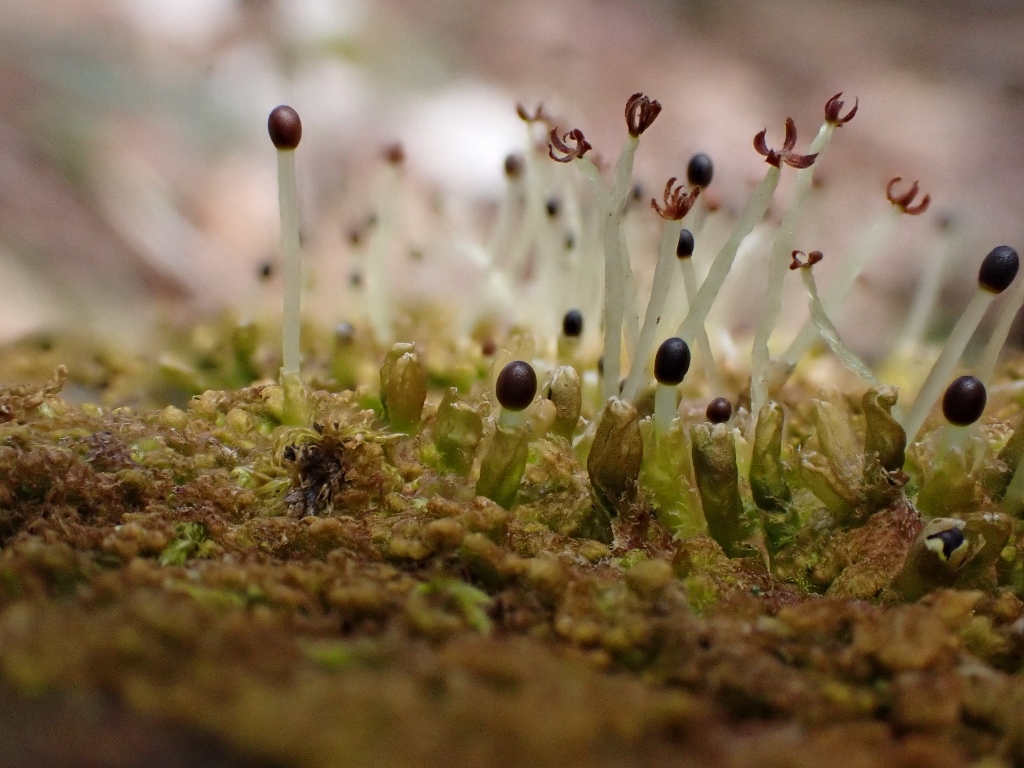
And then, a shimmer beyond the stump-castle caught my eye. From a green-draped log bristled a forest of tiny, luminous stems, like filaments of frosted glass. Each column was topped with a shiny brown head--so that they looked like magical matchsticks—and clasped at its base by a tiny cup of leaves. My eyes traveled among them on a Lilliputian safari, shrinking down to smaller than an ant in order to fit among the stems without getting soaked by glittering drops that perched here and there.


I later discovered that these were the reproductive structures of leafy liverworts. Also called scale moss, liverworts are plants whose leaves are only a single cell thick. With no structures of support, they sprawl along the surfaces of rocks, soil, and trees, often intermingling with their similar-looking, but distant relatives, the mosses.

Like mosses, liverworts reproduce through spores instead of seeds. But mosses send their spores skyward on wiry, green or brown stalks called setae; structures that keep bristling above the leaves long after their capsules have emptied into the wind. The frosted-glass look of liverwort setae belies their more ephemeral nature.

Liverwort spores mature inside their capsules while those brown globes stay nested down into the cups of leaves. Only when the spores are ripe does the seta expand and lift the capsule up just high enough to catch a breeze. Four lines of thicker cells dry unevenly, which puts stress on the shrinking tissues and bursts the capsule open.

Last spring I captured images of the opened capsules after a late snowstorm!


I spotted a few of these flower-like capsules in among the others, and admired the rust-brown color of the spores. While some spores will fall out on their own, or catch a ride on slug or beetle, some of them are ejected through the action of cells called elaters. With a spiral band of thickening, instead of the capsule’s straight lines, a single, water-filled elater cell will coil as it dries. Tighter and tighter it twists, until it tears itself free from the inside of the capsule and flings spores into the air with its sudden flight.

A day later, the translucent seta bends down and begins to melt away.

When I finally looked up from this fairy forest to rest my eyes, I was surprised to find that thousands of these little beings carpeted many of the logs in the glade. Who waved the magic wand? With my search image trained, with my brain now knowing what to look for, a whole new world had materialized in minutes.


Once I knew what I was looking for, thousands of leafy liverwort sporophytes appeared on the fallen logs. My whole walk home, I spotted them in places I'd never seen them before.
Photo by Emily Stone


Behind me, the trunk of the old hemlock tree still stood straight and tall, its rise and fall controlled by a clock much slower than that of the setae. It, too, makes little brown globes full of new life at the top of its stem. It, too, will one day crumple to the ground. And on its softening trunk, the earth will knit blankets of lush diversity.

Will you see them?


*    *    *


And here are some additional photos because I'm now obsessed with these little "spring ephemerals"...


Emily’s award-winning second book, Natural Connections: Dreaming of an Elfin Skimmer, is now available to purchase at www.cablemuseum.org/books. Or order it from our friends at redberybooks.com to receive free shipping!

For more than 50 years, the Cable Natural History Museum has served to connect you to the Northwoods. The Museum is closed, but our Mysteries of the Night exhibit is available online. Connect with us on Facebook, Instagram, YouTube, and cablemuseum.org to keep track of our latest adventures in learning.