Thursday, October 28, 2021

Celebrating All Hallowtide: A Naturalist’s View of Death

“Every year we have been witness to it: how the world descends into a rich mash, in order that it may resume.”

By Mary Oliver, from “Lines Written in the Days of Growing Darkness”


Our glorious fall colors are drifting to the ground, lying thick in the woods and the edges of our yards that we’ve set aside for wild things. Their thin bodies will protect queen bees, wood frogs, and firefly larvae, and become a rich mash that feeds new growth in the spring.

These frosty leaves may be dead, but they are both food and protection for many still-living things in the ecosystem. Photo by Emily Stone.


For now, the year is transitioning toward dark days and gray thoughts. We are at the half-way point between the Autumn Equinox and Winter Solstice. Also known as a “cross-quarter day,” many cultures believe that October 31 and November 1 are days when the boundary between this world and the next is more easily crossed. As plants senesce, insects freeze, and hunting seasons begin, death surrounds us.

My identity as a naturalist informs the way I think about the world more than any other influence. Naturalists seek to observe the interconnected relationships between living and non-living beings so we can understand the past, present, and future of our local and cosmological environments. It is within this framework that I think about death, reincarnation, and everlasting life.

When my dear Aunt Nan died, a poem called “Wings” by Mary Oliver became a comfort to me. It is about a great blue heron. The last lines are: “my bones knew something wonderful about the darkness--and they thrashed in their cords, they fought, they wanted to lie down in that silky mash of the swamp, the sooner to fly.”

Poems are often metaphors, filled with symbolism, but as a naturalist I recognize the truth in these words. Swamps are cradles of both decomposition and of new life. If Nan, I, or anyone were to lie down in “that silky mash of the swamp,” efficient teams of bacteria would dismantle our bodies bit by bit back into their component parts, and they would get passed, bit by bit, up the food chain. Soon, they might become part of a heron. And when those powerful wings rise into the sky, atoms who were once part of our bodies rise, too.

Of course, if you ask Nan, the wings that carry her skyward belong to a dragonfly. Nan told us that she would come back as a dragonfly, or rather, as ALL dragonflies. By giving us this touchstone, Nan ensured that she’d continue to be present in our hearts and minds.

This concept is well stated by the Greek philosopher Pericles, whose quote is in the sympathy cards I always keep on-hand. He said: “What you leave behind is not what is engraved in stone monuments, but what is woven into the lives of others.” This strikes a deep chord with me. Naturalists are often teachers, protectors of landscapes, and planters of flowers and trees. All of those actions have impacts far into the future. We live on as long as our actions ripple out into the world.

Life and death, creation and destruction, are intertwined in the web of the Universe, as seen in these backlit leaf veins. Photo by Emily Stone.


I was never an astronaut-aspiring space kid, but I did become enthralled with stars once I learned that they, like us, are born and die. Stars arise from clouds of dust, where gravity brings the particles together. Mass builds and gravity increases until hydrogen atoms smashing into each other combine to form helium. Nuclear fusion begins, light shines, and a star is born.

As the star ages and becomes a red giant, helium fuses into carbon, oxygen, nitrogen, magnesium, and eventually iron. But where does the rest of the periodic table come in? Those elements can’t be created during a star’s life. They are conceived during its death.

The heat and energy involved in a large star’s death—in a supernova—are enough to synthesize many more elements, which are all hurled into space to form a supernova remnant, also called a nebula. Nebulas are the birthplaces of stars, and also of planets like Earth. The atoms who coalesced to form the Earth now cycle endlessly through her rocks, her air, her water, and her life. We literally are made of stardust.

This story is reenacted over and over in nature. There can be no creation without destruction.

So, from a Naturalist’s point of view…from a worldview filled with connections and joyful reciprocity: Our veins course with stardust. Our muscles are built from venison. Our lungs converse with maples trees. Our bones swirl through the mud with herons. With every breath, with every bite, we are intimately connected with all the atoms on Earth. When we think like naturalists; when we allow ourselves to be woven into the web; then, as Mary Oliver writes: “life is real, and pain is real, but death is an imposter.”

May you find connection on this All Hallowtide.


Note: This article is a revision of one published last year at this time. 

You can also view a video version of these ideas!


Emily’s award-winning second book, Natural Connections: Dreaming of an Elfin Skimmer, is now available to purchase at www.cablemuseum.org/books and at your local independent bookstore, too.

For more than 50 years, the Cable Natural History Museum has served to connect you to the Northwoods. The Museum is now open with our exciting Mysteries of the Night exhibit. Follow us on Facebook, Instagram, YouTube, and cablemuseum.org to see what we are up to.

Thursday, October 21, 2021

A Spooky Walk with Extra Legs

Shuffling restlessly around the house, I needed to do something else before bed. Scrub the sink? Nah. Read? I’d just fall asleep. I looked out the windows: dark. Thick clouds obscured both stars and moon. But darkness in the woods hasn’t scared me for years, not since I had to swallow my own hesitations and put on a brave face to lead night hikes for kids at camp. We hooted for owls, played tricks with our night vision, tested our hearing, and experimented with smells. (I love night hikes so much that we offer them by request through the Museum!)

Eventually I got so comfortable that I could walk across camp with no yard lights, no flashlight, and no moon. I’d feel the gravel road under my feet, sense the opening in the forest at my turn, find the firm path through the woods, and let the soft duff warn me if I strayed off the edge.

To preserve my comfort in the dark, I shield myself entirely from horror movies and sinister mysteries. Nothing could entice me to watch the Blair Witch Project. I cover my eyes during the previews.

Now the main threats to my night explorations are simply adulting and going to bed early. Last night that restlessness got me out the door.

Instead of going entirely without light, I decided to bring my UV flashlight and camera along. Night is all about using different senses. The UV flashlight interacts with our dominant sense of vision, but it also allows us to see the word in a different way.

Near a stump, the striated flesh of decaying mushrooms glowed blue. As I rested my hand to stabilize the camera, slimy, cold fungal goo oozed between my knuckles. Ew. Nearby, the chlorophyll in moss fluoresced with a deep blood-red. The knobby twig of a hemlock tree arched across spiky moss tufts like a tiny backbone. Who needs a haunted house when you’ve got the woods?

A spine-like hemlock twig rests on moss that is fluorescing blood red. Taken using a 365nm UV flashlight. Photo by Emily Stone.


Near another stump, a decaying lump of white fungus—once a choice edible called abortive entoloma—glowed pink and blue from spots of mold. The entoloma by itself is a boring gray mushroom. But when it attacks a nearby species of honey fungus, their bodies merge to form a tasty white nugget nicknamed “shrimp of the woods.” Fungi eating fungi eating fungi. How does that compare to a zombie apocalypse?

Sometimes called “shrimp of the forest,” abortive entolomas are choice edible mushrooms…except when they are covered in mold that fluoresces pink and blue. Taken using a 365nm UV flashlight. Photo by Emily Stone.


Most of these finds are cryptic and the colors faint. I have to hold both the UV flashlight and my face close to the ground in order to experience all of the shades and textures. Occasionally, though, a shimmering specter reflects my beam. Such was the case with a small white mushroom—not parasitized or molding—but displayed regally in a little alcove like a ghost bride in her gown. I snapped a dozen glamour shots of this beauty, playing with the angle of light to maximize the glow.

This tiny mushroom glowed like a ghost bride. Taken using a 365nm UV flashlight. Photo by Emily Stone.


With my nose still near the mossy bank, I spotted something blue under a soil overhang. Copper in their blood makes slugs fluoresce a beautiful bluish green. But near the legless slug I spotted something else also glowing faintly blue. Hundreds of creepy legs tickled the moss as the millipede burrowed away from my light. It must have hit a roadblock, though, and two segmented antennae poked out again from behind a lichen flap, followed by the rounded head. As I watched it crawl away, the graceful, sequential motion of the legs reminded me of a witch’s fingers as she casts a spell.


Millipedes go back farther than witches, though. 400 million years ago, when oxygen levels were higher, their ancestors grew to be six feet long! That’s as close to a horror movie as I need to get.

They may look scary, but millipedes don’t bite. They mostly shred up rotting leaves and assist with decomposition in the soil. They won’t slime you like a slug. They don’t have 1,000 legs, but they do have two pairs of legs per abdominal segment, as compared to centipede’s single pair. And, if I’d been a little more intrusive with my light, their genitalia fluoresce in unique colors that give scientists an easier way to tell apart the purported 70,000 species worldwide.

I often say that I’m not interested in writing fiction because Nature has already come up with plenty of good stories I can tell. The same goes for fictional horror films, I guess. Who needs fake monsters when the ones along my driveway give me that same thrill? Creepy, slimy, gross, and also fascinating, beautiful, and part of a healthy ecosystem.

Feeling restless with the early dark? Take a night hike and let Nature be your Halloween!


Emily’s award-winning second book, Natural Connections: Dreaming of an Elfin Skimmer, is now available to purchase at www.cablemuseum.org/books and at your local independent bookstore, too.

For more than 50 years, the Cable Natural History Museum has served to connect you to the Northwoods. The Museum is now open with our exciting Mysteries of the Night exhibit. Follow us on Facebook, Instagram, YouTube, and cablemuseum.org to see what we are up to.

Thursday, October 14, 2021

Flights of Fall in the Boundary Waters

Thick, gray clouds still hung low over the glassy lake, but in the west, a sliver of clear sky had begun to show above the dark trees. All day, the air had been so damp that rain gear was needed, even though drops never coalesced enough to fall. It had felt like a typical day in the Boundary Waters Canoe Area Wilderness as we paddled and portaged into a pink granite campsite on the Kawishiwi River.

(This was during the 10 minutes of sun you'll read about in a minute!)


With the pots washed and firewood gathered, we picked up books and journals to relax. I was immediately distracted by a flock of active locals twittering between a tall white pine and a thicket of baby birch. Chickadees scolded and gurgled at each other in the hierarchy of a relatively new winter flock. Even-smaller birds with drab feathers and faint white wingbars kept up a constant chatter of tsee-tsee-tsee. It’s a wonder that these golden-crowned kinglets can survive Northwoods winters. They do it by feeding frantically on cryptic caterpillars all day, then diving into cover with their friends at dark and sharing body heat all night.

Then, out over the lake and behind a pine, a different flock—maybe juncos?—darted from left to right in fish-school formation. One bird was slightly bigger than the rest, with sharp wings and a dark body. “Merlin!” I gasped, as the flock escaped, and the falcon swooped up to perch at the top of a birch tree nearby. I grabbed for my camera, but when I looked up, he was gone.

Merlins are small falcons who specialize in hunting smaller birds, like this blue jay, on the wing. Photo by John Harrison, Wikimedia Commons.


I was surprised to see this little raptor still migrating through. I would have guessed that they head south in early fall like their smaller cousins, American Kestrels. But when I checked the raptor count data from Hawk Ridge in Duluth, I found that merlins migrate later, with the highest ever number of individuals recorded on October 9, 1997. In contrast, kestrels’ record high was September 9.

Otherwise, the behavior we witnessed was exactly what I’d expect. Those pointed wings are built for the speed and maneuverability that merlins need for hunting songbirds on the wing. A species of prairies as well as boreal lakes and forests, merlins have done the opposite of cardinals and have used city habitats to begin breeding farther south. This range expansion has likely helped to fuel their recovery from declines caused by DDT contamination in the 1960s.

Before I could settle back into my book, the sun emerged below the edge of the weather front. For ten minutes, the campsite glowed, the trees lit up, and the water sparkled in the only sunshine of the day. Then the trees swallowed it up, and the world turned orange. The colors from those last moments of sunset seemed to pour themselves into our fire grate, and we roasted s’mores while the stars came out.


Thick morning fog gave the world an eerie look, but it burned off around lunchtime. As we prepared to pull away from shore after a portage, the darting flights of dragonflies caught my eye. Dragonflies? In October?


One couple paused for a break on my pantleg...


Each of the male autumn meadowhawk dragonflies was using an appendage at the tip of his abdomen to grasp a brown female meadowhawk by the back of her head. This tandem position indicates that they’ve already mated, and now he’s guarding her to make sure that no other male horns in. As I watched, the pairs dipped low enough to touch her abdomen to the water. Then, to my horror, they rose up and seemed to whack her abdomen against rocks emerging from the water.


Over and over the pairs dipped, whacked, and repeated this behavior, with half a dozen couples visible in my camera’s viewfinder. I’ve read that dragonfly females are often injured during the mating process, but this seemed extreme. When I posted my video and question in the Wisconsin Dragonfly Society’s Facebook group, member Jim Johnson explained that the female dragonfly picks up a drop of water, extrudes eggs into it, and then shakes the eggs loose by slamming into a rock.

Other resources mentioned alternating between water and mud, and also that eggs are often laid in shallow water, deep water, and on land. All of these options have tradeoffs, but the main goal is to reduce the number of eggs that fish eat, and to make sure some of the eggs survive the winter, no matter which habitat faces the most challenges in that particular year.

Over and over, I read that autumn meadowhawks are aptly named for having the latest flight period of any Northwoods dragonfly. If we continue without hard frosts, they could be seen into November.

The forecast continues to be unseasonably warm, and perfect for canoeing. While this triggers a bit of worry about our changing climate, I’m grateful to have squeezed in this late-season trip, and have witnessed some of the last flights of fall.


Emily’s award-winning second book, Natural Connections: Dreaming of an Elfin Skimmer, is now available to purchase at www.cablemuseum.org/books and at your local independent bookstore, too.

For more than 50 years, the Cable Natural History Museum has served to connect you to the Northwoods. The Museum is now open with our exciting Mysteries of the Night exhibit. Connect with us on Facebook, Instagram, YouTube, and cablemuseum.org to see what we are up to.

Bonus photos!


Thursday, October 7, 2021

Save the Bees with a Messy Garden

The activity of bumble bees in the Museum’s pollinator gardens has continued to distract me through my office windows on warm afternoons. But bumble bees aren’t the only bees out there; the other bees are just hidden.

Of the 166 species of bees who are native to Northwestern Wisconsin, approximately 70% nest in the ground, and 30% nest in tiny holes in wood, hollow twigs and stems, or other above-the-ground cavities. While bumble bees are part of that first group, little cuties like blue orchard mason bees, small carpenter bees, and masked bees don’t have the large body size and warm fuzz that allow bumble bees to fly in cooler temperatures. They may already be snuggled cozily into burrows or hollow stems hidden in the garden…

...Or wish they were. On last week’s hike when I spotted dozens of bumble bees, I also snapped photos of a metallic green small carpenter bee in the clutches of a northern crab spider. She was likely a mother bee who had spent the summer laying and provisioning eggs in a hollow stem, and then standing guard at the nest entrance to ward off parasites.


I never would have spotted this small carpenter bee if the northern crab spider hadn’t grabber her and held her still for me! These small bees build their nest in hollow plant stems. Photo by Emily Stone.


Even with her vigilance against invaders, the survival of her children and grandchildren truly depends on hollow plant stems left standing after they die. And this is where gardeners can help.

In the warm, dry, mosquito-free afternoons of autumn, it’s tempting to look for ways to stay outside longer. Often that means “cleaning up” the gardens. I’ll tear out my tomatoes, clear the bean vines off the trellis, and make sure that there is no disease-carrying residue left in my plot. In your flower gardens, though, especially if you’ve planted native, perennial species with the bees and butterflies in mind, it’s best to leave the flower stalks alone.

As I was cleaning up my plot in the Cable Community Farm last week, I paused to chat with a volunteer taking care of the pollinator plantings around the edge. She was carefully snipping off bergamot stems in order to get at the weeds more easily. We chatted for a minute about the best ways to support pollinators, and I reminded her that many bees need these stems for nesting. “But I’ve been working with flowers all my life,” she expressed in confusion, “and I’ve never seen any signs of a bee nesting in any of the stems!” I had to admit that I’d never seen a bee nest in a stem either, and so I went home to do more research.

The Xerces Society, which works for insect and pollinator conservation, put together a wonderful guide to “Nesting and Overwintering Habitat for Pollinators and other Beneficial Insects.” They explain that bees don’t nest in the growing stems, they nest in last year’s stems that are dry, hollow, and snipped off in early spring to expose an opening.

The time to cut back your dead flower stalks is early spring, just before bees begin to look for new nest sites. Photo by Emily Stone.


The 12-page, illustrated resource lays out a nice timeline for gardeners. First, don’t cut down your flower stalks in the fall! Birds and other critters will eat the seeds. The structure will also help create insulating air spaces in the subnivean zone, a layer between ground and snow where many living things survive the winter. Plus, those seed heads are picturesque when capped by snow.

These bergamot seed heads were left up in the Museum’s pollinator gardens and provided both blossoms of snow through the winter and bee nesting sites in the spring. Lois Nestel, the Museum’s founding director, wrote, “Most people are aware of the beauty of summer flowers and often bemoan their passing as winter approaches. This need not be a cause for regret because, while much color may be lost, there continue—as seeds, pods, and capsules—many forms that rival the flowers in beauty and grace.” Photo by Emily Stone.


Early next spring, before it warms up, is the time to prune the stalks. If you cut the stalks at a variety of heights, from 8 inches up to 24, then the resulting cavities will be different diameters, and you can support a higher diversity of bees. Pruning shrubs at the same time can also open doors to new nest sites, because carpenter bees can excavate the soft center pith and create a tunnel.

By summer, new growth will hide those dead, brown stalks, and bees will love having nectar and pollen sources so close to home. Solitary bees aren’t aggressive, and only sting if you accidentally squash one, so you don’t need to worry that encouraging them puts you or kids in danger.

What next? Well, nothing. Protecting bees is easy for lazy gardeners! If all goes well, the stems you snip off next spring will fill up with baby bees, who will also spend next winter there, and some species may not emerge until late the following summer. The stems will naturally fall over after a few years and add to the litter on the ground—which benefits both plants and insects.

Could you just put up a bee house instead? In recent years, both Etsy crafters and manufacturers have put many of these cute contraptions on the market. They often consist of holes drilled in wood, or a case filled with something like hollow bamboo. The problem, according to some scientists, is that these homes aren’t cleanable. When they are left up year after year, diseases and parasites move in, and kill any bees who attempt to nest there. They can be actively harmful instead of helpful. At the Museum, our bee cabinets can be opened, and are cleaned out every couple years. In your garden, the cut stems will naturally fall over as new stems grow, so you never have to worry about cleaning them!

With this information, native bee and flower lovers can drop those shears, step away from the garden, and go for a beautiful fall hike instead!


Emily’s award-winning second book, Natural Connections: Dreaming of an Elfin Skimmer, is now available to purchase at www.cablemuseum.org/books and at your local independent bookstore, too.

For more than 50 years, the Cable Natural History Museum has served to connect you to the Northwoods. The Museum is now open with our exciting Mysteries of the Night exhibit. Connect with us on Facebook, Instagram, YouTube, and cablemuseum.org to see what we are up to.


Thursday, September 30, 2021

Fuzzy Bees Fattening Up

My office window looks out onto the Museum’s backyard and the pollinator gardens that grow there in tousled abundance. Wildflower season peaked weeks ago, but gems of color still glint in the afternoon sunshine. Once-fragrant bergamot has dried into tufty brown seed heads, but the golden petals of black-eyed Susans and lance-leaved coreopsis contrast nicely with the frilly purple petals of asters. Those complementary colors are more beautiful—and more attractive to bees—than either on their own.

And, despite chilly nights and damp mornings, there are still bees. I’m watching them fly busily on their rounds as I write this, actually. We’re all reveling in the afternoon sunshine. Earlier this morning, I shuffled through damp grass to see how they were doing, and to observe the insects when they were too cold to zoom away. Sure enough, I found a few fuzzy bumble bees clinging to the tufts of pollen-coated anthers like sleepy toddlers. These bees aren’t young’uns, though; they are nearing the end of their lives.

Have you ever watched a bumble bee breathing?


Bumble bees are one of the only types of native bees who form a colony—similar to honey bees—where a single queen produces 50 to 500 worker bees. She laid eggs all summer. The first round she fed and raised herself. In five weeks, those eggs hatched into larvae, pupated, and metamorphosed into adults. A few days after reaching maturity, that first generation took over care and feeding of their sisters. More bees could raise more bees, building on the colony’s success until the ultimate test this fall.

That test? Raising a set of new queens who are built to survive the winter. First, the old queen begins to lay unfertilized eggs. These will grow into male drone bees whose one job before they die is to fertilize females from a different colony. The act of laying unfertilized eggs triggers the queen to stop producing a particular pheromone. With that pheromone gone, the workers change their behavior, and start raising the fertilized eggs not as worker females, but as new queens.

I was hoping to find one of those new queens on my little backyard safari, but armed with a millimeter ruler, I only found 16 mm long common bumble bee workers (Bombus impatiens). Queens are at least 17 mm, according to the literature. These workers must still be seeking provisions for their colony, in a race against the frost. Not all nests get their timing right, and some succumb to killing cold or starvation before they can send their reproductive generation into the world.


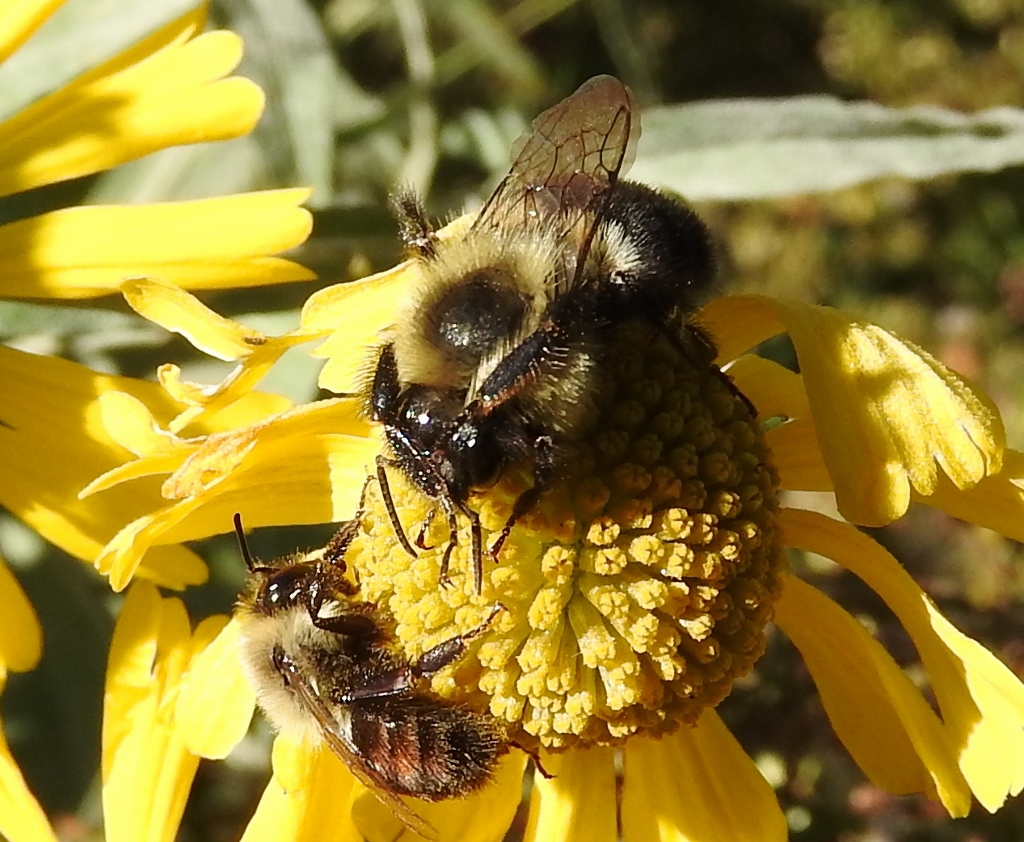
The larger bee on the left is a new queen common bumble bee who is storing up fat for hibernation. The smaller bee on the right is a worker, who will take pollen and nectar home to the colon to feed any remaining larvae until the metamorphose into the reproductive generation of drones and queens. They are both enjoying resources from common sneezeweed, a native aster. Photo by Emily Stone.


To be successful, a new queen must stuff herself on nectar and pollen to build up fat stores for hibernation, the same way grizzly bears in Alaska bulk up to compete in Fat Bear Week in Katmai National Park. For a male drone to be successful, he just needs to stay alive long enough to mate with a female. He dies. She digs in for a long, cold winter.

This is different from honey bees, whose sugary stores allow the hive to survive the winter.

Bumble bees, like many tiny critters, endure the off-season in shallow, soil burrows protected by fallen leaves and eventually by an insulating blanket of snow. As I poked around looking for more bees, I was happy to see a tangle of dead leaves and stems in the pollinator garden. They will insulate the plants’ roots, and keep uncountable critters cozy through the drastic temperature swings and freezing cold. Yards that are too “clean” provide little shelter for our wild neighbors, and something as simple as not tidying up our gardens can save thousands of little lives.

Uploading my photos, I used iNaturalist to identify them, and also checked bugguide.net. I learned that male common bumble bees have yellow goatees, and females have black faces. I also discovered that a few common bumble bees have rusty brown abdomens instead of black.

A male common bumble bee with his blond facial hair. The cold temps make it way easier to get this close! He held very still... Photo by Emily Stone. 


And here, I’ll pull back the curtain a little bit. I wrote this much on one day, and then headed out on a geology field trip before finishing the article. On my way home, I decided to hike St. Peter’s Dome to catch peak fall colors from that spectacular viewpoint.

The view from St. Peter's Dome.


Right where the trail starts, the Forest Service had planted a profusion of asters and goldenrod who were receiving the full force of the low afternoon sun. And on those flowers were more bumble bees that I’ve ever seen at one time. More than twenty crawled on a single plume of goldenrod.


By the time I hiked back down from the view (spectacular!) the sun had set and temperatures had dipped to 55 degrees. Now the bees were clinging to the flowers wherever they’d last been feeding, their muscles slowed and paralyzed by the chill. This made them much easier to photograph! I found a large queen with a yellow mane of fuzz, many smaller workers, and several males with their yellow goatees. I even spotted a worker with the rusty stripes. Two hundred photos later, I finally headed home.

Here's a rusty-phase worker on the left, and a new queen common bumble bee on the right. On sneezeweed. Photo by Emily Stone.


This is a perfect example of why I love writing about seasonal events as they happen. Without having done some research on the handful of bees in our pollinator gardens, I wouldn’t have known what I was looking at when I found the profusion of bees along the trail. These coincidences bring me joy—and I hope they enhance your enjoyment of nature, too!


Just two dudes enjoying a hot pink aster! Photo by Emily Stone.


Emily’s award-winning second book, Natural Connections: Dreaming of an Elfin Skimmer, is now available to purchase at www.cablemuseum.org/books and at your local independent bookstore, too.

For more than 50 years, the Cable Natural History Museum has served to connect you to the Northwoods. The Museum is now open with our exciting Mysteries of the Night exhibit. Connect with us on Facebook, Instagram, YouTube, and cablemuseum.org to see what we are up to.


Bonus photos! I also spotted this crab spider eating a sweat bee. Focus on the spider.


Here the focus is on the bee.


Thursday, September 16, 2021

How to Photograph Cute Baby Animals

Opening emails is not usually exciting. But as each message loaded and revealed photos of baby animals—each one more adorable than the last—my heart soared. I could already tell that the Museum’s Northwoods Animal Babies Photo Contest had been a success.

I compiled the photos in a single folder and sent it off to James Netz, a professional photographer with a gallery in Hayward, who has been sponsoring photo contests at the Museum off and on for many years. James also gets the unenviable job of picking just three winners from around a hundred wonderful entries.

When I sent an email to the participants, Bonnie Chase wrote back with a quick story about her photo of a hidden fawn looking up out of the garden with big, dark eyes. Her enthusiasm was contagious:

“It was a once in a lifetime shot of the little sweetie! On an early summer morning, my eye caught sight of a doe and her wobbly legged fawn walking across our hillside. When Mama stopped at the edge of the woods, the fawn tucked itself into some shrubs. Mama left after a few minutes, but I waited an hour before checking on the fawn. The little sweetie had found a cool spot on a hot day with a great view of the lake, staying there all day, until Mama came back hours later. She’s enjoyed eating my petunias ever since.”


Photo by Bonnie Chase


After I finished laughing about Bonnie’s petunias, I asked the other participants for their stories, too.

Some people mentioned using their knowledge of wildlife—gained from years of observation—to be there at the right moment. William Johnson wrote, “Knowing that deer with fawns will leave them and move away, I quietly watched the area for a few minutes, and this little guy stood up to stretch.”

Photo by William Johnson


Many photographers emphasized the importance of spending time in nature.

“A majority of my wildlife photography is simply based on good luck, good informants, and always having the camera with me,” wrote Monica Edeker. Susan Overson agreed. In early spring, she kayaks near the Namekagon Dam every day to “watch for nests, adults, and their young, and quietly observe and photograph wildlife at various stages of development.”

Photo by Susan Overson


Kris Dew was simply driving her pontoon across the lake to put it into winter storage, when, as she “drifted with one eye on the launch, this young loon kept popping up from under my boat. Was he fishing or taunting me? We enjoyed this game for 45 minutes. Amazing!”

Photo by Kris Dew


Monica emphasized her point with a story about traipsing into a cornfield in her good clothes on the way home from work to get photos of fox kits playing. “A couple kits were braver than the others and posed while I snapped away with the camera,” she recalled.

Photo by Monica Edeker


In another encounter with foxes, Bill Thornley embodied the respectful attitude that wildlife photographers must have toward their subjects. “Their mother barked nervously in the distance, so I snapped a few photos and quickly moved along. I didn’t want to disturb her anymore.” Photographing baby animals without impacting their behavior is as challenging as it is important!

Photo by Bill Thornley


As a professional photographer, James Netz will go to some extra lengths to get great photos. “I love to shoot images of owls,” he told me. And one encounter with a great horned owlet “was particularly special because while I was shooting images of it, with its parent and sibling, it decided it was time to fledge from the branch it shared with the rest of its family.” This created a few minutes of chaos—both for the owls, and for James’s camera angles. In the end, the determined expression that James captured on the owlet’s face was worth it. And, he noted with relief, the owlet was able to get back in the tree safely and reunite with its family “after it had some rebellious moments of freedom.”

Photo by James Netz


Owls also play a central role in my favorite story, which comes from Leslie Sullivan. Her family was lucky enough to have great horned owls nest in the back yard when they lived in Madison, Wisconsin.

“We watched them be conceived, we found egg shells when they hatched, we dissected owl pellets, we watched them learn to fly, we saw the parents feed them, and we had a very close relationship with them from February to the end of June. I think this experience formed my young children to be nature lovers for life.”

Photo by Leslie Sullivan


Thanks to these talented photographers, we can all enjoy adorable photos that reinforce our love of nature. You can vote for your favorites in our People’s Choice Award contest, hosted on the Cable Natural History Museum’s Facebook page now through the end of September. Winners will be announced on October 1st!


(A new album of photos will be posted every Wednesday at noon and Sunday at 6:00 a.m., so keep coming back to vote for your favorites! Winners of the 6 albums will go head-to-head in the Championship Round, September 29-30. Likes = 1 point and Comments = 2 points)


And, here's one more bonus story from my editor and mentor, who is also my dad! He was the outdoor writer for the Des Moines Register for 25 years, and took photos to go with his stories. 

Photo by Larry Stone

"Instinctively triggering the shutter in reaction to a ghostly sound and shape in the darkness, it was as much luck as anything that I captured this great horned owl bringing a sora to feed its eager, half-grown babies.

Luck helps. But it took a bit of preparation as well. We were secluded in a blind atop 30 feet of scaffold. The old Nikon F (yes, this was the film days!) was synched with a borrowed, high-output, battery-operated flash. And we’d come prepared with sleeping bag, warm clothes, and food for the expected long night of hoping for “action.”

When chill and fatigue drove us back to the newspaper office, we still had to wait a day for the Ektachrome to be processed. “Eureka!” was my first reaction to the stunning image that later made the cover of the Des Moines Register’s Picture Magazine. 

Luck was with us again days later when we returned to the blind to try for more photos. With a thunderstorm approaching, we delayed our climb up the scaffold. But that climb never happened. The gusty winds dumped our blind off the tower. Fortunately, we were not in it!"
--Larry Stone


Emily’s award-winning second book, Natural Connections: Dreaming of an Elfin Skimmer, is now available to purchase at www.cablemuseum.org/books and at your local independent bookstore, too.

For more than 50 years, the Cable Natural History Museum has served to connect you to the Northwoods. The Museum is now open with our exciting Mysteries of the Night exhibit. Connect with us on Facebook, Instagram, YouTube, and cablemuseum.org to see what we are up to.

Thursday, September 9, 2021

A String of Pearls

Cool water flowed around my ankles as I peered through shifting, shimmering sun specks at the river’s surface. Small, white ovals among the gravel on the river bottom caught my eye, and I submerged my waterproof camera to get a better look. But my wrists and hands disturbed the invisible current, and the added turbulence picked up the tiny mussel shell and tumbled it downstream.

As I stood up and straightened my back, my gaze also headed downstream to where the river slid around a corner. My partner and I had stopped on this shallow gravel bar to stretch our legs during a 20-mile-long day of paddling on the Namekagon River. We’d planned this two-night trip at the last minute in order to replace our annual trip to the Boundary Waters. Due to severe drought and extreme fire danger in northern Minnesota, the entire Wilderness had been closed to visitors.


My view from the stern. 


We were used to paddling for a while and then coming to the end of the lake, unloading the canoe, launching it and our packs onto our shoulders, and portaging across rough, narrow trails into the next lake. While portages are hard, they also provide a very welcome chance to straighten our legs. Rivers don’t provide the same variety. So, after a long stretch of paddling we picked a shallow spot, swung our feet over the gunnels, and stood up.

Seeing that little shell reminded me about a staff training we’d had back in my early days at the Museum, when a National Park Ranger came and taught us about mussels. Their shells are made of calcium carbonate, which, like baking soda, helps to neutralize acids, she’d told us. In this region where so many of the lakes and wetlands that feed the Namekagon River are stained brown by tannic acids leached like tea from aquatic plants, mussel shells buffer the acidity of the river water. That’s just one reason why these sensitive little creatures, and even their shells, are protected. It is illegal to take or even move any mussel shell—even empty ones—in the St. Croix and Namekagon rivers.

Why such strict rules? Well, the Namekagon River is a National Park. It’s easy to forget since there are no entrance stations, entrance fees, or scenic drives. You don’t need permits or reservations, even to camp with in the park. The main clue is that classic arrowhead logo on brown road signs that direct paddlers to river landings, and a visitor center currently hidden in road construction near Trego.

Technically, the Namekagon River is part of the St. Croix River National Scenic Riverway. This designation (along with National Historic Sites, National Monuments, and National Recreation Areas) is administered by the National Park Service. Wisconsin Senator Gaylord Nelson grew up paddling on this river, and was instrumental in making sure that it is preserved for the enjoyment of all.

As I pondered those mussels and the people who protect them, I was filled with gratitude. We were frustrated and sad when our Boundary Waters trip became impossible, but within a few hours we had planned this new adventure super close to home. We’d chosen the river because—despite flowing near roads and through towns—the Namekagon River still provides impressive water quality and a wilderness feel.

The little mussels who speckle the river bottom are probably capable of producing pearls, although the likelihood that one actually would is extremely low. No matter, the river itself is a string of pearls.

Wildlife sightings formed little bright spots connected by the winding stream. Shallow riffles led to deep pools filled with redhorse suckers and smallmouth bass. Little green herons startled off their perches, and we chuckled at the awkward way their yellow legs hung down as they flew. They tipped up their long, rusty necks as they tried to put in as little effort as possible to maintain their invisible bubble of distance from our fleeting presence.

We also spooked bald eagles out of their piney perches, and listened to the rustle of their feathers as they pushed against the air. Ospreys soared in the clear, blue sky. An otter bobbed upright in a riffle to check us out before disappearing completely. A stately buck, with his 6-point rack still in velvet, picked his way across the wide channel in front of us.

Belted kingfishers were the most plentiful pearls on the river, and we admired their natty, blue-gray suits as they swooped from tree to tree and let loose their ratcheting cry. As usual, they made me think of Mary Oliver’s poem, The Kingfisher. At this moment in history, the most poignant line is: “I think this is the prettiest world—so long as you don't mind a little dying, how could there be a day in your whole life that doesn't have its splash of happiness?”

As thousands of acres of trees and their animal neighbors burn in Minnesota and elsewhere; hurricanes inundate the homes of humans and animals; and the Delta variant surges through communities; thoughts of death weigh heavily on our hearts and minds. Are we ok with all this dying? Not really, not most of us. And yet allowing ourselves to be crushed by the sadness can’t bring anyone back to life.

Allowing ourselves to experience that “splash of happiness” is necessary if we’re going to keep working to save the world and the people we love. Under the crush of the news, it’s going to take a regular upwelling of gratitude to protect our tender hearts.

Back in the canoe, we marveled as a diving kingfisher sent up a spray of glittering droplets.


Emily’s award-winning second book, Natural Connections: Dreaming of an Elfin Skimmer, is now available to purchase at www.cablemuseum.org/books and at your local independent bookstore, too.

For more than 50 years, the Cable Natural History Museum has served to connect you to the Northwoods. The Museum is now open with our exciting Mysteries of the Night exhibit. Connect with us on Facebook, Instagram, YouTube, and cablemuseum.org to see what we are up to.