Thursday, September 30, 2021

Fuzzy Bees Fattening Up

My office window looks out onto the Museum’s backyard and the pollinator gardens that grow there in tousled abundance. Wildflower season peaked weeks ago, but gems of color still glint in the afternoon sunshine. Once-fragrant bergamot has dried into tufty brown seed heads, but the golden petals of black-eyed Susans and lance-leaved coreopsis contrast nicely with the frilly purple petals of asters. Those complementary colors are more beautiful—and more attractive to bees—than either on their own.

And, despite chilly nights and damp mornings, there are still bees. I’m watching them fly busily on their rounds as I write this, actually. We’re all reveling in the afternoon sunshine. Earlier this morning, I shuffled through damp grass to see how they were doing, and to observe the insects when they were too cold to zoom away. Sure enough, I found a few fuzzy bumble bees clinging to the tufts of pollen-coated anthers like sleepy toddlers. These bees aren’t young’uns, though; they are nearing the end of their lives.

Have you ever watched a bumble bee breathing?


Bumble bees are one of the only types of native bees who form a colony—similar to honey bees—where a single queen produces 50 to 500 worker bees. She laid eggs all summer. The first round she fed and raised herself. In five weeks, those eggs hatched into larvae, pupated, and metamorphosed into adults. A few days after reaching maturity, that first generation took over care and feeding of their sisters. More bees could raise more bees, building on the colony’s success until the ultimate test this fall.

That test? Raising a set of new queens who are built to survive the winter. First, the old queen begins to lay unfertilized eggs. These will grow into male drone bees whose one job before they die is to fertilize females from a different colony. The act of laying unfertilized eggs triggers the queen to stop producing a particular pheromone. With that pheromone gone, the workers change their behavior, and start raising the fertilized eggs not as worker females, but as new queens.

I was hoping to find one of those new queens on my little backyard safari, but armed with a millimeter ruler, I only found 16 mm long common bumble bee workers (Bombus impatiens). Queens are at least 17 mm, according to the literature. These workers must still be seeking provisions for their colony, in a race against the frost. Not all nests get their timing right, and some succumb to killing cold or starvation before they can send their reproductive generation into the world.


The larger bee on the left is a new queen common bumble bee who is storing up fat for hibernation. The smaller bee on the right is a worker, who will take pollen and nectar home to the colon to feed any remaining larvae until the metamorphose into the reproductive generation of drones and queens. They are both enjoying resources from common sneezeweed, a native aster. Photo by Emily Stone.


To be successful, a new queen must stuff herself on nectar and pollen to build up fat stores for hibernation, the same way grizzly bears in Alaska bulk up to compete in Fat Bear Week in Katmai National Park. For a male drone to be successful, he just needs to stay alive long enough to mate with a female. He dies. She digs in for a long, cold winter.

This is different from honey bees, whose sugary stores allow the hive to survive the winter.

Bumble bees, like many tiny critters, endure the off-season in shallow, soil burrows protected by fallen leaves and eventually by an insulating blanket of snow. As I poked around looking for more bees, I was happy to see a tangle of dead leaves and stems in the pollinator garden. They will insulate the plants’ roots, and keep uncountable critters cozy through the drastic temperature swings and freezing cold. Yards that are too “clean” provide little shelter for our wild neighbors, and something as simple as not tidying up our gardens can save thousands of little lives.

Uploading my photos, I used iNaturalist to identify them, and also checked bugguide.net. I learned that male common bumble bees have yellow goatees, and females have black faces. I also discovered that a few common bumble bees have rusty brown abdomens instead of black.

A male common bumble bee with his blond facial hair. The cold temps make it way easier to get this close! He held very still... Photo by Emily Stone. 


And here, I’ll pull back the curtain a little bit. I wrote this much on one day, and then headed out on a geology field trip before finishing the article. On my way home, I decided to hike St. Peter’s Dome to catch peak fall colors from that spectacular viewpoint.

The view from St. Peter's Dome.


Right where the trail starts, the Forest Service had planted a profusion of asters and goldenrod who were receiving the full force of the low afternoon sun. And on those flowers were more bumble bees that I’ve ever seen at one time. More than twenty crawled on a single plume of goldenrod.


By the time I hiked back down from the view (spectacular!) the sun had set and temperatures had dipped to 55 degrees. Now the bees were clinging to the flowers wherever they’d last been feeding, their muscles slowed and paralyzed by the chill. This made them much easier to photograph! I found a large queen with a yellow mane of fuzz, many smaller workers, and several males with their yellow goatees. I even spotted a worker with the rusty stripes. Two hundred photos later, I finally headed home.
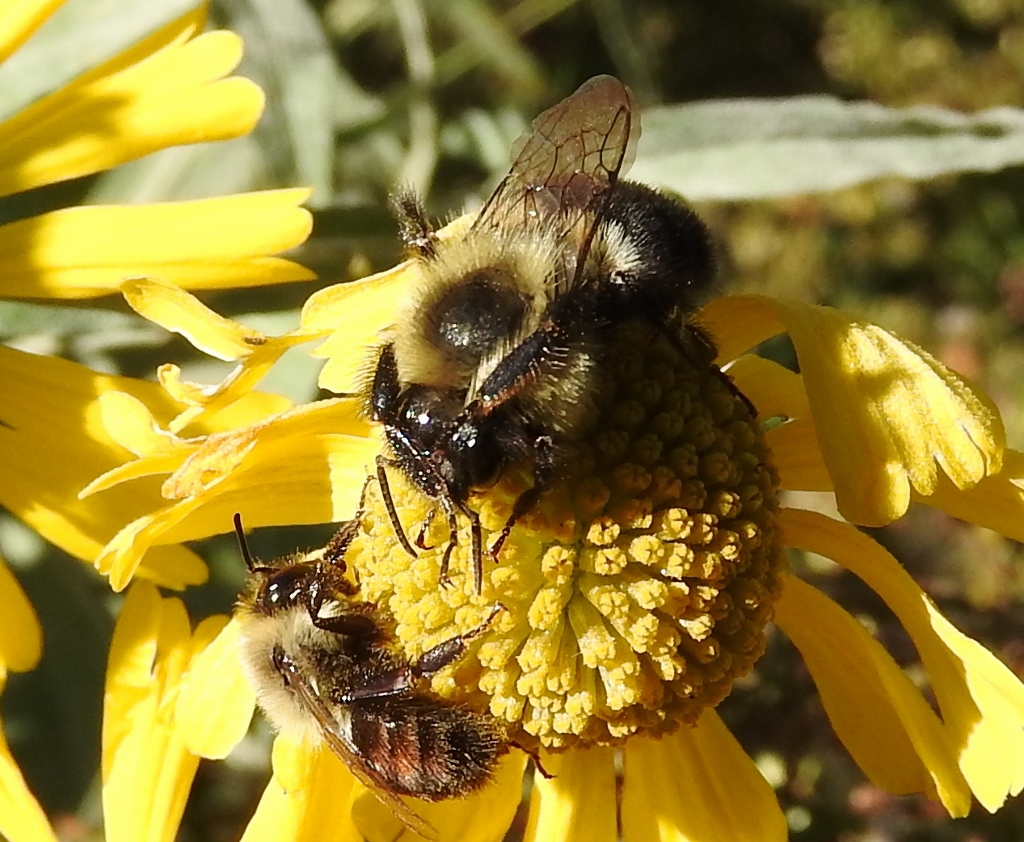
Here's a rusty-phase worker on the left, and a new queen common bumble bee on the right. On sneezeweed. Photo by Emily Stone.


This is a perfect example of why I love writing about seasonal events as they happen. Without having done some research on the handful of bees in our pollinator gardens, I wouldn’t have known what I was looking at when I found the profusion of bees along the trail. These coincidences bring me joy—and I hope they enhance your enjoyment of nature, too!


Just two dudes enjoying a hot pink aster! Photo by Emily Stone.


Emily’s award-winning second book, Natural Connections: Dreaming of an Elfin Skimmer, is now available to purchase at www.cablemuseum.org/books and at your local independent bookstore, too.

For more than 50 years, the Cable Natural History Museum has served to connect you to the Northwoods. The Museum is now open with our exciting Mysteries of the Night exhibit. Connect with us on Facebook, Instagram, YouTube, and cablemuseum.org to see what we are up to.


Bonus photos! I also spotted this crab spider eating a sweat bee. Focus on the spider.


Here the focus is on the bee.


Thursday, September 16, 2021

How to Photograph Cute Baby Animals

Opening emails is not usually exciting. But as each message loaded and revealed photos of baby animals—each one more adorable than the last—my heart soared. I could already tell that the Museum’s Northwoods Animal Babies Photo Contest had been a success.

I compiled the photos in a single folder and sent it off to James Netz, a professional photographer with a gallery in Hayward, who has been sponsoring photo contests at the Museum off and on for many years. James also gets the unenviable job of picking just three winners from around a hundred wonderful entries.

When I sent an email to the participants, Bonnie Chase wrote back with a quick story about her photo of a hidden fawn looking up out of the garden with big, dark eyes. Her enthusiasm was contagious:

“It was a once in a lifetime shot of the little sweetie! On an early summer morning, my eye caught sight of a doe and her wobbly legged fawn walking across our hillside. When Mama stopped at the edge of the woods, the fawn tucked itself into some shrubs. Mama left after a few minutes, but I waited an hour before checking on the fawn. The little sweetie had found a cool spot on a hot day with a great view of the lake, staying there all day, until Mama came back hours later. She’s enjoyed eating my petunias ever since.”


Photo by Bonnie Chase


After I finished laughing about Bonnie’s petunias, I asked the other participants for their stories, too.

Some people mentioned using their knowledge of wildlife—gained from years of observation—to be there at the right moment. William Johnson wrote, “Knowing that deer with fawns will leave them and move away, I quietly watched the area for a few minutes, and this little guy stood up to stretch.”

Photo by William Johnson


Many photographers emphasized the importance of spending time in nature.

“A majority of my wildlife photography is simply based on good luck, good informants, and always having the camera with me,” wrote Monica Edeker. Susan Overson agreed. In early spring, she kayaks near the Namekagon Dam every day to “watch for nests, adults, and their young, and quietly observe and photograph wildlife at various stages of development.”

Photo by Susan Overson


Kris Dew was simply driving her pontoon across the lake to put it into winter storage, when, as she “drifted with one eye on the launch, this young loon kept popping up from under my boat. Was he fishing or taunting me? We enjoyed this game for 45 minutes. Amazing!”

Photo by Kris Dew


Monica emphasized her point with a story about traipsing into a cornfield in her good clothes on the way home from work to get photos of fox kits playing. “A couple kits were braver than the others and posed while I snapped away with the camera,” she recalled.

Photo by Monica Edeker


In another encounter with foxes, Bill Thornley embodied the respectful attitude that wildlife photographers must have toward their subjects. “Their mother barked nervously in the distance, so I snapped a few photos and quickly moved along. I didn’t want to disturb her anymore.” Photographing baby animals without impacting their behavior is as challenging as it is important!

Photo by Bill Thornley


As a professional photographer, James Netz will go to some extra lengths to get great photos. “I love to shoot images of owls,” he told me. And one encounter with a great horned owlet “was particularly special because while I was shooting images of it, with its parent and sibling, it decided it was time to fledge from the branch it shared with the rest of its family.” This created a few minutes of chaos—both for the owls, and for James’s camera angles. In the end, the determined expression that James captured on the owlet’s face was worth it. And, he noted with relief, the owlet was able to get back in the tree safely and reunite with its family “after it had some rebellious moments of freedom.”

Photo by James Netz


Owls also play a central role in my favorite story, which comes from Leslie Sullivan. Her family was lucky enough to have great horned owls nest in the back yard when they lived in Madison, Wisconsin.

“We watched them be conceived, we found egg shells when they hatched, we dissected owl pellets, we watched them learn to fly, we saw the parents feed them, and we had a very close relationship with them from February to the end of June. I think this experience formed my young children to be nature lovers for life.”

Photo by Leslie Sullivan


Thanks to these talented photographers, we can all enjoy adorable photos that reinforce our love of nature. You can vote for your favorites in our People’s Choice Award contest, hosted on the Cable Natural History Museum’s Facebook page now through the end of September. Winners will be announced on October 1st!


(A new album of photos will be posted every Wednesday at noon and Sunday at 6:00 a.m., so keep coming back to vote for your favorites! Winners of the 6 albums will go head-to-head in the Championship Round, September 29-30. Likes = 1 point and Comments = 2 points)


And, here's one more bonus story from my editor and mentor, who is also my dad! He was the outdoor writer for the Des Moines Register for 25 years, and took photos to go with his stories. 

Photo by Larry Stone

"Instinctively triggering the shutter in reaction to a ghostly sound and shape in the darkness, it was as much luck as anything that I captured this great horned owl bringing a sora to feed its eager, half-grown babies.

Luck helps. But it took a bit of preparation as well. We were secluded in a blind atop 30 feet of scaffold. The old Nikon F (yes, this was the film days!) was synched with a borrowed, high-output, battery-operated flash. And we’d come prepared with sleeping bag, warm clothes, and food for the expected long night of hoping for “action.”

When chill and fatigue drove us back to the newspaper office, we still had to wait a day for the Ektachrome to be processed. “Eureka!” was my first reaction to the stunning image that later made the cover of the Des Moines Register’s Picture Magazine. 

Luck was with us again days later when we returned to the blind to try for more photos. With a thunderstorm approaching, we delayed our climb up the scaffold. But that climb never happened. The gusty winds dumped our blind off the tower. Fortunately, we were not in it!"
--Larry Stone


Emily’s award-winning second book, Natural Connections: Dreaming of an Elfin Skimmer, is now available to purchase at www.cablemuseum.org/books and at your local independent bookstore, too.

For more than 50 years, the Cable Natural History Museum has served to connect you to the Northwoods. The Museum is now open with our exciting Mysteries of the Night exhibit. Connect with us on Facebook, Instagram, YouTube, and cablemuseum.org to see what we are up to.

Thursday, September 9, 2021

A String of Pearls

Cool water flowed around my ankles as I peered through shifting, shimmering sun specks at the river’s surface. Small, white ovals among the gravel on the river bottom caught my eye, and I submerged my waterproof camera to get a better look. But my wrists and hands disturbed the invisible current, and the added turbulence picked up the tiny mussel shell and tumbled it downstream.

As I stood up and straightened my back, my gaze also headed downstream to where the river slid around a corner. My partner and I had stopped on this shallow gravel bar to stretch our legs during a 20-mile-long day of paddling on the Namekagon River. We’d planned this two-night trip at the last minute in order to replace our annual trip to the Boundary Waters. Due to severe drought and extreme fire danger in northern Minnesota, the entire Wilderness had been closed to visitors.


My view from the stern. 


We were used to paddling for a while and then coming to the end of the lake, unloading the canoe, launching it and our packs onto our shoulders, and portaging across rough, narrow trails into the next lake. While portages are hard, they also provide a very welcome chance to straighten our legs. Rivers don’t provide the same variety. So, after a long stretch of paddling we picked a shallow spot, swung our feet over the gunnels, and stood up.

Seeing that little shell reminded me about a staff training we’d had back in my early days at the Museum, when a National Park Ranger came and taught us about mussels. Their shells are made of calcium carbonate, which, like baking soda, helps to neutralize acids, she’d told us. In this region where so many of the lakes and wetlands that feed the Namekagon River are stained brown by tannic acids leached like tea from aquatic plants, mussel shells buffer the acidity of the river water. That’s just one reason why these sensitive little creatures, and even their shells, are protected. It is illegal to take or even move any mussel shell—even empty ones—in the St. Croix and Namekagon rivers.

Why such strict rules? Well, the Namekagon River is a National Park. It’s easy to forget since there are no entrance stations, entrance fees, or scenic drives. You don’t need permits or reservations, even to camp with in the park. The main clue is that classic arrowhead logo on brown road signs that direct paddlers to river landings, and a visitor center currently hidden in road construction near Trego.

Technically, the Namekagon River is part of the St. Croix River National Scenic Riverway. This designation (along with National Historic Sites, National Monuments, and National Recreation Areas) is administered by the National Park Service. Wisconsin Senator Gaylord Nelson grew up paddling on this river, and was instrumental in making sure that it is preserved for the enjoyment of all.

As I pondered those mussels and the people who protect them, I was filled with gratitude. We were frustrated and sad when our Boundary Waters trip became impossible, but within a few hours we had planned this new adventure super close to home. We’d chosen the river because—despite flowing near roads and through towns—the Namekagon River still provides impressive water quality and a wilderness feel.

The little mussels who speckle the river bottom are probably capable of producing pearls, although the likelihood that one actually would is extremely low. No matter, the river itself is a string of pearls.

Wildlife sightings formed little bright spots connected by the winding stream. Shallow riffles led to deep pools filled with redhorse suckers and smallmouth bass. Little green herons startled off their perches, and we chuckled at the awkward way their yellow legs hung down as they flew. They tipped up their long, rusty necks as they tried to put in as little effort as possible to maintain their invisible bubble of distance from our fleeting presence.

We also spooked bald eagles out of their piney perches, and listened to the rustle of their feathers as they pushed against the air. Ospreys soared in the clear, blue sky. An otter bobbed upright in a riffle to check us out before disappearing completely. A stately buck, with his 6-point rack still in velvet, picked his way across the wide channel in front of us.

Belted kingfishers were the most plentiful pearls on the river, and we admired their natty, blue-gray suits as they swooped from tree to tree and let loose their ratcheting cry. As usual, they made me think of Mary Oliver’s poem, The Kingfisher. At this moment in history, the most poignant line is: “I think this is the prettiest world—so long as you don't mind a little dying, how could there be a day in your whole life that doesn't have its splash of happiness?”

As thousands of acres of trees and their animal neighbors burn in Minnesota and elsewhere; hurricanes inundate the homes of humans and animals; and the Delta variant surges through communities; thoughts of death weigh heavily on our hearts and minds. Are we ok with all this dying? Not really, not most of us. And yet allowing ourselves to be crushed by the sadness can’t bring anyone back to life.

Allowing ourselves to experience that “splash of happiness” is necessary if we’re going to keep working to save the world and the people we love. Under the crush of the news, it’s going to take a regular upwelling of gratitude to protect our tender hearts.

Back in the canoe, we marveled as a diving kingfisher sent up a spray of glittering droplets.


Emily’s award-winning second book, Natural Connections: Dreaming of an Elfin Skimmer, is now available to purchase at www.cablemuseum.org/books and at your local independent bookstore, too.

For more than 50 years, the Cable Natural History Museum has served to connect you to the Northwoods. The Museum is now open with our exciting Mysteries of the Night exhibit. Connect with us on Facebook, Instagram, YouTube, and cablemuseum.org to see what we are up to.

Thursday, September 2, 2021

Going with the Flow

By guest writer Courtney Curtiss, Northland College 22


Columnist's Note: Courtney Curtiss is a Natural Resources major with a minor in geology at Northland College. She was recently my student in "WRI 273: Writing the Environmental Essay." It was a joy to have her in class, and I'd like to share one of her essays with you this week. Enjoy! –Emily Stone


Photo by Emily Stone


Seagulls sang their screeching song as they flew across the bright blue sky. I paddled along the shore of the Bayfield Peninsula with Sand Island, one of the Apostle Islands, visible on the horizon. Excitement coursed through my whole body as I sat in the front seat of the sea kayak, vibrating like I was full of electricity.

It was a perfect windy and sunny afternoon to spend with five other Northland College students. With no clouds in sight, the warmth of the bright sun on my face was a familiar hug I had not felt for two weeks before this trip because of responsibilities with classes and homework. Leaves were beginning to fall from the nearby trees, which brought the scent of autumn with the breeze, but the sunscreen slathered on my exposed skin made it smell like summer. Appreciation filled my body, as I realized how fortunate I was to have the opportunity to visit an area that most people travel hundreds of miles to experience.

Deep, dark depression had kept me from going outside and exploring nature recently. I knew the sea kayaking trip was an activity that would bring me out of my funk. Breathing in the fresh breeze cleared my mind. It lifted the fog that hovered inside my head and allowed me to reconnect with nature and my body. Growing up on dirty Lake Huron made kayaking on Lake Superior feel special, and it also made it easy to feel a connection to home.

The glistening blue waves from Lake Superior pushed me forward, making it effortless to paddle. I heard the wind, piercing my ears with cold air, as it pushed the fresh water around me; it was almost like the wind was whispering. "I am here to help guide you." The waves that guide me toward positivity and personal growth in my own life are my loving mother and amazing boyfriend. Without them, I would not have gotten to a place where I was happy and mentally stronger.

Arriving at the sea caves was breathtaking. There were archways to weave through, and some arches were so low that had to lean forward to avoid smacking my face on the hard rock. My knuckles whitened as I gripped the sides of the kayak with eyes closed until I thought it was safe to sit up. Paddling farther from shore, the guide pointed out the holes in the sides of the cave walls. The holes looked like frightened faces with ghostly round eyes and mouths. When the waves hit the holes, there was an eerie howling sound. The howling was almost like it was a cry for help, reminding me of dark days when I cried every night from the guilt I felt from leaving my family and low self-esteem.


Photo by Emily Stone (from a trip to the sea caves in 2012)


The geologist in me remembered the story about how the old caves and wide archways were created by strong waves crashing into the fine-grained, red sandstone after it was deposited over a billion years ago, slowly being worn down over time. Something beautiful emerged from that destruction. The caves had visible scars from water wearing the sediment down. But my scars were invisible since they were dark marks on my emotions and memories, created from the constant negativity I pushed onto myself.

Paddling into the caves was like teleporting to a different planet with the never-ending, dark tunnels and red ceilings that dripped with water. The cave was suffocatingly small there, and it only got smaller as the boat went deeper. Cold sandstone pushed on both sides of my boat, squeezing the breath out of my lungs without even touching my arms. I heard only the scrape of my kayak along the rock walls and the echoes of the crashing waves.

Photo by Emily Stone (from a trip to the sea caves in 2012)


When my kayak finally landed back on the sandy beach, I felt the muscles in my arms growing bigger—and sore—after paddling for three hours. But my power to push depressive thoughts away also grew stronger during the experience.

Stepping my bare left foot onto the soft sand, I felt like I was back home on the beaches in Michigan along Lake Huron. The frigid waters of September were tempting, so I immersed myself up to my neck. It was even more numbing than the emotional hole I had been in earlier that year, but this was a good kind of numbing. The cold made me appreciate the times when I was warm and dry: warm, happy, with dry eyes and no tears in sight.


For more than 50 years, the Cable Natural History Museum has served to connect you to the Northwoods. The Museum is now open with our exciting Mysteries of the Night exhibit. Connect with us on Facebook, Instagram, YouTube, and cablemuseum.org to see what we are up to.


Thursday, August 26, 2021

Sturgeon Survey on the Couderay River

As I peered into the deep pool below the bridge through my polarized sunglasses, the four-foot-long, dark gray torpedo slid smoothly above the pale, sandy bottom near a school of giant catfish.

This hole on the Couderay River near Radisson, WI, is a favorite hangout for lake sturgeon. Max Wolter, Fisheries Biologist with the Wisconsin Department of Natural Resources (WDNR), knows this because his crew had caught them here before—including in 2019, the last time I joined them on the survey. Still, knowing a fish is there, and catching it, are two very different things.

In 2019, the guys had first attempted to hook the sturgeon using a worm as bait. This year they went straight to a tactic that proved to be more successful. Fisheries Technicians Evan Sniadajewski and Scott Braden unwound a gillnet—basically a nylon volleyball net on moveable poles—and waded upstream of the pool into waist-deep water. Lee Dubois, a Masters student at UW Milwaukee, got the humongous landing net out of the canoe. Its diameter was about the same size as the circle my arms would make if I was telling a whopper of a big fish story. Max—standing in the stern of his canoe—herded a sturgeon toward the gillnet.

The fish rodeo was exciting and quick. Before I could even see a way to help, the guys had stopped the sturgeon’s upstream escape with the gillnet, and Lee had scooped it safely into the landing net. After some excited whoops, the tagalongs—me and four Museum members—all waded over to Max’s canoe to process our first big catch.

Lee Dubois and Evan Sniadajewski—fisheries biologists with the Wisconsin Department of Natural Resources—are studying sturgeons’ natural return to the Couderay River following the removal of a dam. Photo by Emily Stone.


As Evan showed us this magnificent fish, he began to wax poetic about their adaptations. Sturgeons are bottom feeders. The whisker-like barbels on the underside of their snout are covered with chemoreceptors to help them “smell” food underwater. “It’s probably the most sensitive part of their body,” he said admiringly. When those barbels sense food (snails, insects, leeches, crayfish and small clams), the sturgeon thrusts its tubular mouth downward to suck up prey. Any gravel that gets sucked up in the process is expelled through their gills.


Sturgeon barbels are covered in chemoreceptors.


We all took the opportunity to run a hand over the sturgeon’s skin, and I was astonished to find that it was sandpapery—like a shark’s skin. Max also pointed out the smoothly arched dorsal fin—which, when we eventually let her go, cut through the surface of the water just like a mini Jaws. Sturgeons are pretty ancient fish. They evolved just as the dinosaurs blinked out 100 million years ago, and have undergone very little anatomical change since then (although the 29 species of sturgeons worldwide have quickly evolved a wide range of body sizes to fit various niches.)

Max waved his hand-held tag reader over the sturgeon’s head. The scanner beeped! The WDNR has been tagging sturgeons on the Couderay River for enough years that it’s more likely to find a tagged fish than an untagged one.

Since the Grimh Dam in Radisson was removed in 2011, the Couderay now flows freely into the Chippewa River—where sturgeon populations are healthy enough for harvest. The WDNR is documenting the sturgeons’ natural recovery into one of their historic haunts, now that the fish are no longer cut off by the dam. In Wisconsin, lake sturgeon is a species of “special concern” with regulated harvest, but sturgeons are listed as threatened or endangered in 19 of the 20 states within the fishes' original range.

Since this sturgeon was only 41 inches long, and the one we’d caught here in 2019 was 50 inches long, we knew that they couldn’t be the same fish. The guys would compare data back at the office, and learn more about the movement of sturgeon in the river.

Over the course of the day (only 3 river miles long), we captured three sturgeon, all with tags. We were thrilled to see those fish, and to watch the guys use all their skills to catch them. It was a little anticlimactic for me, though, because in 2019 we had caught 10 sturgeon on this same stretch of river.

When I asked Max where the others might have gone, he cited the dry spring and said that they’d probably moved down river, or perhaps not migrated as far upstream as normal, in response to lower water levels. Recent rains have brought the river back up to normal, but the fish haven’t followed.

I could tell that these guys have a passion for fish and fishing that I’ll never match. Many of their field days include pushing through overgrown creeks under the constant attack of mosquitoes and horseflies. This spectacular day on the river was a real treat—to put their skills in fishing and fish handling to work in a beautiful setting. It’s because of their passion—and the funding you provide through your fishing licenses—that sturgeon (and trout and bass etc.) will only vanish deeper into a pool, and not disappear from our state.

Author’s Note: portions of this article were published in 2019.


Emily’s award-winning second book, Natural Connections: Dreaming of an Elfin Skimmer, is now available to purchase at www.cablemuseum.org/books and at your local independent bookstore, too.

For more than 50 years, the Cable Natural History Museum has served to connect you to the Northwoods. The Museum is now open with our exciting Mysteries of the Night exhibit. Connect with us on Facebook, Instagram, YouTube, and cablemuseum.org to see what we are up to.


Saturday, August 21, 2021

Woops!

Hello Museum Members--

I got my scheduling mixed up between your e-newsletter and what I sent to the newspapers. So, if you're surprised to be reading about monarchs instead of sturgeon, it's ok. Just know that you'll get to read about sturgeon NEXT week!

Thanks for understanding!

Emily

Thursday, August 19, 2021

A Monarch’s Demise

“Have you seen the newest monarch chrysalid?” asked my coworker Mollie, poking her head in my office door. My eyes lit up. While I counted 32 monarch butterfly caterpillars outside the Museum’s front doors earlier this summer, we’d only discovered the whereabouts of three chrysalids—the next stage in their life cycle.

A monarch chrysalid


Once monarch caterpillars get fat, they travel several feet away from the milkweed plants where they’d been gorging themselves and look for a good hiding spot. Choosing a safe location to pupate is essential, and it’s a skill that they’ve developed over millennia. Caterpillars are immobile, soft, and vulnerable for about 24 hours as they attach their rear end to a leaf or other surface with a little silk pad, then curl into a J-shape and shed their exoskeleton to reveal the chrysalid. After the chrysalid has time to harden, they are a little more durable for the rest of the 8-15 days it takes for an orange and black butterfly to develop and emerge.

A monarch caterpillar in the "J" getting ready to turn into a chrysalid.


Mollie led me out the Museum’s front doors and then turned immediately to her right. There, on the underside of a stone ledge on the building’s foundation hung a delicate, sea-green chrysalid. Even though I’ve been admiring them all summer, I just can’t seem to get enough of the beauty and magic encapsulated in these Lilliputian packages. I leaned over to admire the gold dots shimmering on the pupa’s tiny ridges, and as I did, something small and black walked into view around the chrysalid’s shoulder.

The body had three segments, six legs, and two antennae. Was it an ant? No, there were tiny, translucent wings. This critter gave me a bad feeling, and using a pen I tried to shoo the little one off the chrysalid. It didn’t budge. Then the docent at the front desk got our attention to answer a question, and Mollie and I headed back inside.

The little visitor niggled at my conscience, though, so I did some Googling. As I feared, the critter looked just like a tiny wasp who has recently come to light as a parasite on monarch pupae.


The monarch chrysalid that was parasitized by wasps. You can see small, dark exit holes where the wasps emerged. The whole colony was subjected to several freeze-thaw cycles to kill the wasps for inclusion in the Museum's collections. 


Pteromalus cassotis is one of many types of Chalcid wasps who each specialize in parasitizing their own flavor of insect. Entomologists hypothesize that pretty much every species of insect, plus many plants, are parasitized by one or a few species of wasps who are specific to their host. Logically, it follows that there are likely more species of wasps on Earth than any other animal. Most of them have not yet been described by scientists.

And actually, it would be nice if they were only parasitizing the insects. Parasites steal energy from their host but don’t always kill them. Insects who make plant galls are parasites. They hurt the plant, but not to the point of death. In contrast, P. casspotis and other Chalcid wasps are parasitoids, which means that they have a catastrophically cozy relationship with their host that results in the hosts’ death.

With this sad knowledge, I took a closer look at the monarch chrysalid a week or so later. Odd, dark blotches showing through the translucent green case confirmed that it was not developing normally. I was still curious, though. Carl Stenoien, a PhD student at the University of Minnesota, only confirmed the wasp’s relationship with monarchs as recently as 2015, while working with Karen Oberhauser at UMN’s Monarch Lab. I wanted to see this phenomenon for myself.

So, I carefully scraped the silk button off the concrete and taped it to a small stick. Then I set the stick and the dangling chrysalid inside a glass jar with cloth in place of the lid, and placed it on a back corner of my desk.

About a week later, I looked up from emails and noticed movement in the jar. Hundreds of tiny wasps had appeared. According to Stenoien’s research, anywhere from 1 to 425 wasps might emerge from a single chrysalid—all raised on energy stolen from the monarch pupa. Most of them are larger, black females, and as few as nine percent are the smaller, bronze-colored males. I could see the variation of color and size in the wasps crawling around my jar. With their big red eyes, elegant, teardrop-shaped abdomens (no pointy stinger, just an ovipositor used for laying eggs), and tan legs, these little ladies were almost pretty.


Pteromalus cassotis is a species of parasitoid wasp that attacks only the pupae of monarch butterflies. The larger individual on the left is female, and the smaller one is male. The lines are millimeters.


While the population of monarch butterflies has declined by an alarming 80 percent over the last decade, natural enemies like these tiny little wasps are probably not a significant part of their demise. Human-caused issues, such as habitat loss, pesticide and herbicide use, and climate change are much more significant issues.

Still, it would be easy to frame these little parasitoid wasps as villains, since they attack a beautiful, charismatic butterfly—but nature is not that simple. Those uncountable species of parasitoid wasps do us a favor by killing insects who cause crop damage. They also help keep wild nature in balance. There is such a thing as a world with too many caterpillars—at least in the opinion of the plants who those caterpillars eat, and the other herbivores who might also need those plants, and the animals who need to eat those herbivores, and so on up the food chain.

Whew! That was quite a journey. By simply going outside to look at something pretty, I ended up reminding myself that even the smallest critters have important roles to play on Earth.

I’m a lot bigger than those wasps. What does that say about the impact I could have?


A monarch butterfly that metamorphosed successfully!


Emily’s award-winning second book, Natural Connections: Dreaming of an Elfin Skimmer, is now available to purchase at www.cablemuseum.org/books and at your local independent bookstore, too.

For more than 50 years, the Cable Natural History Museum has served to connect you to the Northwoods. The Museum is now open with our exciting Mysteries of the Night exhibit. Connect with us on Facebook, Instagram, YouTube, and cablemuseum.org to see what we are up to.