Thursday, January 13, 2022

Least Weasels in the Subnivean Zone

Sometimes, when temperatures struggle to rise above zero, it takes all of my willpower to get out for a simple walk. Even when cheeks sting and the ice in my eyelashes sews up the corners, I know that getting outside will do wonders for my mood. When possible, I do try to plan any outdoor excursions for “the heat of the day.”

So it was noon on one of those bitterly cold days by the time I wrapped up some cookie baking and clomped down my driveway. Coyote tracks quilted the snow between the tire tracks, but they were softened by time and flurries. Nothing new.

And then, there was something new! Several pairs of tiny tracks stitched a line across flat ground and up the bank before disappearing into a hole no bigger than one gloved finger would poke under a mess of dead branches. Each set of prints could have fit on a nickel. In a few places, parallel lines connected the tracks to each other as the critter’s jump didn’t quite rise fully above the snow. Any signs of tiny toes were obscured within the texture of snowflakes.

Tracks of a least weasel disappear into the snow—into the subnivean zone.
Photo by Emily Stone.


“Least weasel!” I exclaimed before taking a few quick photos. Then my phone died from the cold.

With a maximum size of 8 inches long—including tail—least weasels are the smallest weasels in Wisconsin. Female weasels are smaller than males, tending toward 6.5 inches long, and weighing only 37-40 grams. Small animals tend to lose heat quickly, because of their large surface-area-to-volume ratio, so it’s odd that the smallest of the dozen or so least weasel subspecies lives in northern Russia, and the largest lives in North Africa.

There is one major benefit to being small in winter, though: least weasels can fit easily into the narrow passages and tight spaces of the subnivean zone. Inside this magical space where ground meets snow, a crystalline blanket traps the earth’s warmth, and temperatures hover near freezing. The subnivium is so important to Mustela nivalis, that their scientific name means “weasel of the snow.”

Earlier that morning, when the air temp read -13, my thermometer buried under just 6 inches of fluff registered a balmy 28 degrees. Being small means that the least weasels almost never have to venture up into the frigid, windswept winter world.

In fact, their entire body is designed to exploit the underground. A narrow head, lithe body, short legs, and flexible spine allow weasels to maneuver easily in tight spaces. Sensitive whiskers and a great sense of smell guide weasels in the darkness. They don’t dig their own tunnels, but then, why would they? Mice, voles, and chipmunks can be found in the dens they’ve dug themselves—in either snow or soil.

With a bite to the neck, least weasels are even able to take on adult rabbits—prey that is at minimum 16x bigger than this feisty little predator. In fact, least weasels are the world’s smallest carnivore. When relaying this fact, I’m often asked, “What about shrews?” Shrews are insectivores, and members of the now-obsolete taxonomic order Insectivora instead of the weasel’s order of Carnivora.

Unlike wolves—another member of Carnivora—who often gorge on a kill and then go without eating for several days, weasels cache their prey and come back for smaller snacks 8-10 times each day. To feed their fiery metabolisms, weasels eat at least half of their own weight daily, and more in the winter.

Least weasels are prey as well as predators, and they attempt invisibility by transitioning from summer brown to winter white fur. Unlike their cousins, the short-tailed and long-tailed weasels, least weasels do not keep a black tip on their tail. In the larger weasels, that bit of misdirection tricks raptors into aiming for the wrong end. In least weasels, their head and their tail are just too close for comfort.

Least weasels change from brown fur in the summer, to all white in the winter.
Photo by Cecil Sanders, flickr.com.


Speaking of comfort, I found myself a bit jealous of the “weasel of the snow” today as I ventured into a sparkling, -21-degree morning. While my car and lungs protested equally at being asked to work in such conditions, my subnivean thermometer had risen to 31 degrees under the added insulation of a fresh foot of snow.

I probably won’t have another chance to see tracks or sign from my tiny neighbor this winter. At least I know that they are staying warm under the snow as I imagine their adventures in the subnivean zone.


Emily’s award-winning second book, Natural Connections: Dreaming of an Elfin Skimmer, is available to purchase at www.cablemuseum.org/books and at your local independent bookstore, too.

For more than 50 years, the Cable Natural History Museum has served to connect you to the Northwoods. Follow us on Facebook, Instagram, YouTube, and cablemuseum.org to see what we are up to.

Thursday, January 6, 2022

The Multi-Species Fun of Sledding

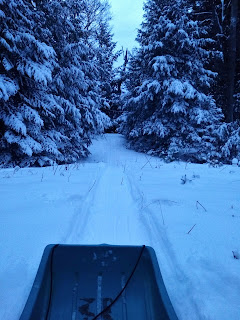
The purple shadows of evening were sliding out as I pulled into the driveway. After tossing my backpack inside the front door, I snugged up the hood on my puffy coat and grabbed the blue plastic sled from its corral behind the bike rack. The first run was slow, as fresh, fluffy snow compacted beneath me. I stomped up the trail and launched again, this time gliding a few feet farther; my heart feeling a few ounces lighter.

My sledding hill isn’t very big, but I do notice that playing on it does release stress and tension at the end of a day. Photo by Emily Stone.


I’ve always loved sledding. Maybe it has to do with my January birthday, or the thrill of going fast (but not too fast), or even the laughing chaos of a tumbling crash. Once I became an “adult,” I would wait until Christmas break when I could use my niece and nephews as an excuse to play in the snow. But after finding a sled in a free pile on a curb last spring, the only excuse I need is to be already wearing snow boots and ski pants.

Last week, while researching play in young animals for our new Growing Up Wild exhibit, I happened across something interesting: sliding down hills is one of the more widespread forms of play, and one of the types of play reported in adult animals, too!

River otters are the classic sliders. I’ve followed their tracks for miles as they scampered up the short, steep banks of a lake, only to launch themselves back down. Even on flat ice, they will propel themselves along the slippery surface. Can we blame all of that playfulness on the juveniles? I doubt it.

Otters are one of several critters who enjoy sliding on the snow, even on the flat surface of a lake! Photo by Emily Stone.


The snowy home of polar bears is conducive to sliding, too. One bear was observed cascading off a glacier, dropping fifty feet into the water, and then climbing up to do it all over again. Smaller hills—including the furry summit of Mom’s back—are also fair game for bear cubs.

Ravens and crows have been caught on video rolling down snowy car windshields, rooftops, and more. Like (college) kids sledding on trays smuggled out of the cafeteria, one crow in Russia made do with a white jar lid. With pokey feet resting on the slippery lid, and wings flapping madly for balance, the crow made run after run down the neighbor’s rooftop. No need for a chairlift, the crow picked up the lid in their beak and flew back to the peak.


Since wild animals slide down snowy hills, and likely have been doing that for millennia, the human history of sledding probably goes back pretty far, too, right? It’s hard to tell. The use of sleds for practical purposes can be confirmed all the way back to 1900 B.C., through paintings depicting rocks being pulled on sleds toward pyramids under construction. In the Cimbric War of 113 B.C. some Germanic tribes surprised Roman warriors by sledding out of the mountains on their shields. It's hard to believe that kids during these eras never saw the grownups using sleds for work, then nabbed one to race down a hill for fun.

Of course, childhood was probably shorter and less fun back then, especially for the working class. In contrast, the youth of Russian aristocrats in the 1650s seemed to have sledding backwards. They made their sleds from blocks of ice, and their chutes from wood!

In the United States, sledding became mainstream when farm equipment manufacturer Samuel Leeds Allen patented the steerable Flexible Flyer in 1889.

Animals slide and humans sled, ski, and snowboard, but my next question is WHY?

Multiple experiments have confirmed that playful young are more likely to survive to adulthood. Despite many hypotheses, however, scientists haven’t been able to prove the mechanisms behind how play increases survival rates.

There are some interesting clues, though. Play might allow young to test, learn, and stretch their own limits and abilities. Creative play seems to encourage brain development. The motor skills and physical fitness developed during play may improve animals’ ability to escape predation. The short-term stress of play might also give the animal’s stress response practice in recovering quickly after an incident. Could being startled in a game of peek-a-boo make being startled by a predator easier to recover from when the danger recedes?

Even in adults, it’s likely that play can release tension, improve the immune system, and ward off disease. What do you say to that?

I say wheeeeee!


Emily’s award-winning second book, Natural Connections: Dreaming of an Elfin Skimmer, is now available to purchase at www.cablemuseum.org/books and at your local independent bookstore, too.

For more than 50 years, the Cable Natural History Museum has served to connect you to the Northwoods. The Museum is now open with our exciting Mysteries of the Night exhibit. Follow us on Facebook, Instagram, YouTube, and cablemuseum.org to see what we are up to.

Thursday, December 30, 2021

Fragile Threads

By Guest Writer JoAnn Malek

[JoAnn Malek is a long-time Museum member and a recent participant in the Natural Connections Writing Workshop. JoAnn has graciously fine-tuned an essay that she drafted during that class. It touches on realities we all must face at some point—for ourselves and our loved ones--and I’m excited to share it with you this week. –Emily Stone]

Our morning hike began on a steep downhill sidewalk laden with wet leaves, squished Osage oranges, errant branches, and jutting rocks. I was wary and careful, glad to have good eyes, new walking shoes, and sturdy trekking poles.

The trees above were lush, with leaves in more shapes, sizes, and greens than we find in a Wisconsin woods in October. Rocky ditches and muddy gullies carried trickles of water, a reminder of how this ridged, deep-valleyed hill country was formed. Raptors were using updrafts, soaring in the blue, but a bank of dark clouds was spreading across one section of sky. My rain jacket was at home.

The author admires a tree during her visit to Arkansas last October. Photo by N. Deegan.


I had been touched to be invited along on a daughter’s family vacation. After several years of self-sufficiency, I was pleased to take a back seat for the trip through five states. My son-in-law brought two mountain bikes, to be used for different kinds of riding, apparently. This was a recreational mecca, after all. Grandson, daughter, and I packed hiking boots.

We continued walking into the Razorback Regional Greenway and emerged onto a flat sidewalk centered with a yellow line. I stayed far to the right, hoping my failing ears would perceive the approaching whirr of tires and the “on your left” warnings. Paths into the forest beckoned, but not for those without wheels and helmets.

Motion filled the woods. Riders leapt over hills, swerved around bermed corners, plunged down rock ramps, and roller-coastered through bumps.

Muscular adults peddled high-tech bicycles. There were daring, invincible teens, of course. But also small legs pumping, and mini wheels spinning. Parents carrying young ones. A group of young men in overalls, accompanied by young women and little girls wearing long skirts and lace caps. Teachers trailing school children. Even old women like me were riding.

There was much to watch as we walked, but I stopped short when an orange-spotted spider appeared just in front of me, hanging by a long, long thread. Thick ivory legs, a round ball of a body, and those pretty orange circles helped me identify Araneus gemmoides, a cat-faced or jewel spider. This species occurs throughout the Western U.S., including the Midwest, but I’d never bumped into one before.

Funny, but I found myself identifying with that brave, dangling thing. My long-time motto comes from Eleanor Roosevelt: “you must do the thing you think you cannot do.” I agree to adventures and accept challenges. That’s how I ended up on this tangle of trails in Bentonville, Arkansas. The spider had left the safety of the tree as I had left the safety of isolation from Covid-19.

At home, I care for a cabin and much that surrounds it, haul logs, tend a wood stove, and drive short and longer distances. I kayak, swim, hike, skate, and ski alone. The spider wove the thread that held her. I’ve woven one, too. Now we both cling to our independence.

When Jim became ill, our plans and dreams were cancelled. After his death, it seemed I’d been given another chance. But I had learned that any type of misstep can change everything. I’m fragile and vulnerable, like that eight-legged dangler.

Abruptly, a passerby severed the long thread. The spider fell gently to the ground and scurried away. Her journey had been altered. I expect that the threads connecting me to cabin life will one day be severed. Will that happen when it is no longer safe for me to drive? Will the aches and pains of an aging body prevent me from completing required tasks? Will an accident interrupt this life permanently?

I know, for now, that I can trust myself, but I must trust others as well. My children are watchful, always aware of my capabilities. They will help me continue to live in my happy place for as long as possible. When the thread of independence finally breaks, they will help me to move gently on to the next phase of my journey.


For more than 50 years, the Cable Natural History Museum has served to connect you to the Northwoods. The Museum is now open with our exciting Mysteries of the Night exhibit. Follow us on Facebook, Instagram, YouTube, and cablemuseum.org to see what we are up to.

Thursday, December 23, 2021

Snowflakes: Growing Up Wild

Snowflakes whirled outside my office window, blanketing the rainstorm’s aftermath in white and distracting me from work. Looking back down, I tried to focus on my screen, where the words Growing Up Wild sat above a rudimentary diagram of the Museum’s exhibit hall.

Ideas are coming together for our new exhibit, scheduled to open in May 2022. We’re excited to explore the many different ways that Northwoods critters begin, grow, survive, and eventually become adults. It’s fascinating to compare and contrast the life cycles of bears, butterflies, bluegills, eagles, humans, and more. Each critter takes their own unique path through the adventure of childhood, and it can be fun to imagine ourselves in their shoes.

Gazing back out the window, it struck me that the dancing snowflakes also grow up wild. Just like each of us and the other critters, snowflakes must begin somewhere, and then be shaped by changing circumstances at each moment of their development.


By Unknown author - Popular Science Monthly Volume 53, Public Domain, https.commons.wikimedia.orgwindex.phpcurid=15208176


How does a snowflake begin? In the sky, individual water molecules float suspended among molecules of air. Although temperatures may be well below 32 degrees and what we think of as the freezing temperature of water, the water vapor won’t freeze without help. Help comes in the form of ice nucleators around which the water can assemble into the crystal structure of ice.

Bits of dust and soot can become nucleation sites, and scientists are also discovering the importance of airborne bacteria. In particular, some bacteria have surface proteins that look a little bit like ice crystals. The protein template makes it much easier for water molecules to snap into place and begin the freezing process.

Why would a bacterium have evolved this trick? Well, these microbes need their ice-forming powers to access food. When on the surface of a leaf, the sharp edges of the ice they cause to form cut into the plant’s cells and spill juicy nutrients into the bacteria’s waiting arms.

On a windy day, though, those bacteria might get scooped up into the upper atmosphere. High above the Earth, the bacteria are cold, dry, and hungry. They need to get back down, but they are too light to fall on their own. Here’s where the ice-nucleating protein comes in handy again. The bacteria gather water molecules around themselves and form snow crystals.

Like tiny ballerinas, the crystals float across the sky and dance back down toward the Earth. The wind-tossed path that each crystal takes as it grows, and the conditions it encounters along the way, are what make each snowflake unique.

The first form that snowflakes take is a hexagonal prism with six facets, plus top and bottom basal facets. This shape is a result of the crystal structure of water, or the way the molecules line up when it forms a solid. How that crystal grows is a result of slight shifts in the temperature and humidity the flake encounters as it travels.

For example, when a snow crystal spends time in an area with low humidity, that promotes flat surfaces to grow. It’s easier for the sparse water molecules to latch onto thin, rough edges than a smooth face. When that crystal moves into an area of higher humidity, branches sprout from the six corners because of the way they project into the humid air. Sticking out farther causes branches to grow faster, in an example of a positive feedback loop.

Even slight changes in temperature and humidity tip the balance back and forth between the growth of branches and flat surfaces. In this way, a complex pattern emerges. Because each snowflake follows its own path through microclimates in the sky, each crystal is unique. Because the six sides of a single snowflake experience almost the same conditions, they grow mostly symmetrically. (A snow crystal can also be called a snowflake, but once crystals bump into each other and get messy, they can only be called snowflakes.)

Although the “childhood” of a snowflake’s growth typically only last 30-45 minutes, the result can be spectacular. From a single ice nucleator and water vapor in the air, we get the spontaneous formation of mesmerizing patterns. From chaos arises order. This is the quintessential example of something scientists call physical morphogenesis—the spontaneous creation of pattern and form by inanimate materials.

Of course, like kids of all species, some snowflakes generate chaos. A few end up as beautiful individuals, lauded for their perfection. Many more are scarred and broken. And a few fail to develop at all. Each is important for creating the snowpack we value. Each is ephemeral, spending only a short time in a particular form on this Earth.

Gazing out of my window, I imagined myself as a snowflake: tossed through the clouds, experiencing new environments, and growing up wild.


Watch this amazing video to learn more about Dr. Ken Libbrecht's research on snowflake growth, and to see him grow snow crystals in real-time by changing the temperature and humidity. 

More resources here!


Emily’s award-winning second book, Natural Connections: Dreaming of an Elfin Skimmer, is now available to purchase at www.cablemuseum.org/books and at your local independent bookstore, too.

For more than 50 years, the Cable Natural History Museum has served to connect you to the Northwoods. The Museum is now open with our exciting Mysteries of the Night exhibit. Follow us on Facebook, Instagram, YouTube, and cablemuseum.org to see what we are up to.

Thursday, December 16, 2021

Subnivean Experiments

One evening in the 1970s, little Gary Siegwarth learned a lesson. While outside his family’s home in Iowa there had been a big snowstorm, inside there was ice cream—ice cream that had to be shared among five kids. Wanting to make sure that he got his fair share, young Gary took the cardboard carton out of the freezer, then out of the house, and hid it deep within one of the drifts. When he came back a day later, the sweet treat was just a melty, unappetizing blob.


An artist's impression of the event. ;-)


“I thought it was the perfect hiding place from my siblings,” Gary told me, “Turns out the ice cream cache quickly metamorphosized into a subnivean shake…I was surprised. I just never really thought about it.” Gary had accidentally discovered the magical realm of the Subnivean Zone.

I’ve been wanting to explore that world a little more, too, but instead of burying precious ice cream, I buried thermometers. The night before our first big snowstorm, I wrapped a few indoor/outdoor temperature sensors in plastic wrap and placed them where I thought snowdrifts would soon form.

One sensor is under the boughs of a hemlock tree. Deer and snowshoe hares are known to seek the cover of evergreens in winter, because those dense needles prevent some warmth from escaping to the stars.

Another sensor is out in the open—just to the side of the planned sledding run—and I made sure to snuggle it in under dry autumn leaves and fern stems. The third sensor is leaning against the base of an ash tree. This one I expect to become more interesting in the spring, when tree wells expand in the strengthening sun.

The final sensor is dangling about four feet above the ground, in the branches of a dying spruce, in an attempt to shade it from the sun and get the most accurate air temperature possible.

Thermometers in place, I snuggled in, too.

By dawn, the sky had shaken down about five inches of dry, fluffy snow. By the end of the day, the total was seven. I watched the digital weather station eagerly, as temperatures from each of the thermometers shifted and changed. I knew that the data would get more interesting as the air temperature dropped.

Sure enough, the evening after the storm, when air temps hit zero in the dying spruce, every other thermometer was significantly warmer, and none more drastically than the one placed in the open, under leaves, with the thickest blanket of snow. Its temperature read 30 degrees. Even as the air temp sank down to 8 below, the buried thermometer only reached 27.

Yes, I keep my house cool. The thermostat is set at 64 and this weather station sits near a window, so it's often even cooler. I wear a cozy sweatshirt, sometimes down vest, curl up under blankets, and often overheat if I'm doing chores! Among my friends I do not have the coldest house. Not even close. I've always been a fan of saving energy and saving money.


According to the International Dairy Food Association, the ideal temperature for ice cream storage is zero degrees Fahrenheit and should not rise above 10. It’s no wonder that young Gary’s ice cream melted! He had placed his stolen treat in the same microclimate as my temperature sensor in the Subnivean Zone.

As winter’s first snowflakes drift through the dark, some land on top of dead plants, fallen leaves, twigs, and other detritus of the forest floor. In many places, snow never fully reaches the ground. In addition, the residual heat of summer still radiates from the earth. This warmth causes the bottommost snowflakes to sublimate—or transition directly to water vapor without becoming liquid first. The damp air then rises through the snowpack and refreezes into a crystal ceiling above spacious (for a mouse) rooms and runs.

As the first flakes fall, they often don’t reach the ground. In the air spaces below leaves, sticks, and other objects on the forest floor, the Subnivean Zone begins to form. Photo by Emily Stone.


In this space, with a blanket of snow to trap the earth’s warmth, and a solid break against the windchill, temperatures hover around freezing. Deeper snow provides even more insulation, and all manner of critters—from mice to martens, bacteria, fungi, spiders, hibernating insects, frozen wood frogs, and more—rely on the moderated microclimate.

To Gary’s credit, it didn’t take much thinking for him to figure out what had gone wrong. As a kid in farm country, he’d heard many times that a blanket of snow was better for the alfalfa and protected it from winter kill. He also had plenty of direct experience with the relative warmth of snow forts.

And still, it can take a while for information to sink in. Years later, in junior high, teenage Gary was playing football at a neighbor’s house. They grabbed a snack of ice cream sandwiches out of the freezer and Gary buried his in the snow for safekeeping. As before, the deliciousness melted and oozed away. That was the last time he experimented with ice cream in the Subnivean Zone.

While Gary never admitted guilt to his family in the case of the disappearing ice cream (he thinks he probably got in trouble even while taking the 5th), he still learned something important from these two accidental experiments. And he went on to become a scientist.

I’m not going to put any ice cream at risk this winter, but I am going to watch eagerly as my experiment in the snow plays out. How will deeper drifts and colder air temps impact the Subnivean Zone? I’ll be sure to let you know when I find out!


Emily’s award-winning second book, Natural Connections: Dreaming of an Elfin Skimmer, is now available to purchase at www.cablemuseum.org/books and at your local independent bookstore, too.

For more than 50 years, the Cable Natural History Museum has served to connect you to the Northwoods. The Museum is now open with our exciting Mysteries of the Night exhibit. Follow us on Facebook, Instagram, YouTube, and cablemuseum.org to see what we are up to.

Thursday, December 9, 2021

Cozy Carpenter Ants

On dark winter mornings my dad gets up early and starts a fire to make sure the chill is gone by the time my mom joins him for breakfast. By mid-afternoon, sunshine beams in through their south-facing windows and the indoor temperature can easily reach 75 degrees without much help from the in-floor heat. Dad stokes the fire longer on cloudy days, sometimes with help from eager grandkids.

All of those cozy flames require a good supply of firewood.

So, minutes after arriving home for Thanksgiving, I found myself down by the old barn helping my dad start up the wood splitter. Always mindful of protecting people’s hearing, he handed me a set of earmuffs to match his own.

One by one, we hefted one-to-two-foot diameter rounds onto the platform, and I watched as he guided the splitter into the wood grain. Chunk after chunk peeled off and fell to the grass. I loaded my arms and carried them into the stack.

Having my young back at his disposal, Dad passed over the smaller logs (Mom could help with those later) and focused on some of the biggest rounds from low on the trunk or where a branch had diverged to form a Y. It was a red elm, he told me, much denser wood than the American elms he leaves standing dead for woodpecker habitat.

After we’d hoisted a particularly large chunk onto the splitter, I hovered nearby to catch half as it separated. With the slow force of the wedge, a section of tree opened like a book, and revealed another civilization.

I didn't get a good photo of the galleries while splitting wood, but we did include a carpenter ant gallery (and predator!) in our Curiosity Center at the Museum.


Maybe that’s overly dramatic, but the intricate catacombs excavated by carpenter ants were quite impressive. I lowered the split log to the ground and examined it more closely. Several cavities were packed full of shiny black bodies, and as I disturbed them, unique individuals emerged. First was a large ant with wings. A queen, I surmised. Carpenter ant colonies can have more than one queen, although they aren’t friendly with each other.

A large, winged queen sits near a gallery filled with worker ants. 


The other odd individual was smaller than most, but also had a pair of long, shimmering wings extending beyond his abdomen. This was probably a male. Drone ants only come into the picture when the colony is ready to reproduce. They hatch from unfertilized eggs, mate with a new queen from another colony, and die. The observation has been made that they don’t have a father—only the queen bestows her genetic information on them—but they do have a grandfather, because the queen was born from a fertilized egg.


This smaller, winged carpenter ant is probably a male drone. Photo by Emily Stone.


But Wikipedia reports that nuptial flights—when drones mate with new queens so that they can go start new colonies—happen when it’s warm and humid. That’s not how I’d describe November in Iowa. So why would there be guys hanging around the colony?

[Come to think of it, why is a winged queen hanging around? Queens remove their wings after they've mated and found a place to establish a colony. Maybe November weather did feel conducive to mating...until it didn't.]

And why didn’t I see any clusters of small, white eggs? As it turns out, carpenter ants build both primary nests and satellite nests. Primary nests host the queens and the eggs, and require high humidity so the eggs don’t dry out. Older larvae, pupae, and worker ants can handle life in the drier satellite nests.

Both kinds of nests are excavated into dead or dying trees. Carpenter ants don’t eat the wood, but they do chew their way through the soft, wide parts of growth rings formed during rapid spring growth. The denser “late wood” is left for the walls. Tunnels between the rings allow for easy movement, and add to the lacey quality of the galleries.

The ants’ work is important to decomposition in the forest. Not only is their waste sawdust easily returned to the soil, their galleries multiply the surface area available to things like fungi and bacteria who actually can digest the wood.

If wood isn’t part of their diet, though, what is? A colony’s foragers will often head out at night in search of insects—either living or dead. They’ll extract the insects’ bodily juices and bring that nutrition back to the colony, leaving the exoskeleton behind. Some species also join the “farming” of aphids for their honeydew. As aphids slurp plant juices, they excrete excess sugar water. In return for this soft drink, ants ward off aphid-eaters like ladybugs. Bacteria in the ants’ guts may help them synthesize additional amino acids.

In preparation for winter diapause, ants achieve up to 50% bodyfat and increase their glycerol content as antifreeze. They also huddle together in their galleries. All of these habits make them a favorite food of pileated woodpeckers, who are quite willing to chisel their way through pretty solid wood in order to access these fatty, sugary, concentrated treats.

By fueling the birds’ metabolisms, the ants themselves are just as important to winter warmth in the wild as the logs they live in are to the cozy fires of people.


Emily’s award-winning second book, Natural Connections: Dreaming of an Elfin Skimmer, is now available to purchase at www.cablemuseum.org/books and at your local independent bookstore, too.

For more than 50 years, the Cable Natural History Museum has served to connect you to the Northwoods. The Museum is now open with our exciting Mysteries of the Night exhibit. Follow us on Facebook, Instagram, YouTube, and cablemuseum.org to see what we are up to.

Thursday, December 2, 2021

Clubmoss Magic

A flock of hikers crunched down the oak-leaf-covered trail behind me, their blaze orange accessories complementing the last of autumn’s browns. The leaves had already been kicked up by herds of turkeys and scraped aside by the local 8-point buck. On this “Deer Widows Walk” (named for the marketing ploy that entices hunters’ wives into stores while their husbands are busy in tree stands on opening weekend of gun deer season) non-hunters of all genders were simply interested in hiking without fear of stray bullets.

The Forest Lodge Estate—owned by the Forest Service but not yet open to the public without a guide—provided just the place. The plan was to hike briskly between nature stops, and a brisk wind off Lake Namakagon held us to that plan.

Not far in, a patch of green—with exclamation points of yellow—caught my eye. Smiling to myself, I reached for the old Bic lighter I’d slipped into my pocket before the hike—hoping for just this opportunity! This would be a nature stop. “Gather up everyone! Make sure you can see,” I encouraged as I crouched next to the patch of doll-sized Christmas trees.


Only those mini trees weren’t really trees. You might know them as ground pine, prince’s pine, or clubmoss. None of those names are entirely accurate, though. They definitely aren’t pines, or mosses, nor do they belong to royalty. If you’re botanical, you might know them by the genus Lycopodium (Greek for little wolf foot), but after recent DNA testing, most of our species have been given new names. Their family remains: Lycopodiaceae.

Back in the 1700s, Carl Linnaeus put these plants into a group we call “Fern Allies,” a sort of catchall name for non-flowering plants who have a vascular system and reproduce through spores. Clubmosses often bear their spores on specialized stems called strobili, which looked to someone like little, yellow clubs.

Before crouching down, I’d tapped one of those strobili experimentally, and had been rewarded by a small poof of yellow. It’s not often that I’m in the woods at the particular moment when the spores are ripe but not yet gone. And now, here I was with both an audience and a lighter.

Gloves removed, I held the lighter downwind of the strobili. With my left thumb and pointer finger I gave a little flick, sending a cloud of spores toward the flame. Poof! For an instant, the fire crackled higher. I flicked again, and another tiny explosion shone in our eyes.


Clubmoss spores contain 50% fat, but that’s not why they are so flammable. Instead, it’s the simple equation of fine dust with a relatively large surface area per unit of volume being combined with plenty of oxygen and a spark. It’s the same combination that makes the news when a grain elevator explodes.

I’ve only harnessed the power of Lycopodium powder to win favor with my nephews or impress field trip participants. Historically, though, it provided the flash for photography. And in 1807, before fossil fuels were widely available, Lycopodium spores were used by French inventors to power the first internal combustion engine and propel a boat. You can still purchase Lycopodium powder, often under the name “Dragon’s Breath,” for relatively safe use in magic tricks and theatrical special effects.

I love making things explode safely, but that isn’t necessarily the neatest thing about these spores. Very similar to the seeds of orchids, they are designed to drift widely, but don’t carry enough energy to grow on their own. Once they land in a likely spot—not compacted or disturbed—the spores are attacked by fungi in the soil. Or maybe attack isn’t the right word. Because the tiny clubmoss gametophyte is fed by the fungi in a symbiotic relationship.

In a pattern called “the alternation of generations,” the tiny gametophyte produces eggs and sperm, which combine and grow into the sporophyte—the clubmoss we know and love. Clubmosses grow slowly, though, and the sporophyte’s first year of growth is entirely below the soil, and entirely fed by the same fungi that partnered with its parents.

Once the young clubmoss reaches the sunlight, it begins to photosynthesize and produce its own sugars, but even then it grows slowly. Each year the horizontal stem, called a rhizome, grows a little farther and sends up just one vertical shoot. Clubmosses don’t need to grow rapidly, because toxic alkaloids in their leaves deter most animals from snacking on their ever-greens. Christmas wreath-makers are their main enemies, since a single wreath could contain—and kill—many years’ worth of growth.

It’s best to leave these delightful plants in the woods, where, if you happen to find them when their spores are ready and the wind is right, you can see a little clubmoss magic.


Emily’s award-winning second book, Natural Connections: Dreaming of an Elfin Skimmer, is now available to purchase at www.cablemuseum.org/books and at your local independent bookstore, too.

For more than 50 years, the Cable Natural History Museum has served to connect you to the Northwoods. The Museum is now open with our exciting Mysteries of the Night exhibit. Follow us on Facebook, Instagram, YouTube, and cablemuseum.org to see what we are up to.